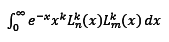
Orthogonality of Associated Laguerre Polynomial

Click For Summary

Homework Help Overview

The discussion revolves around proving the orthogonality of associated Laguerre polynomials, specifically using their Rodrigues' form and differential equations. Participants are exploring the mathematical properties and relationships of these polynomials in the context of orthogonality.

Discussion Character

  • Exploratory, Mathematical reasoning, Assumption checking

Approaches and Questions Raised

  • The original poster attempts to substitute Rodrigues' form into the orthogonality equation but encounters difficulties. Some participants suggest using the differential equation associated with the polynomials and propose a method involving multiplication and subtraction of equations. There is confusion regarding which form of the polynomial to utilize.

Discussion Status

Participants are actively engaging with the problem, offering different approaches and clarifying steps. While some guidance has been provided regarding the use of differential equations, there is still uncertainty about connecting these methods to the orthogonality proof.

Contextual Notes

There is mention of specific forms of the associated Laguerre polynomial and the differential equation governing them, indicating a focus on mathematical rigor. The discussion reflects a lack of consensus on the best approach to take, highlighting the complexity of the topic.

Muh. Fauzi M.
Messages
17
Reaction score
1
I have a problem when trying to proof orthogonality of associated Laguerre polynomial. I substitute Rodrigue's form of associated Laguerre polynomial :
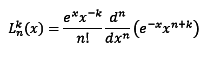
upload_2015-3-17_17-49-19.png

to mutual orthogonality equation :

upload_2015-3-17_17-49-40.png

and set, first for
upload_2015-3-17_17-50-7.png
and second for
upload_2015-3-17_17-50-20.png
.

But after some step, I get trouble with this stuff :
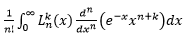
upload_2015-3-17_17-50-31.png

I've already search solution for this form but still no light. Any body here could help?
 
Physics news on Phys.org
The best way is using the differential equation. Write it for ## L^k_n ## and ## L^k_m ##. Then multiply the first by ## L^k_m## and the second by ## L^k_n ##. Then subtract one from the other. Come back if you encounter a problem!
 
Last edited:
Shyan said:
The best way is using the differential equation. Write it for ## L^k_n ## and ## L^k_m ##. Then multiply the first by ## L^k_m## and the second by ## L^k_n ##. Then subtract one from the other. Come back if you encounter a problem!
Well I still didn't get it. ## L^k_n ## has a rodrigues form and also associated Laguerre polynomial. Which one I need to use?
 
Muh. Fauzi M. said:
Well I still didn't get it. ## L^k_n ## has a rodrigues form and also associated Laguerre polynomial. Which one I need to use?
I said the differential equation, which is:
## x \frac{d^2 L_n^{k}}{dx^2} +(k+1-x) \frac{dL_n^{k}}{dx} +n L_n^k =0##
 
Shyan said:
I said the differential equation, which is:
## x \frac{d^2 L_n^{k}}{dx^2} +(k+1-x) \frac{dL_n^{k}}{dx} +n L_n^k =0##
Nah... I got it. But still, I am stuck when connecting it with the orthogonality...
 
Muh. Fauzi M. said:
Nah... I got it. But still, I am stuck when connecting it with the orthogonality...
I explained it in that post! Just write the equation two times for ## L_m^k ## and ## L_n^k##. Then multiply the first by ## L_n^k## and the second by ## L_m^k ## and subtract one from the other. Then find an integrating factor and multiply the equation by it. You'll find out how to continue but come back if you didn't.
 

Similar threads

  • · Replies 1 ·
Replies
1
Views
2K
  • · Replies 3 ·
Replies
3
Views
2K
  • · Replies 1 ·
Replies
1
Views
3K
  • · Replies 6 ·
Replies
6
Views
4K
  • · Replies 4 ·
Replies
4
Views
5K
Replies
8
Views
9K
  • · Replies 2 ·
Replies
2
Views
6K
  • · Replies 2 ·
Replies
2
Views
2K
  • · Replies 7 ·
Replies
7
Views
3K
  • · Replies 3 ·
Replies
3
Views
4K