Oscillator using ad829 works - trying to make it work using 741

Click For Summary
SUMMARY

The discussion revolves around the challenges of creating a triangle wave oscillator using the AD829 op-amp and substituting it with the slower 741 op-amp to achieve a frequency of 30 kHz. Users suggest alternatives such as the TL071 and LF356 op-amps, noting the importance of adjusting resistor values (specifically R2 to 20K) to optimize performance. The conversation highlights the necessity of understanding slew rate limitations and the implications of using different op-amps in a buck converter circuit, particularly regarding output amplitude and stability.

PREREQUISITES
  • Understanding of op-amp configurations and characteristics (e.g., AD829, 741, TL071, LF356)
  • Knowledge of oscillator design principles, particularly triangle wave generation
  • Familiarity with buck converter topology and control systems
  • Basic grasp of resistor-capacitor (RC) timing circuits and their impact on frequency
NEXT STEPS
  • Research the specifications and performance characteristics of TL071 and LF356 op-amps
  • Learn about calculating slew rates for non-sinusoidal inputs in op-amp circuits
  • Explore the design and implementation of PI controllers in buck converters
  • Investigate the use of high-side MOSFET drivers like IR2011 for improved circuit performance
USEFUL FOR

Electronics engineers, hobbyists designing oscillators, and those working on buck converter projects will benefit from this discussion, particularly in optimizing op-amp selection and circuit design for specific frequency and amplitude requirements.

FOIWATER
Gold Member
Messages
434
Reaction score
12
Hello,

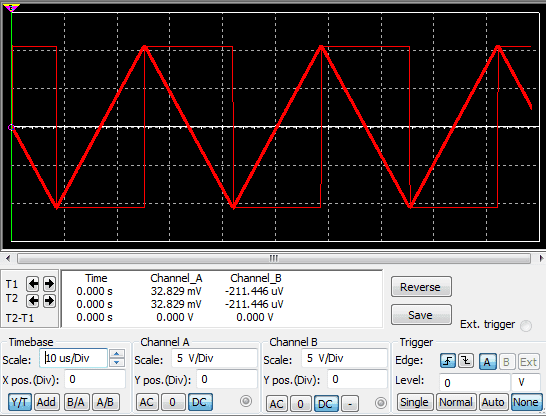
I have a triangle wave generator working nicely with video op amps but I am trying to substitute much slower op amps. I am required to get it to oscillate at 30 kHz. I performed calculations and got it to about 29.8kHz you can see it attached for the AD829's

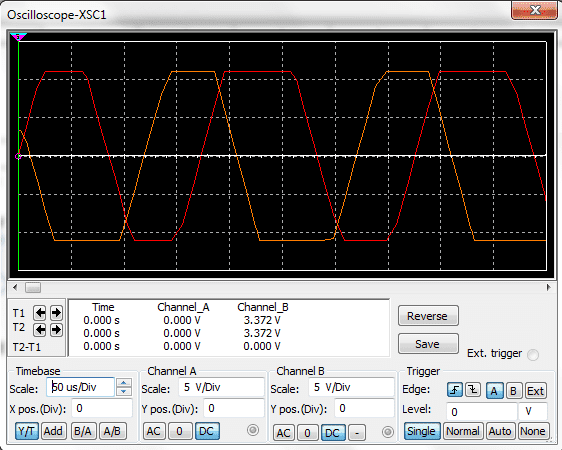
I tried substituting 741 for the AD829 and I am having issues getting it to work?

I was wondering if someone could help me.

Please see attached, thanks
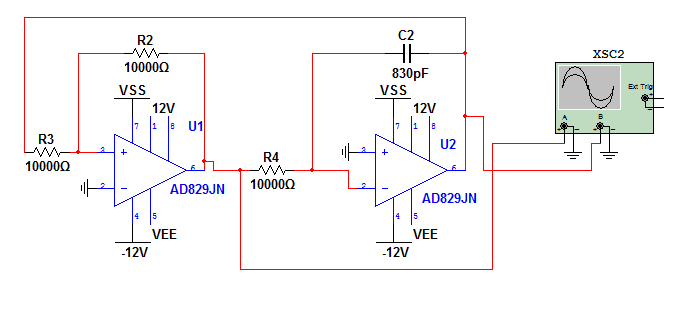
AD829 circuit.png


AD829 waveform.png


741 waveform.png
 
Last edited by a moderator:
Engineering news on Phys.org
PS: I am not sure how to calculate the slew rate limitation since the input is not sinusoidal.

I am not sure how to overcome the issue.. any information appreciated
 
SR_min = 10 * (+Vsat - -Vsat)/(1/2F) = 10 * (+12V - (-12V))/16.7μs = 24V/16.6μs = 10 * 1.44V/μs = 14V/μs
So you need to change the op amp try TL071.
Also I don't like your R2 and R3 resistor values and C3. Change R2 to 20K and correct C2 or R4 to get 30khz
 
Last edited:
Agreed Jony upon using cursors I see that it isn't at 30kHz although mathematically it should be I had to change some values.

Thanks I will use another op amp.

TL071 isn't something available immediately, what are your impressions of the LF356 JEFT opamp for this?

Seems to simulate well, but I've heard it can be touchy in practice.
 
LM356 has almost the same slew rate as TL071.
 
  • Like
Likes 1 person
Cool, Thanks once again Jony
 
Try to change R2 to 20K or large and this will reduce the amplitude of a waveform and reduce SR stress.
 
yes R3Vcc/R2 gives the trigger points of the trigger but I need the amplitude large I am driving a mosfet and I need the 12 volts.. maybe Ill post the rest of the circuit tonight I will try to assemble it
 
Jony - I don't have slew rate issues anymore (even at 12 volts) but what I do have is an annoying cut off at the lower end. I was warned the LF356 is touchy. I have been backed into a corner and am resulting to overkill using a video op amp. for the integrator, and a LF356 for the shmitt trigger. In your opinion, would you think two LF356 would definitely be able to perform this function or is it possible it may be outside of its capabilities?

I attached a picture of the annoying cutoff using the LM356 to integrate.. Any feedback appreciated as always
 

Attachments

  • IMG_0806.jpg
    IMG_0806.jpg
    54.5 KB · Views: 589
  • #10
Can you display the comparator's output on the other channel? Superimposed.
 
  • #11
I will take it later if that's OK, (not because I am lazy) but because the scope is in my room mates room and he isn't home

Thanks for the reply N.O.
 
  • #12
What is your supply voltage? What type of a op amp you use as a Schmitt trigger?
Also show as Schmitt trigger output and try to change R2 to 20K.
 
  • #13
Supply is +-12, I am using the LF356 as the Schmitt trigger, I will post output of schmitt trigger tonight. I will change R2 to 20K and show it. I did change it here at home on your advice it works fine perfect trianglular output with two LF356's but the frequency of 30khz was hard to obtain. But I need 12 volt output to drive a mosfet what do you suggest
I'll try to post more specific results so we can be more specific, my bad.
I will do as you suggest, thanks
 
  • #14
Are you needing the triangular output to drive the FET, or the squarewave? Are you wanting that driving waveform to be 12v pk-pk or 24v pk-pk?
 
  • #15
Sorry,
Using the triangular output as an input to a comparator, along with the signal from a PI controller (which takes the output from a buck converter) So the output of the comparator is actually driving the mosfet. As you said, square wave. Oh, I see. I can just have a 12 volt supplying my comparator...

I want the driving signal to be 12 v peak, 24 peak to peak

OK I will try to reduce the rail voltage in my oscillator and use the right components based on Jony's suggestion to get it working nicely. I will post back with more waveforms when I get a chance.

Thanks
 
  • #16
Do you know whether or not there is any disadvantage to going possibly even lower in amplitude than 6 volts? (ie, using a resistor even larger than 20K)

I will let you know what I am trying to do here, I am trying to achieve this circuit I have attached.

I assume the oscillator amplitude could be very low in fact?

The idea is that the input voltage can change (lower than the 28 volt supply) and the output is to be a regulated 20v, 4A. A classic buck converter. Right now i have the oscillator working but has to be with AD829. But as you said, I wasn't realizing that its the 311 output that ultimately determines the amplitude of the gating signal. I guess I wasn't thinking clearly.
 

Attachments

  • ckt.png
    ckt.png
    26.6 KB · Views: 616
  • #17
FOIWATER said:
Do you know whether or not there is any disadvantage to going possibly even lower in amplitude than 6 volts? (ie, using a resistor even larger than 20K)

I will let you know what I am trying to do here, I am trying to achieve this circuit I have attached.

I assume the oscillator amplitude could be very low in fact?.
Changing the Schmitt's trigger levels by changing R2 has the effect of changing the amplitude of the triangular wave. It's the triangular wave that is used in your controller, so you may not be free to meddle with its amplitude without understanding the effect this will have on the operation of the 311 and how it controls the rest of the circuit.

Does the published schematic really show R2 and R3 of equal value?
 
  • #18
I apologize, this is my schematic
 
  • #19
The resistor sizes are left out because I do not know how to set them lol

I understand only how things should be laid out approximately.
 
  • #20
FOIWATER said:
I apologize, this is my schematic
Do you mean you are working off a published schematic but where none of the component values is specified? Or is the whole 10 IC circuit your own 'invention'?
 
  • #21
Of course it's a combination of things I learned or picked up along the way and I would in no way claim it's my invention. This schematic and all components are from me yes. Not from a published schematic

I only know I need four components essentially, the main converter (power) ckt, a controller, which I taken as PI.. an oscillator and an isolation ckt. The specifics, I am trying to work out. I expect tuning the PI to be the hardest part. Right now, though, I want to get the oscillator working perfectly.

I realize I could use other means of creating this (the oscillator). Such as a timer and current source, but I would like to do it this way, as I learned it some time ago and was looking for a way to implement it..

I do appreciate your responses
 
  • #22
Okay. Getting the oscillator to work won't be any problem. That will be the easy part. :smile:

Is this a college/university project or something?
 
  • #23
I actually got the oscillator working, for 6 volts, very nice output. Right now the output of the LM311 is "moving" about 0 volts.

Yes it is such a project
 
  • #24
FOIWATER said:
I actually got the oscillator working, for 6 volts, very nice output. Right now the output of the LM311 is "moving" about 0 volts.
Is that 12v pk-pk? Would that be sufficient for your needs?
 
  • #25
Yes that is 12 v pk to pk, It would be sufficient for my needs bearing in mind the LM311 is just going to go rail to rail anyway. So it's output will be a 12 volt square wave with the duty cycle determined by the PI controller. So as far as I know 12v pk-pk from the oscillator is OK but there could be a problem that I am not considering with that as well.
Right now, I don't have the PI controller configured, I am sending an input to the LM311 from the oscillator, and instead of the PI I am using a simple amplifier and trimpot to see if my output of LM311 is as expected. It is, and changign the trimpot changes the duty cycle. However, the square wave kind of 'moves' up and down around 0 volts. Like floating on the oscilloscope over time it shifts (ie, a constant 24v pk-pk that shifts in amplitude)
Not sure what could be causing that, It's the only thing I have connected. The pull-up resistor I have placed is 1K ohms. I have also tried 330 ohms and even 10K but nothing seems to stop it. I have also tried different samples of the LM311 to now success.

Thanks for the replies
 
  • #26
Baseline drift as the duty cycle changes sounds like you might have the oscilloscope on AC coupling. Use DC.
 
  • #27
Actually, it changes even when I don't trim the pot (ie, when the duty cycle isn't changing)
 
  • #28
Then I'd look for careless earthing. AC at mains frequency getting mixed in with your signal to the CRO causing the display to drift up and down.
 
  • Like
Likes 1 person
  • #29
Ah so you trying to build a buck converter. If so, can you tell me why you use symmetric power supply in this circuit? For buck converter you don't need symmetric supply, and why you don't use P-channel MOSFET of N-channel with bootstrap capacitor? And finally why you use so many op amp.
 
  • #30
OK NascentOxygen I will try to rectify using those hints..

Jony, it could be my lack of understanding. Would you suggest a single sided supply, and a sawtooth oscillator?

I need so many op amps, because I am controlling the output of the buck converter. Two of them are for the oscillator, and four are for the PI controller (one subtractor, one summer, one proportional gain, and one integral gain) finally the LM311 to compare the PI signal to the oscillator signal... I am not sure how else to do it.

I am not sure how bootstrapping would help me..
 

Similar threads

Replies
33
Views
5K
  • · Replies 41 ·
2
Replies
41
Views
7K
  • · Replies 6 ·
Replies
6
Views
3K
  • · Replies 5 ·
Replies
5
Views
2K
Replies
2
Views
2K
  • · Replies 33 ·
2
Replies
33
Views
13K
  • · Replies 3 ·
Replies
3
Views
2K
Replies
9
Views
7K
  • · Replies 34 ·
2
Replies
34
Views
6K
  • · Replies 3 ·
Replies
3
Views
3K