Palmgren-Miner equation derivation

  • Context: Undergrad 
  • Thread starter Thread starter k.udhay
  • Start date Start date
  • Tags Tags
    Derivation
Click For Summary
SUMMARY

The Palmgren-Miner equation, referenced in ISO standard ISO 6336-6, consolidates damage from multiple torque cycle bins into a single equivalent torque. Each bin represents a specific torque applied over a defined number of cycles. The equation allows for the calculation of total damage caused by these bins, leading to a comprehensive understanding of fatigue in materials. The discussion emphasizes the need for further derivation of the equivalent torque formula as outlined in the ISO standard.

PREREQUISITES
  • Understanding of the Palmgren-Miner equation
  • Familiarity with ISO standard ISO 6336-6
  • Knowledge of torque cycle bins and their implications in material fatigue
  • Basic principles of engineering approximation
NEXT STEPS
  • Study the derivation of the Palmgren-Miner equation in detail
  • Research ISO standard ISO 6336-6 for specific applications
  • Explore fatigue analysis techniques in materials engineering
  • Examine case studies involving torque cycle bins and their effects on material performance
USEFUL FOR

Engineers, material scientists, and researchers focusing on fatigue analysis and torque applications in mechanical systems will benefit from this discussion.

k.udhay
Messages
167
Reaction score
13
TL;DR
This equation is used in ISO standard ISO 6336-6. I want to understand how it is derived.
Summary: This equation is used in ISO standard ISO 6336-6. I want to understand how it is derived.

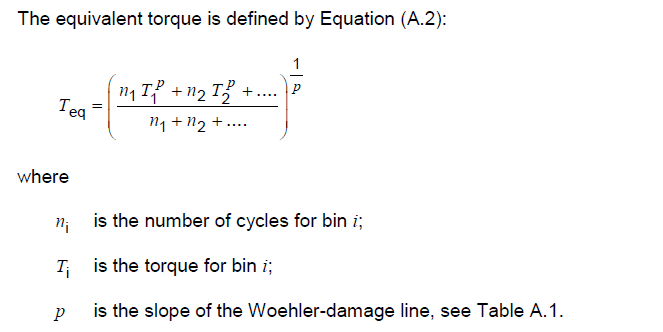
This equation helps to consolidate damage caused by multiple torque, cycle bins. A bin means a torque applied for a given number of cycle. As an outcome of the equation, a single equivalent torque that produces the total damage caused by multiple bins for the total number of cycles as original bins.

The equation is:
Equivalent torque from ISO standard.PNG


Pl. note that coordinates n1,T1; n2,T2 and n3,T3 do not need to be on the same line.

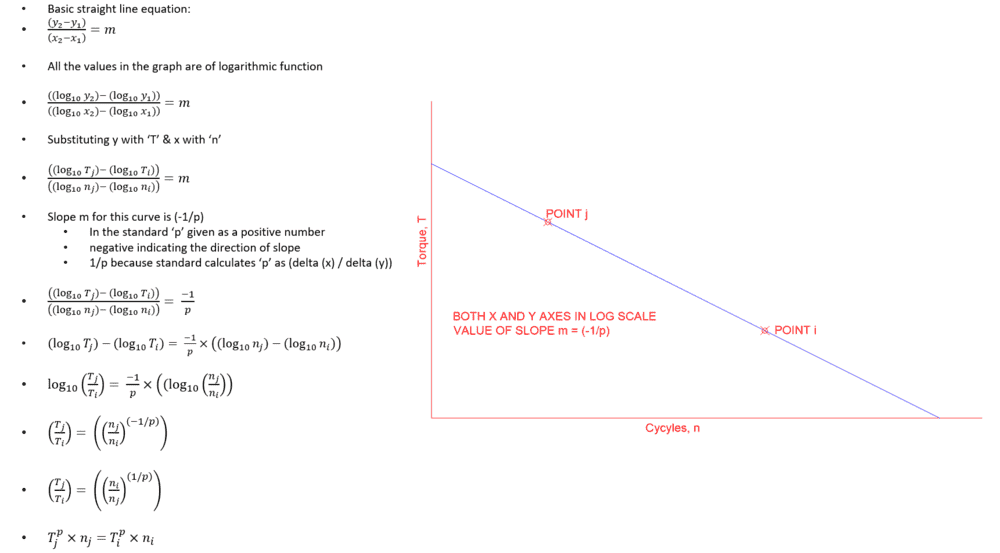
My objective is to derive the above equation. While I attempted to do that, I could progress to this level:
SN curve fundamental equation.PNG


Can someone help to proceed further to reach until the equivalent torque formula given in the ISO standard? Many thanks in advance!
 
Last edited by a moderator:
Physics news on Phys.org
Hi, I was about to answer this and suggest it would be better in the Engineering topic here (as this is all about engineering approximation rather than scientific derivation), but while searching for refs I realized that you have posted this on another forum where it has been answered: https://www.eng-tips.com/viewthread.cfm?qid=460402
 
  • Like
Likes   Reactions: berkeman

Similar threads

  • · Replies 5 ·
Replies
5
Views
2K
  • · Replies 1 ·
Replies
1
Views
2K
  • · Replies 2 ·
Replies
2
Views
7K
  • · Replies 3 ·
Replies
3
Views
2K
  • · Replies 1 ·
Replies
1
Views
3K
  • · Replies 2 ·
Replies
2
Views
2K
  • · Replies 75 ·
3
Replies
75
Views
7K
  • · Replies 2 ·
Replies
2
Views
3K
Replies
16
Views
2K
  • · Replies 4 ·
Replies
4
Views
4K