- 9,714
- 11,670
This query comes from not being able to answer some one else's query 
it show's I have been away from textbooks and classrooms way too long ( see my signature )
I have forgotten my basics
These RL circuits
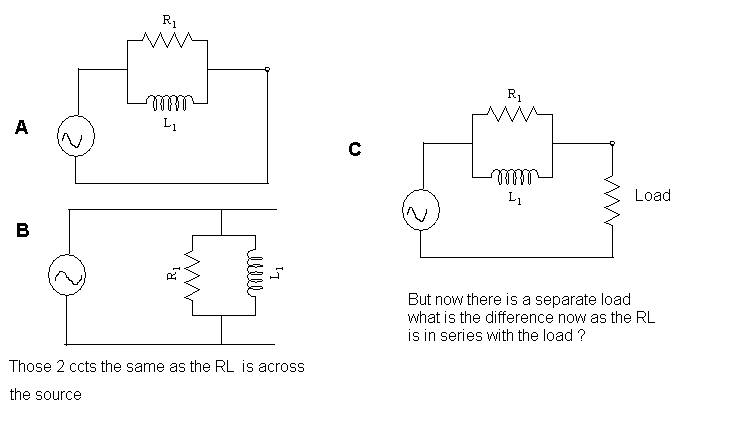
Now I realize A and B are just the same with the RL rotated
and following that C would be the same as B with the load inserted below the RL
For C ... What difference is there if the load is say
1) antenna
2) some other circuit on a separate module ( possibly/probably capacitively coupled)
or if circuit B and the load was parallel across the source and the RL network ?
Bouncing around a number of www sites infers that the parallel RL is used as a form impedance matching
between the source and load ?
I cannot find specific comments for another use ... is there one ?
I was considering a filter ...
with ref to ...
http://amrita.vlab.co.in/?sub=1&brch=75&sim=322&cnt=1
Theory:
With an ac signal applied to it, the parallel RL circuit shown below offers significant impedance to the flow of current. This impedance will
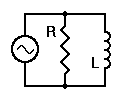 change with frequency, since that helps determine XL, but for any given frequency, it will not change over time.
Then gets into a mass of complex impedance calc's as most sites do
one place seen was in an FM phase modulator circuit ...
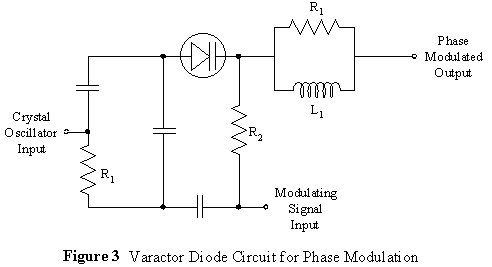
I haven't played with phase modulation circuits ... so not too sure of the process therea little help in understanding please
cheers
Dave
it show's I have been away from textbooks and classrooms way too long ( see my signature )
I have forgotten my basics
These RL circuits
Now I realize A and B are just the same with the RL rotated
and following that C would be the same as B with the load inserted below the RL
For C ... What difference is there if the load is say
1) antenna
2) some other circuit on a separate module ( possibly/probably capacitively coupled)
or if circuit B and the load was parallel across the source and the RL network ?
Bouncing around a number of www sites infers that the parallel RL is used as a form impedance matching
between the source and load ?
I cannot find specific comments for another use ... is there one ?
I was considering a filter ...
with ref to ...
http://amrita.vlab.co.in/?sub=1&brch=75&sim=322&cnt=1
Theory:
With an ac signal applied to it, the parallel RL circuit shown below offers significant impedance to the flow of current. This impedance will
Then gets into a mass of complex impedance calc's as most sites do
one place seen was in an FM phase modulator circuit ...
I haven't played with phase modulation circuits ... so not too sure of the process therea little help in understanding please
cheers
Dave
