Discussion Overview
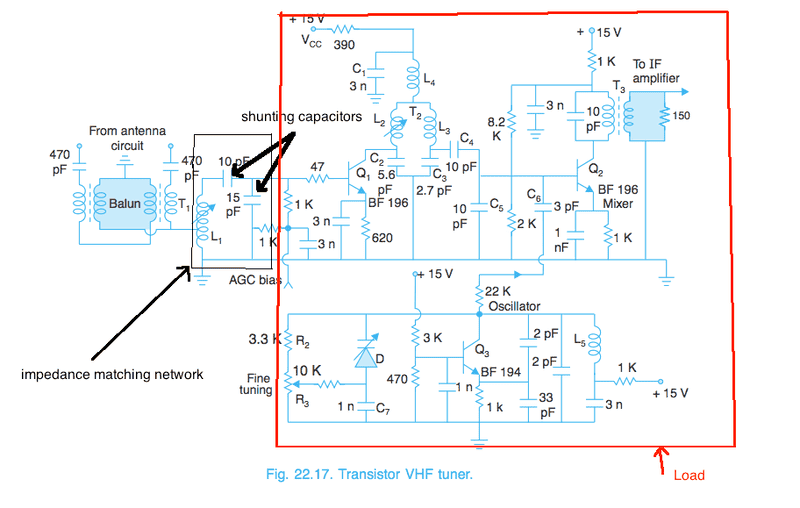
The discussion revolves around the matching of a 75Ω impedance using a tapped coil and two shunt capacitors in a VHF tuner circuit. Participants explore the theoretical and practical aspects of impedance matching, resonance, and the design considerations for the circuit.
Discussion Character
- Technical explanation
- Debate/contested
- Mathematical reasoning
Main Points Raised
- One participant seeks help in calculating the load value for matching 75Ω impedance using a tapped coil and capacitors.
- Another participant suggests that the tap on the coil (L1) is crucial for matching impedance and describes the role of the capacitors in forming a capacitive voltage divider.
- Concerns are raised about the interpretation of resonance and the function of capacitors in the circuit, questioning whether they act as a voltage divider at resonance.
- Further elaboration is requested on the impedance characteristics of L1 and its role as an autotransformer.
- A participant mentions the difficulty in determining the turns ratio without knowing the input impedance of Q1.
- Modeling the circuit using simulation software (Spice) is proposed as a method to determine the input impedance.
- One participant outlines a detailed manual calculation process for determining the impedance and Q factor of the circuit components.
- Discussion includes the need for specific values such as L1 inductance, turns ratio, and frequency of operation for accurate calculations.
- Participants share simulation files and discuss the results, including impedance values at various points in the circuit.
- Speculations about the circuit's design for wide-band TV reception and the implications of component values on performance are presented.
Areas of Agreement / Disagreement
Participants express differing views on the role of capacitors at resonance and the implications of impedance matching. There is no consensus on the exact values needed for the input impedance of Q1 or the optimal design parameters for the circuit.
Contextual Notes
Participants mention various assumptions regarding the circuit design, including the need for specific frequency ranges and the effects of resistive loading on the tuned circuit. The discussion reflects a range of calculations and interpretations that may depend on additional context or definitions.
Who May Find This Useful
Individuals interested in RF circuit design, impedance matching, and VHF tuner applications may find this discussion relevant.