Unable to get the desired impedance in this LTspice simulation

Click For Summary

Discussion Overview

The discussion revolves around impedance matching, specifically the challenge of matching a 52 ohm resistance with a 2k ohm resistance using inductance in an LTspice simulation. Participants explore the necessary inductance and frequency values to achieve the desired impedance, referencing theoretical concepts and practical simulation results.

Discussion Character

  • Technical explanation
  • Debate/contested
  • Mathematical reasoning
  • Experimental/applied

Main Points Raised

  • One participant describes a method of achieving impedance matching by adding an inductance of 318 ohms in series with a 52 ohm resistor, aiming for a parallel equivalent of 2k ohms.
  • Another participant suggests writing equations for the complex impedances to solve for unknowns, questioning if the same inductance is used in both circuits.
  • Some participants express confusion about whether there are one or two circuits involved, with differing interpretations of the problem statement.
  • There is a discussion about the implications of using a single frequency for matching complex impedance, with some arguing that it cannot be equivalent across a range of frequencies.
  • One participant mentions that the Q factor of the circuit is low, which may affect the accuracy of approximations used in calculations.
  • Several participants recommend using Smith charts for visualizing impedance matching and suggest that the reactive values can be solved independently of frequency.
  • Another participant notes that the lack of frequency information in the original article complicates the problem, suggesting that different articles might provide clearer information.
  • One participant asserts that the frequency is not necessary to solve for reactive values, as they remain consistent across different frequencies.

Areas of Agreement / Disagreement

Participants express differing views on whether the problem involves one or two circuits, and there is no consensus on how to proceed without the frequency value. Some agree that the reactive values can be calculated independently of frequency, while others emphasize the need for specific component values based on frequency.

Contextual Notes

Participants highlight limitations due to missing frequency information and the complexity of solving for multiple unknowns in the impedance matching equations. The discussion reflects varying levels of understanding regarding the application of theoretical concepts to practical simulation.

brainbaby
Messages
232
Reaction score
5
TL;DR
Impedance matching
Hello friends,

I am studying an article on impedance matching which states about matching a resistance of 52 ohms with 2k ohm. It is accomplished by adding an inductance of XL= 318 ohms in series with the 52 ohm resistor yielding a parallel equivalent of 328ohm as reactance and 2k ohm as my desired resistance. see in fig 1.
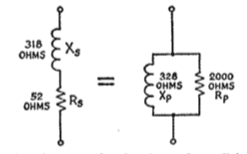
1.png

fig 2 states adding a counter reactance to negate the additional reactance as in fig 1 part 2...(leaving it for a moment)
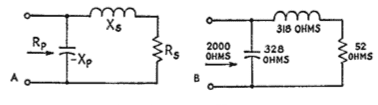
2.png


I simulated this circuit in LTspice and found out the impedance to be 1Meg ohms which way beyond my expectation of 2k ohm.
(I have tried many arbitrary values of f and L and haven't found any luck yet. For the time being its 5H.)
I am not sure about what inductance value should I take so that I can achieve resultant impedance of 2k ohm in the graph.
Unfortunately I also don't have the frequency value as it is not mentioned in the article.(XL=2.pi.f.L)

What inductance and f should be need for 2k ohm as a result.?


impedance match.PNG


Thank you!
 

Attachments

Engineering news on Phys.org
brainbaby said:
Summary:: Impedance matching

Unfortunately I also don't have the frequency value as it is not mentioned in the article.(XL=2.pi.f.L)

What inductance and f should be need for 2k ohm as a result.?
Write the equations for the two complex impedances and solve them for those unknowns? Are you trying to use the same inductance in both circuits? If not, you will have 3 unknowns and 2 equations...
 
  • Like
Likes   Reactions: brainbaby
berkeman said:
Write the equations for the two complex impedances and solve them for those unknowns? Are you trying to use the same inductance in both circuits? If not, you will have 3 unknowns and 2 equations...
There is only one circuit I think. The values look about right using approximations with mental arithmetic:-
1) Transformation ratio, N = 2000/50 = 40
2) Required Q = sqrt N = sqrt 40 = 6.5
3) Xc = XL = Q * 50 = 325 ohms
 
  • Like
Likes   Reactions: brainbaby
tech99 said:
There is only one circuit I think.
I was referring to these two, but maybe I'm not understanding the problem statement...

1581539587704.png
 
berkeman said:
I was referring to these two, but maybe I'm not understanding the problem statement...

View attachment 257013
OK yes I see.
 
  • Like
Likes   Reactions: berkeman
berkeman said:
Are you trying to use the same inductance in both circuits?
They are not two different circuits.
The second one is just a parallel equivalent of the initial one.

berkeman said:
Write the equations for the two complex impedances and solve them for those unknowns
I am having two unknowns. All I have is the reactance value i.e 318 ohm. It left me with an unknown freq. and inductance (L).
 
tech99 said:
There is only one circuit I think
Absolutely.
 
berkeman said:
I'm not understanding the problem statement
With two unknowns how can I able to find value of L (on simulation as well)
 
brainbaby said:
They are not two different circuits.
The second one is just a parallel equivalent of the initial one.
No. There is no way to make these two circuits equivalent across a range of frequencies. You should be able to match their complex impedance at a single frequency, I think, but I haven't tried it yet.

1581602462126.png
 
  • Like
Likes   Reactions: brainbaby
  • #10
berkeman said:
There is no way to make these two circuits equivalent across a range of frequencies. You should be able to match their complex impedance at a single frequency,
yes. I agree but I can't find the freq until I know the inductance.
 
  • #11
Matching network chapters in my textbooks talk about something similar... series to parallel equivalent circuits, but what it's trying to show is that the impedance is stepped up or down by about ##Q^2## (assuming Q >> 1)

What I think I see in the OP is an attempt to use the series to parallel equivalent circuit as a matching network, but it is not a matching network. How to see what I think you're looking for? I would recommend doing a frequency (AC) sweep; plot values from the voltage source instead of other elements. Here:

ltspicesch.png


plotimpedance.png


The Q of the series one with the 318 Ohm inductor and 52 Ohm resistor is about 6.115. This is not much greater than one so the ##Q^2## approximation won't work very well, but that was based off of

$$R_s = {{R_p} \over {1 + Q^2}}$$

So you'll see it'll get to about 52 Ohms.

$$52.086 = {{2000} \over {1 + 6.11538^2}}$$

Higher Q correlates to narrow band. After it talks about all that fun stuff, then it'll talk about a L network. If the OP wants to match a 52 Ohm load to a 2000 Ohm source, then they can do something that'll look like series L and shunt C away from the load (followed by the source impedance). I would recommend reading about Smith charts rather than doing the calculation by hand... even though it's more common for RF engineering... the math still works and it's much more convenient and fun than the hand calculations (you could actually eye ball the values and get really close).

Solve for the reactive values and you'll be done so far as how your literature is doing it; you can choose a frequency after because you know that ##X_L## is ##\omega L## and ##X_C## is ##{1} \over {\omega C}##.
 
Last edited:
  • Like
Likes   Reactions: brainbaby
  • #12
A Pi filter can be used to match a narrow band. Wider bands can be matched by ladder networks with multiple stages. The Pi topology can be either low or high pass. You must specify the terminal impedances, frequency, and Q.
You can also use L or T networks.
There is a calculator here; https://www.eeweb.com/tools/pi-match
Attached is an LTspice model Pi for freq = 1kHz with Q=20.
 

Attachments

  • Like
Likes   Reactions: brainbaby
  • #13
brainbaby said:
Summary:: Impedance matching

I am not sure about what inductance value should I take so that I can achieve resultant impedance of 2k ohm in the graph.
Unfortunately I also don't have the frequency value as it is not mentioned in the article.(XL=2.pi.f.L)
The article is stating that to match 52Ω to 2000Ω you will need a an inductive reactance of 318Ω and a capacitive reactance of 328Ω. You choose the parts values, inductance and capacitance, to get those reactances at whatever frequency you are operating at. If you want to operate at a different frequency, you must choose different component values to obtain the needed reactances.

So choose a frequency, then compute what inductance and capacitance values you need that have the required reactances.

For further understanding, find the L and C values for 1/2 the frequency, twice the frequency, 10 times the frequency.

Cheers,
Tom
 
  • Like
Likes   Reactions: brainbaby
  • #14
brainbaby said:
Summary:: Impedance matching

Unfortunately I also don't have the frequency value as it is not mentioned in the article.
This is a very popular topic. Why not locate a different article in which all the variables are actually stated. This lacking piece of information is causing far more angst that is really necessary. :wink:
 
  • Like
  • Love
Likes   Reactions: brainbaby and Tom.G
  • #15
It may throw some off, but the OP doesn't need the frequency to solve the problem. They only need to solve for the reactive values. These values will be the same no matter frequency they are solving at.

smithchart_solvethread.png


This is just a L network. The problem is solved- good for all frequencies (results are normalized by 2000). L networks are great for learning. I would recommend trying that one first. Read about Smith charts and you'll be able to "see" the answers without any tedious calculations just like above.

## x_L = 0.016## and ##{1 \over | x_C|} = 6.1##

Now: If they want to solve for specific L and C values, then they will need the frequency, but it doesn't change the above. Example simulated below you'll see the match no matter which frequency I plug into the parametric sweep.

1581727833288.png


1581727866505.png
 
  • Like
Likes   Reactions: brainbaby

Similar threads

  • · Replies 9 ·
Replies
9
Views
2K
  • · Replies 7 ·
Replies
7
Views
3K
  • · Replies 19 ·
Replies
19
Views
4K
Replies
1
Views
3K
  • · Replies 15 ·
Replies
15
Views
7K
Replies
9
Views
8K
  • · Replies 11 ·
Replies
11
Views
4K
  • · Replies 49 ·
2
Replies
49
Views
12K
  • · Replies 12 ·
Replies
12
Views
2K
Replies
21
Views
6K