Graduate Partial Differentiation in Lagrange's Equations

Click For Summary
SUMMARY

This discussion focuses on the application of partial differentiation within Lagrange's equations as presented in Thornton and Marion's "Classical Dynamics of Particles and Systems." Key points include the derivation of the total derivative of x in Equation (7.100) and the significance of the term ∂x/∂t in the context of the chain rule. The discussion emphasizes that neglecting this term leads to incorrect results, as demonstrated through specific examples involving the function x(q,t) = 3q²t. The chain rule is confirmed as the foundational principle governing these transformations.

PREREQUISITES
  • Understanding of Lagrange's equations in classical mechanics
  • Familiarity with partial derivatives and total derivatives
  • Knowledge of the chain rule in calculus
  • Basic proficiency in mathematical functions and their dependencies
NEXT STEPS
  • Study the application of the chain rule in advanced calculus
  • Explore Lagrange's equations in depth using "Classical Dynamics of Particles and Systems" by Thornton and Marion
  • Learn about total derivatives and their implications in physics
  • Investigate examples of partial differentiation in various physical systems
USEFUL FOR

Students and professionals in physics, particularly those studying classical mechanics, mathematicians focusing on calculus, and anyone interested in the application of differentiation in dynamic systems.

sams
Gold Member
Messages
84
Reaction score
2
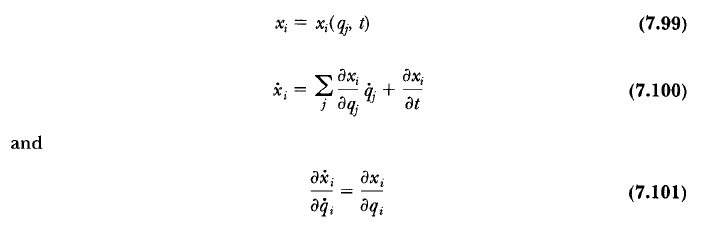
In Section 7.6 - Equivalence of Lagrange's and Newton's Equations in the Classical Dynamics of Particles and Systems book by Thornton and Marion, pages 255 and 256, introduces the following transformation from the xi-coordinates to the generalized coordinates qj in Equation (7.99):
1.PNG
2.PNG


My questions are mathematical rather than physical questions.

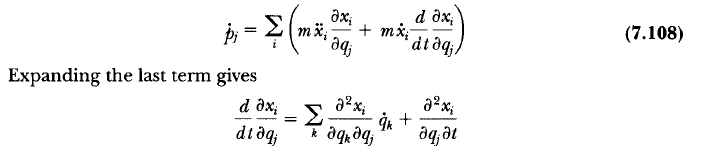
1. Could anyone please explain to me how did the Author make the derivative of x in Equation (7.100) and expanded the time derivative of x in the last term of Equation (7.108)?

2. Is there any mathematical relation of the partial derivatives used for the above two cases?

Your help is much appreciated. Thanks a lot...
 

Attachments

  • 1.PNG
    1.PNG
    2.8 KB · Views: 1,087
  • 2.PNG
    2.PNG
    4.2 KB · Views: 1,004
Last edited:
Physics news on Phys.org
Both situations involve application of the chain rule of differentiation.
$$\dot {x}=\frac{d}{dt}x(q,t)=\frac{\partial x}{\partial q}\frac{\partial q}{\partial t}+\frac{\partial x}{\partial t}=\frac{\partial x}{\partial q}\dot q+\frac{\partial x}{\partial t}$$
 
  • Like
Likes sams
Where did the second term ∂x/∂t came from?
 
sams said:
Where did the second term ∂x/∂t came from?
Perhaps a simple concrete example would be appropriate at this point because it looks like you are confused about what a total derivative means.
Suppose ##x(q,t) = 3q^2t## where ##q=t^4##. What is ##\dot x##?
Answer I (according to the rule I gave you)
$$\dot x= \frac{\partial x}{\partial q}\dot q+\frac{\partial x}{\partial t}=3 (2q)t\dot q+3q^2 =3 (2t^4)t4t^3+3t^8=27t^8$$Answer II (replacing ##q=t^4## in the original expression)
$$\dot x= \frac{d x}{dt}[3(t^8)t]=27t^8$$Clearly the answers would not match if one dropped the ##\frac{\partial x}{\partial t}## term in Answer I.
 
  • Like
Likes sams
sams said:
Where did the second term ∂x/∂t came from?
The same place as the others. The chain rule says that if you have a function ##f(q_1,q_2,...,q_n)## where the ##q_i## are functions of ##t## then the derivative of ##f## with respect to ##t## is $$\frac{df}{dt}=\frac{\partial f}{\partial q_1}\frac{dq_1}{dt}+\frac{\partial f}{\partial q_2}\frac{dq_2}{dt}+...+\frac{\partial f}{\partial q_n}\frac{dq_n}{dt}$$You seem comfortable with that (I've just expanded the sum in 7.100). Now what if ##q_n(t)=t##? Which is to say, what if the function ##f## has (n-1) dependencies on functions ##q_j## and one explicit dependence on ##t##, as your ##x_i(q_j,t)## functions do? In that case, the last term simplifies to ##\partial f/\partial t##. That's all that's going on.
 
Last edited:
  • Like
Likes sams
Thanks a lot! That was very helpful...

The second term in Equation (7.101) is not equal to zero, how did we prove this equation? Is there any certain rule in Mathematics for this relation?
 
sams said:
Thanks a lot! That was very helpful...

The second term in Equation (7.101) is not equal to zero, how did we prove this equation? Is there any certain rule in Mathematics for this relation?
It's the chain rule of differentiation. You must have proved it in calculus I.
If you have a function ##f(u,v)## then
$$\frac{df(u,v)}{dt}=\frac{\partial f}{\partial u}\frac{\partial u}{\partial t}+\frac{\partial f}{\partial v}\frac{\partial v}{\partial t}$$
What do you get when ##v=t##?
 
Last edited:
  • Like
Likes sams
sams said:
The second term in Equation (7.101) is not equal to zero, how did we prove this equation? Is there any certain rule in Mathematics for this relation?
I think the point is that nothing on the RHS of 7.100 has any explicit dependence on ##\dot{q_i}## except ##\dot{q_i}## itself. So the partial derivatives of every term with respect to ##\dot{q_i}## are zero except for the one term where ##j=i##, which gives you 7.101.
 
  • Like
Likes sams

Similar threads

Replies
6
Views
2K
  • · Replies 1 ·
Replies
1
Views
1K
  • · Replies 1 ·
Replies
1
Views
1K
  • · Replies 1 ·
Replies
1
Views
1K
  • · Replies 3 ·
Replies
3
Views
1K
  • · Replies 2 ·
Replies
2
Views
1K
  • · Replies 2 ·
Replies
2
Views
2K
  • · Replies 4 ·
Replies
4
Views
1K
  • · Replies 2 ·
Replies
2
Views
2K
  • · Replies 1 ·
Replies
1
Views
3K