Solving a Problem: Forces Acting on P

  • Thread starter Thread starter greg_rack
  • Start date Start date
  • Tags Tags
    Forces
Click For Summary
SUMMARY

The discussion focuses on analyzing the forces acting on point P in a polar reference system when the angle θ is set at 60 degrees. Three primary forces are identified: the spring force (F_S) directed towards point O, the force (F_P) in the direction of movement along θ, and a normal force exerted by the circle. The equations of motion are established based on these forces, and the relationship between the angles φ and θ is clarified, emphasizing the linear dependence between them.

PREREQUISITES
  • Understanding of polar coordinate systems in physics
  • Familiarity with Free Body Diagrams (FBD) and Kinematics Diagrams (KD)
  • Knowledge of Hooke's Law for spring forces
  • Basic trigonometry to relate angles in geometric configurations
NEXT STEPS
  • Study the derivation of equations of motion in polar coordinates
  • Learn about the application of Hooke's Law in dynamic systems
  • Explore the relationship between angular and linear motion in circular paths
  • Investigate the use of Free Body Diagrams in complex mechanical systems
USEFUL FOR

Students and professionals in physics, mechanical engineering, and anyone involved in analyzing forces in dynamic systems, particularly those using polar coordinates.

greg_rack
Gold Member
Messages
361
Reaction score
79
Homework Statement
The smooth particle P is attached to an elastic cord extending from O to P. Due to the slotted arm guide, P moves along an horizontal path(##r=0.8sin(\theta)##) with constant angular velocity of ##\dot{\theta}=5rad/s##.
The mass of P is 0.08kg, the cord stiffness is k=30N/m and its unstretched length 0.25m.

Find the forces of the guide acting on P for theta=60
Relevant Equations
velocity and acceleration components in polar coordinates, Newton's 2nd law.
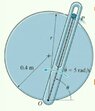
Screenshot 2021-11-22 174214.jpg
Hello guys,

here's a problem which I'm having troubles solving.
It asks for the forces acting on P when ##\theta=60^{\circ}##.
I thought for this problem it would have been convenient to consider a polar reference system(r, theta). Drawing the FBD of pin P at a moment in time, we will have 3(?) forces acting on P:
-one(##F_S##) along the r direction(pointing towards O caused by the spring-modeled cord, function of its stretch and k;
-one(##F_P##) along the positive(direction of movement) theta direction, caused by the push "from backwards" of the guide exerted on P;
-a last normal force, exerted by the circle normal to the path, thus not aligned with the r-theta system defined.

Could you tell me if these are all the forces acting, and thus the equations of motion(FBD+KD) might be built from them?
In case yes, now we could start writing down the EOMs to solve for ##F_P##.
$$
\left\{\begin{matrix}
F_S-Ncos\phi=m(\ddot{r}-r\dot{\theta}^2)\\
F_P-Nsin\phi=m(r\ddot{\theta}+2\dot{r}\dot{\theta})
\end{matrix}\right.$$

We may calculate ##F_S## from Hooke's law, but to solve for ##F_P## and N we still need ##\phi##.
The procedure to calculate such angle seemed kinda convoluted and thus got me thinking I wasn't on the right path... I was as well confused on the problem's request: do they mean "my" ##F_P## by "forces of the guide acting on P"?

Greg
 
Physics news on Phys.org
Yes, those are the forces.
There is an isosceles triangle formed among points O, P and center of circle.
Two of its angles should be 90-60 degrees.
 
greg_rack said:
##\dots~##we still need ϕ.
Suppose you defined ##\phi## as the angle subtended by the center of the wheel when the particle is at ##\theta## and such that ##\phi=0## when ##\theta=0## (particle at the 6 o'clock position). Note that ##\phi=180^{\circ}## when ##\theta=90^{\circ}## (particle at the 12 o' clock position). Can you deduce a general relation between ##\theta## and ##\phi##? After all, the dependence between ##\theta## and ##\phi## can only be linear. If you'd rather measure ##\phi## conventionally, i.e. relative to the 3 o' clock position, then it's a matter of adding (or subtracting) ##90^{\circ}##. Draw a good picture and you will see.
 
Thank you so much guys, now I see the relation!
I didn't realize that the direction of the normal force, was that of the radius of the circle. That helped me the most to spot ##\phi=f(\theta)##.
Too many triangles and scribbles o_O
 

Similar threads

  • · Replies 24 ·
Replies
24
Views
2K
  • · Replies 7 ·
Replies
7
Views
2K
  • · Replies 42 ·
2
Replies
42
Views
3K
Replies
18
Views
4K
Replies
5
Views
1K
  • · Replies 3 ·
Replies
3
Views
1K
  • · Replies 7 ·
Replies
7
Views
2K
  • · Replies 27 ·
Replies
27
Views
5K
  • · Replies 7 ·
Replies
7
Views
1K
Replies
24
Views
3K