JaJoMarston
- 3
- 0
Hi,
This a Classical Mechanics problem I've been trying to solve for a few days now. I cannot use Lagrangian or Hamiltonian formulation, it must be solved using classical Newtonian formulation. One must determine the equations of movement of the particle in cartesian, spherical and cylindrical coordinates, although I'm focusing on cartesian now since I have the feeling that is the hardest part:
1. Homework Statement
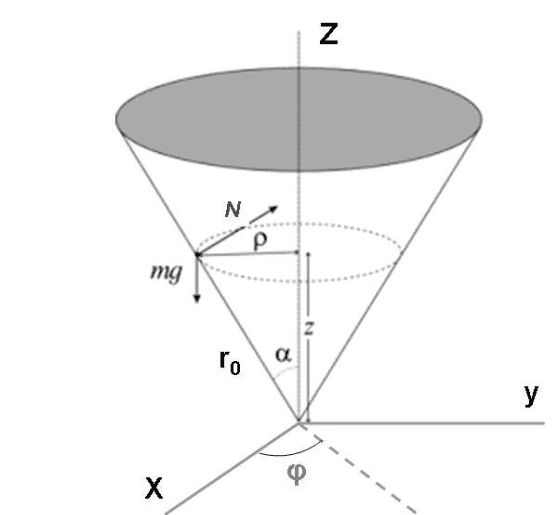
So we have a particle of mass m moving in a frictionless inverted cone. We're asked to find the equations of motion of the particle and the forces of constraint (in cartesian coordinates first).
When t=0, the particle is at a distance r0 from the origin (I guess that's in spherical coordinates), it's at an angle φ(0)=0 and it moves with angular speed ω(0)=w0 (it's not neccesarily constant throughout the movement). It also moves with an initial speed of v(0)=v0.
Second Newton law, that should be it. Also, since the particle is constrained to move inside the cone then:
tan(α)=(x2+y2)/z
We have the weight in the negative Z direction and the normal which should have 3 components.
[/B]
I figured that we can look at the cone as a tilted plane.
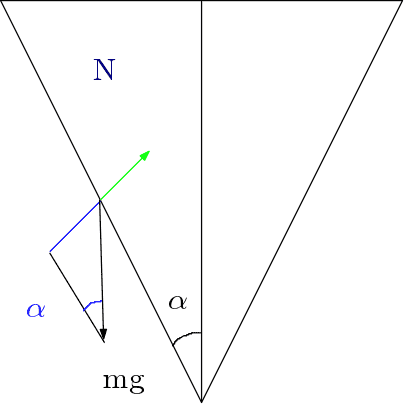
There cannot be any net force in the normal direction of the surface, otherwise the particle would be pulled away from the cone. So from the figure I realized that:
N=mgsin(α)
Now focusing on our set of cartesian axis, the Z component of the normal force must be (by transformation of spherical to cartesian coordinates):
Nz=Ncos(α)=½mgsin(2α)
And so the total acceleration in the z direction must be:
az=g(½sin(2α)-1)
This is pretty easy to integrate using the initial conditions so we can get the speed and position in the Z component.
My problem is with the x and y components. Common sense tells me that the net force in x,y should be zero, so there must be a force that balances the normal in those directions. I thought about the centripetal force, but I don't have the slightlest clue of how to express such force. I know that if the particle was moving in a circle of a fixed radius R the centripetal acceleration would be v2/R, but this is not the case at all. We have an angular velocity that might be varying with time, a radius that is not constant and same goes with the speed.
Thanks in advance.
This a Classical Mechanics problem I've been trying to solve for a few days now. I cannot use Lagrangian or Hamiltonian formulation, it must be solved using classical Newtonian formulation. One must determine the equations of movement of the particle in cartesian, spherical and cylindrical coordinates, although I'm focusing on cartesian now since I have the feeling that is the hardest part:
1. Homework Statement
So we have a particle of mass m moving in a frictionless inverted cone. We're asked to find the equations of motion of the particle and the forces of constraint (in cartesian coordinates first).
When t=0, the particle is at a distance r0 from the origin (I guess that's in spherical coordinates), it's at an angle φ(0)=0 and it moves with angular speed ω(0)=w0 (it's not neccesarily constant throughout the movement). It also moves with an initial speed of v(0)=v0.
Homework Equations
Second Newton law, that should be it. Also, since the particle is constrained to move inside the cone then:
tan(α)=(x2+y2)/z
We have the weight in the negative Z direction and the normal which should have 3 components.
The Attempt at a Solution
[/B]
I figured that we can look at the cone as a tilted plane.
There cannot be any net force in the normal direction of the surface, otherwise the particle would be pulled away from the cone. So from the figure I realized that:
N=mgsin(α)
Now focusing on our set of cartesian axis, the Z component of the normal force must be (by transformation of spherical to cartesian coordinates):
Nz=Ncos(α)=½mgsin(2α)
And so the total acceleration in the z direction must be:
az=g(½sin(2α)-1)
This is pretty easy to integrate using the initial conditions so we can get the speed and position in the Z component.
My problem is with the x and y components. Common sense tells me that the net force in x,y should be zero, so there must be a force that balances the normal in those directions. I thought about the centripetal force, but I don't have the slightlest clue of how to express such force. I know that if the particle was moving in a circle of a fixed radius R the centripetal acceleration would be v2/R, but this is not the case at all. We have an angular velocity that might be varying with time, a radius that is not constant and same goes with the speed.
Thanks in advance.

