Pascal's principle hydraulic lift with torque involved

Click For Summary

Homework Help Overview

The discussion revolves around a problem involving Pascal's principle applied to a hydraulic lift, specifically focusing on the forces and torques associated with two pistons and a lever system. The original poster is trying to determine the force required to support a given mass using the hydraulic system described.

Discussion Character

  • Exploratory, Conceptual clarification, Mathematical reasoning, Problem interpretation, Assumption checking

Approaches and Questions Raised

  • The original poster attempts to calculate the force exerted by piston 1 and questions whether they should assume the pistons are at the same height to find the necessary pressure. Some participants suggest that the pressures from both pistons must equalize to find the required force from the lever. Others discuss the use of the law of the lever to relate the forces and distances involved.

Discussion Status

Participants are actively engaging with the problem, offering guidance on assumptions regarding the heights of the pistons and the correct application of pressure and lever equations. There is an ongoing exploration of the calculations, with some participants noting potential errors in unit conversion and interpretation of area measurements.

Contextual Notes

There is mention of potential confusion regarding the area of piston 2, as well as the units of pressure being discussed. The original poster expresses uncertainty about the height of the pistons, which is not explicitly provided in the problem statement.

fordy314
Messages
6
Reaction score
0
Pascal's principle hydraulic lift with torque involved(need help with lever)
Homework Statement

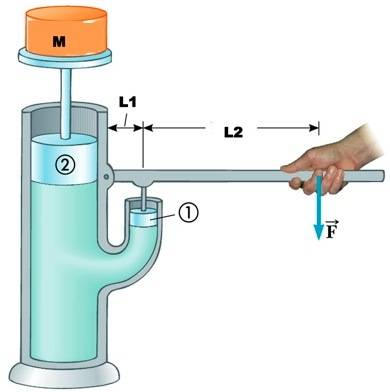
A hydraulic jack is used to support a mass which has a mass of 30.7 kg.
13YOy.jpg

The mass is supported by piston 2 which has a mass of 0.250 kg and an area of 40.2 cm2 . A force is applied by the lever on piston 1 which has a mass of 0.085 kg and an area of 14.2 cm2.

The distance between the hinge and piston 1 is 4.47 cm. A force is applied a further 16.4 cm from piston 1.

What is the magnitude of the force F which must be applied to support the mass? You may neglect the mass of the fluid. You may also wish to TORQUE to someone about this problem.

Homework Equations


ρ=m/v
P=F/A
P=Po+ρgh
Any relevant torque equations (not that far yet)

The Attempt at a Solution


I'm pretty lost here, but I know that I need to find the force exerted by piston1.
The force required to lift the mass and piston2 is:

30.95kg*9.81m/s^2 = 303.6N
P=F/A=303.6N/(pi*.402^2)=598(k?)Pa
This is where I get lost. normally I would take P=Po+ρgh to find the pressure on piston 1 to find the force needed to push against it, but I don't have the height. Am I missing something, or do you think that I'm supposed to assume that they're at the same height?

Thanks.
 
Last edited:
Physics news on Phys.org
It looks like you're supposed to assume they're at the same height. The pressure from piston 1 needs to equal the pressure from piston 2. Then you can find the force that the lever needs to apply to the piston to create that pressure. Using the law of the lever, you can then find the force that needs to be applied to the end of the lever.
 
Ok, then FPiston1=PA1=37.9N

37.9N-(.085kg*9.81m/s^2)=37.1

Now do I want to use the equation F1*d1=F2*d2?

That would be (37.1*.0447m)/.164m=10.1N, but my answer comes up wrong. Any suggestions?
 
fordy314 said:
Ok, then FPiston1=PA1=37.9N

37.9N-(.085kg*9.81m/s^2)=37.1

Now do I want to use the equation F1*d1=F2*d2?

That would be (37.1*.0447m)/.164m=10.1N, but my answer comes up wrong. Any suggestions?


For the area of piston 2, you used:
A=pi*.402^2
When the problem states that the area is .402 meters (not the radius as you undoubtedly thought).
and yes, you've got the right lever equation.
Also if you're still wondering, the pressures are pascals (not kPA).
 
Nessdude14 said:
For the area of piston 2, you used:
A=pi*.402^2
When the problem states that the area is .402 meters (not the radius as you undoubtedly thought).
and yes, you've got the right lever equation.
Also if you're still wondering, the pressures are pascals (not kPA).

Thanks so much. Of course its always that units that'll get me.
 

Similar threads

  • · Replies 2 ·
Replies
2
Views
3K
  • · Replies 5 ·
Replies
5
Views
7K
  • · Replies 4 ·
Replies
4
Views
6K
  • · Replies 2 ·
Replies
2
Views
8K
  • · Replies 3 ·
Replies
3
Views
3K
  • · Replies 3 ·
Replies
3
Views
2K
  • · Replies 1 ·
Replies
1
Views
2K
  • · Replies 4 ·
Replies
4
Views
2K
  • · Replies 1 ·
Replies
1
Views
3K
  • · Replies 4 ·
Replies
4
Views
8K