OmegaKV
- 22
- 1
For line integrals in vector calculus,
[tex]\int^a_b F \cdot dl[/tex]
I almost always see the path oriented from a to b.
But my textbook has the following (look at the first equation for V(r):
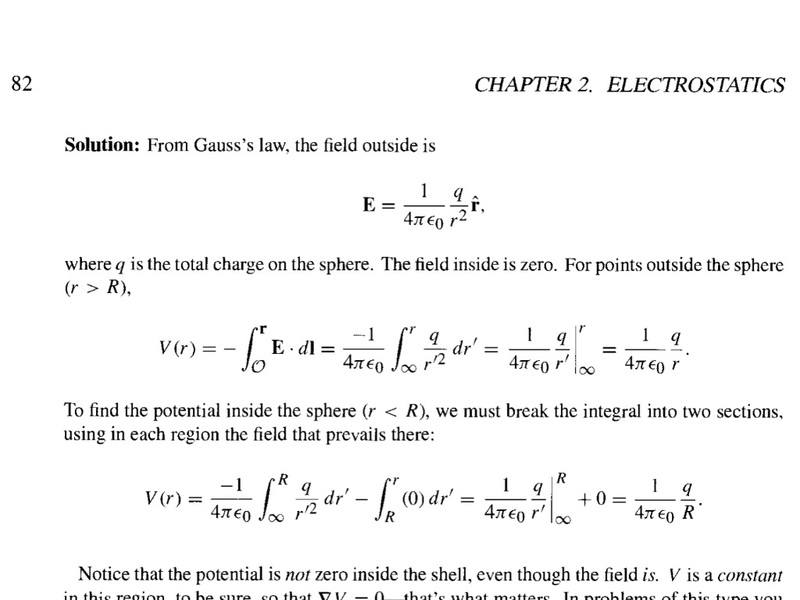
Since the integral's limits are from O to r, I would have expected dl to also be pointing in the direction from O to r (i.e. pointing in the radially inward (minus r hat) direction), but the math in the textbook seems to imply that dl points radially outward (positive r hat direction, from r to O). I say this because the result of E dot dl has no minus sign in front of it.
How do you know which direction to orient dl?
[tex]\int^a_b F \cdot dl[/tex]
I almost always see the path oriented from a to b.
But my textbook has the following (look at the first equation for V(r):
Since the integral's limits are from O to r, I would have expected dl to also be pointing in the direction from O to r (i.e. pointing in the radially inward (minus r hat) direction), but the math in the textbook seems to imply that dl points radially outward (positive r hat direction, from r to O). I say this because the result of E dot dl has no minus sign in front of it.
How do you know which direction to orient dl?