Pendulum and Centripetal Motion Question

Click For Summary
SUMMARY

The discussion focuses on calculating the speed of a 2.0m length pendulum at the bottom of its swing after being raised to a vertical height of 0.12m. The initial approach using centripetal force equations was incorrect, leading to an erroneous speed calculation of 4.429 m/s². The correct method involves applying the conservation of energy principle, where potential energy (PE) converts to kinetic energy (KE), resulting in a final speed of 1.5 m/s.

PREREQUISITES
  • Understanding of pendulum mechanics
  • Knowledge of centripetal force equations
  • Familiarity with conservation of energy principles
  • Basic algebra for manipulating equations
NEXT STEPS
  • Study the conservation of energy in mechanical systems
  • Learn about centripetal force and its applications in pendulum motion
  • Explore the role of tension and gravitational force in pendulum dynamics
  • Investigate the effects of angular displacement on pendulum speed
USEFUL FOR

Physics students, educators, and anyone interested in understanding pendulum motion and energy conservation principles in mechanics.

MaZnFLiP
Messages
16
Reaction score
0
[SOLVED] Pendulum and Centripetal Motion Question

Picture and FBD
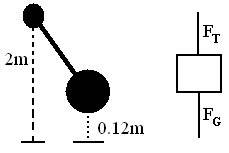
Physics.jpg


The Problem/Question
Calculate the speed of a 2.0m length pendulum at the very bottom of the swing if you raise it a vertical height of 0.12m


Relevant equations

F_net = F_T + F_G = F_C = m(\frac{V^2}{r})

The attempt at a solution

Well, after looking over this problem, I think I'm doing something amazingly wrong.

Looking at My equations, I went from

F_C = F_T + mg

to

m(\frac{V^2}{r}) = F_T + mg

From there I got:

\frac {V^2}{r} = F_T + g because the masses cancel.

Next:

V^2 = gr + F_T

After finding (-9.81\frac{m}{s}^2)(2.0m) = 19.62, I found the square root which was 4.429 \frac {m}{s}^2

The problem is that after looking at the answer sheet, The answer is supposed to be:

1.5\frac{m}{s}^2

Could someone please help as to tell me where I went wrong?
 
Physics news on Phys.org
Hi MaZnFLip,

MaZnFLiP said:
Picture and FBD
Physics.jpg


The Problem/Question
Calculate the speed of a 2.0m length pendulum at the very bottom of the swing if you raise it a vertical height of 0.12m


Relevant equations

F_net = F_T + F_G = F_C = m(\frac{V^2}{r})

The attempt at a solution

Well, after looking over this problem, I think I'm doing something amazingly wrong.

Looking at My equations, I went from

F_C = F_T + mg

At the bottom of the swing, the equation would be F_c=F_T - mg, but everywhere else along the swing the tension is not in the opposite direction as the weight, and you would need some trig functions to take that effect into account. Also, you would need to take into account the tangential acceleration that is actually causing the mass to speed up.

Rather than that, I would suggest using conservation of energy for this problem. What does that give?
 
Umm. The way I learned to use conservation of energy is converting PE since its higher up and when it goes all the way down it turns into KE so PE = KE. That means that MGH = 0.5mv^2 and since the masses cancel that would leave me with GH = 0.5v^2. Multiplying GH together would give me 1.1772. After dividing that with 0.5, I then get 2.3544. Finally, After getting the square root of that, I ended up getting 1.5m/s! Yes! Thank you so much!
 
Sure, glad to help!
 

Similar threads

  • · Replies 8 ·
Replies
8
Views
3K
  • · Replies 9 ·
Replies
9
Views
2K
Replies
1
Views
1K
Replies
2
Views
1K
  • · Replies 15 ·
Replies
15
Views
2K
  • · Replies 3 ·
Replies
3
Views
2K
  • · Replies 2 ·
Replies
2
Views
892
  • · Replies 7 ·
Replies
7
Views
1K
  • · Replies 28 ·
Replies
28
Views
3K