Permanent magnets and "permeance"

Click For Summary

Discussion Overview

The discussion revolves around the longevity and behavior of permanent magnets, particularly in the context of a recumbent exerciser bike that uses a magnetic clutch for resistance. Participants explore concepts related to magnetic permeance, permanence, and the factors affecting magnetization over time, including environmental influences and mechanical interactions.

Discussion Character

  • Exploratory
  • Technical explanation
  • Debate/contested

Main Points Raised

  • One participant notes that they have had to increase the resistance setting on their bike over time, suggesting a potential loss of magnetism in the permanent magnets.
  • Another participant clarifies the distinction between "permeance" and "permanence," asserting that the original term used was correct in the context of permanent magnets.
  • Some participants propose that vibration, dirt, and corrosion could contribute to the demagnetization of permanent magnets over time.
  • A later reply suggests that eddy currents in the flywheel might also cause demagnetization of the permanent magnets.
  • There is a discussion about the concept of magnetic remanence and coercivity as relevant to the loss of magnetism.
  • One participant raises a hypothetical scenario regarding the stability of magnetic domains in an isolated environment, questioning how long they would remain static.
  • Another participant mentions the potential influence of the Earth's magnetic field on the bike's ferrite magnets over time.
  • Links to various resources are shared, discussing magnet lifetime and providing further context on the topic.
  • There is a call for a more rigorous description or quantification of the concepts discussed, including the use of specific terminology related to magnetic fields.

Areas of Agreement / Disagreement

Participants express differing views on the terminology used (permeance vs. permanence) and the factors affecting magnet longevity. The discussion remains unresolved regarding the definitive impacts of various influences on permanent magnets.

Contextual Notes

Participants reference various technical concepts and resources, but there is no consensus on the exact mechanisms or definitions related to the longevity of permanent magnets. The discussion includes assumptions about environmental conditions and the effects of mechanical interactions.

hollowman
Messages
23
Reaction score
6
TL;DR
Permanent magnets and "permeance"
I have an indoor recumbent exerciser bike that uses a non-contact magnetic "clutch" for resistance.
There is permanent-magnetic fulcrum assembly that pivots on a hinge. And a heavy iron flywheel that spins when pedaling. The arc moves toward/away from flywheel based on resistance setting.
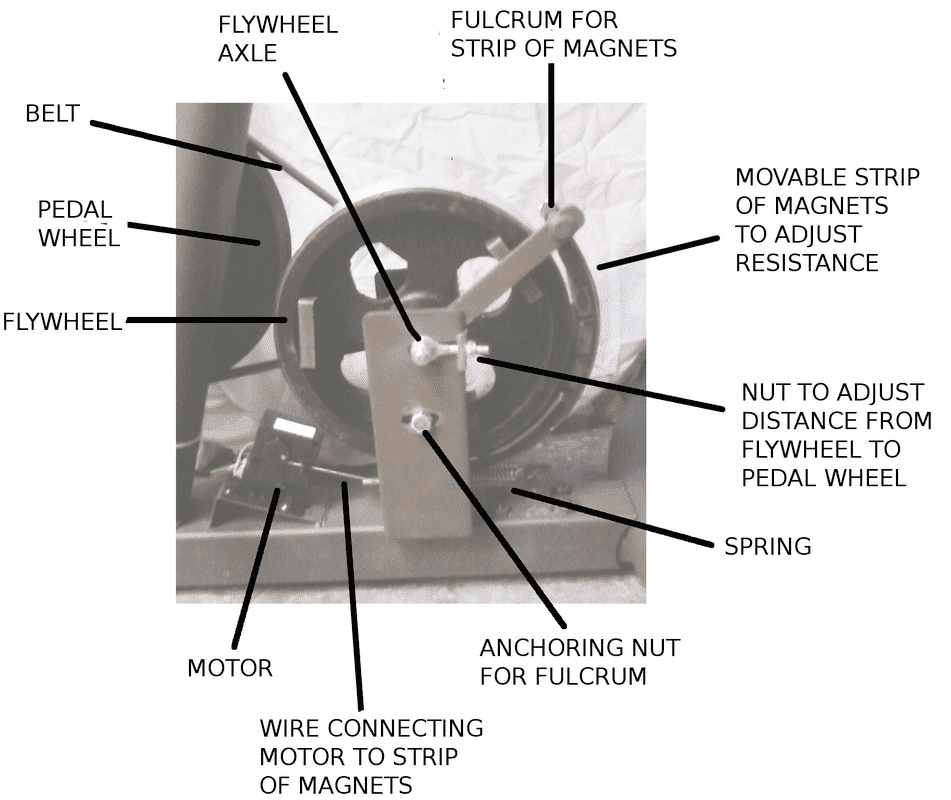
1586362655141.png


I've had the bike for about 10 years and have noticed that I have had to increase the resistance setting in order to achieve the SAME resistance. I added some neodymium magnets to the fulcrum, which restored resistance somewhat.

So the question is about permeance. How long do permanent magnets last in nature, given constant room temperature? Also, what about that iron flywheel. Does its proximity (errrr... magnetic "drag") have de-magnetizing effects?
 
Engineering news on Phys.org
hollowman said:
Summary:: Permanent magnets and "permeance"

So the question is about permeance. How long do permanent magnets last in nature, given constant room temperature?
I think you mean more "permanence" and not permeance. Permeance is a different concept (the inverse of magnetic reluctance):

https://en.wikipedia.org/wiki/Permeance

It looks like vibration would be the main reason that your permanent magnets lost some of their magnetization over time:

https://www.magnetassemblies.com/permanent-magnets/

Non-permanent magnets are electromagnets which require an external electric current to trigger magnetism or non-magnetism. Permanent magnets, on the other hand, retain their magnetism indefinitely or until they are demagnetized by vibration, dirt, corrosion or interfering magnetic fields. Read More…

EDIT/ADD -- Although I suppose it might be possible for the eddy currents in the flywheel to cause some demagnetization of the permanent magnets over time. Will have to do some Googling about that...
 
Last edited:
  • Like
Likes   Reactions: hollowman
demagnetized by vibration, dirt

Wow. Thanks @berkeman. I didn't know that.
 
Another way to think about the issue would be, all else held equal, how long to would magnetic domains remain "in static position" if the fridge magnet or audio cassette tape were isolated in some remote, inter-cluster corner of the universe?
 
In electromagnetism, permeance is the inverse of reluctance. In a magnetic circuit, permeance is a measure of the quantity of magnetic flux for a number of current-turns.

Googling "magnetic permanence" returns results about "magnetic remanence" which is more relevant to your question about the loss of magnetism.

See also: https://sciencing.com/causes-magnet-lose-its-magnetism-8229455.html
 
  • Informative
Likes   Reactions: berkeman
darth boozer said:
In electromagnetism, permeance is the inverse of reluctance. In a magnetic circuit, permeance is a measure of the quantity of magnetic flux for a number of current-turns.

Googling "magnetic permanence" returns results about "magnetic remanence" which is more relevant to your question about the loss of magnetism.
And/or "Coercivity", https://en.wikipedia.org/wiki/Coercivity
" also called the magnetic coercivity, coercive field or coercive force, is a measure of the ability of a ferromagnetic material to withstand an external magnetic field without becoming demagnetized"
 
Another thing to note is that in engineering (especially industries related to permanent magnets/magnetism, like TDK), "permeance" is used as follows:
"in calculating a magnetic circuit, permeance P, which is the reciprocal of magnetic resistance R" ...
https://product.tdk.com/info/en/products/magnet/technote/designguide.html
"Permeance coefficient Pc is used to express the operating point of the magnet on the B-H curve. This value is defined as the ratio of magnetic flux density Bd and magnetic field strength Hd at the operating point."
hysteresis.png
 
  • Like
Likes   Reactions: hutchphd
Going over some web articles, it's possible that the bike's ferrite magnets were, over time, also affected (demag'd) by the Earth's mag. field.
 
  • #10
  • Informative
  • Like
Likes   Reactions: hollowman and anorlunda
  • #11
Tom.G said:
[...]
Cheers,
Tom
Thx.
It would still be helpful if there were a more definitive or rigorous description or quantification -- beyond the somewhat roundabout terminology thrown around this thread, like "permeance". Maybe the "magnetic stuff" or "magnetic mass" of a NATURAL permanent magnet is something like the Higgs Field? Maybe "magnetic field is a vector field" or "tesla" or "webers" (as noted in resources like Wiki).
When measuring mag fields, one can use instruments such as [gauss meter]:
emdex_snap.png

Also see:
https://www.magnet-sdm.com/2017/08/01/magnetic-field-strength-permanent-magnet/
 

Similar threads

Replies
0
Views
2K
  • · Replies 1 ·
Replies
1
Views
3K
  • · Replies 3 ·
Replies
3
Views
2K
  • · Replies 1 ·
Replies
1
Views
711
  • · Replies 16 ·
Replies
16
Views
3K
  • · Replies 5 ·
Replies
5
Views
7K
  • · Replies 12 ·
Replies
12
Views
5K
  • · Replies 8 ·
Replies
8
Views
2K
Replies
2
Views
5K
Replies
19
Views
6K