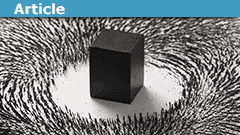
There is something not quite right with this.
Let's say that I measure some magnetic field geometry. Without knowing the source, and simply looking at the geometry and the boundary conditions, I can come up with a particular geometry of the current source. This is what the article is doing, i.e. deducing the current source based on the fact that there is some configuration of a magnetic field.
But is there really a surface current that is responsible for the magnetic field of a ferromagnet? Or is this simply a model that is made to match the magnetic field geometry?
When I move a magnet into a coil, I get create a magnetic field that opposes the change in the magnetic field experienced by the coil. This opposing magnetic field induces a current in the coil. This is not a "model" current. It is real. If you connect a bulb to the circuit, it'll light up.
So is this surface current real, or is it simply a model that matches the field geometry? If I connect 2 ends a wire to various parts of the surface of the magnet, will I measure a current?
The picture of small, closed current loops to model atomic magnetic moment is highly outdated and not very accurate. Maybe to the first approximation, it might be useful, but that is as far as it can go. There are no current loops, and as far as I know, there are no ferromagnetic surface currents. There are modeled Amperian currents to emulate the magnetic field produced by the magnet, but this isn't real.
The other problem with this scenario is the difference between ferromagnets and paramagnets. If all we care about is this surface currrents, then why, in some material, the magnetization dies off when the external field goes away, while in permanent magnets, they stay aligned. This is one of the topics in quantum magnetism, where, among others, the Heisenberg coupling between nearest neighbor, next-nearest neighbor, next-next-nearest neighbor, etc... magnetic moments comes into play. The determination of the magnetic moment configuration of the lowest energy state is significant to result whether something is a paramagnet, ferromagnet, antiferromagnet, etc. This is the ORIGIN of permanent magnet, not the existence of "surface currents".
Zz.