Discussion Overview
The discussion revolves around the installation and phase arrangement of parallel medium-voltage cables, particularly focusing on the implications of cable layout on current sharing, electromagnetic compatibility (EMC), and load capacity. Participants explore theoretical and practical aspects of cable arrangement, including the effects of proximity and magnetic fields in a substation context.
Discussion Character
- Exploratory
- Technical explanation
- Debate/contested
- Mathematical reasoning
Main Points Raised
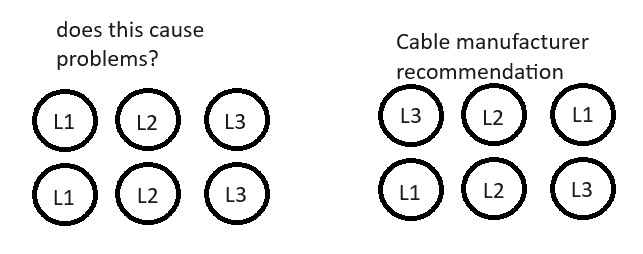
- Some participants question whether the arrangement of parallel phases on a cable rack affects cable load capacity or other operational aspects, especially over a distance of 20 meters.
- Others inquire about specific cable specifications and manufacturer recommendations, suggesting that local electrical codes may influence installation practices.
- One participant emphasizes the importance of achieving equal current sharing in parallel conductors, noting that small impedance variations can significantly impact performance.
- Another participant discusses the relationship between cable arrangement and electromagnetic compatibility, suggesting that a triangular configuration of conductors minimizes magnetic interference.
- A participant raises concerns about the proximity effect, explaining how it can exacerbate losses in multi-layered conductors and affect overall system efficiency.
- Some participants propose that the layout of conductors could influence the magnetic fields generated, potentially leading to induced currents and imbalances in parallel conductors.
- There are calculations presented regarding maximum current capacity and potential overheating issues due to current imbalances in the cables.
Areas of Agreement / Disagreement
Participants express a range of views on the significance of phase arrangement, with no clear consensus on whether the optimal arrangement is critical for short distances. Some agree on the importance of symmetry and minimizing loop areas, while others remain uncertain about the practical implications of their theories.
Contextual Notes
Participants mention various factors that could influence the discussion, including local electrical codes, specific cable specifications, and the potential for current imbalances due to proximity effects. There is also acknowledgment of the complexity involved in evaluating these factors in practical scenarios.
Who May Find This Useful
This discussion may be of interest to electrical engineers, technicians involved in power systems, and those working on medium-voltage installations, particularly in substation projects.