Phase difference between two light waves of the same frequency

Join the discussion
Ask a follow-up here, or get your own question answered by working scientists, mathematicians and engineers — people, not an autocomplete.
Real named experts · corrections over time · the nuance an AI answer skips
12 replies · 1K views
hello478
Messages
165
Reaction score
14
Homework Statement
Two light waves of the same frequency are represented by the diagram.


What could be the phase difference between the two waves?

A 150°
B 220°
C 260°
D 330°
Relevant Equations
phase difference = phase angle in this diagram...
the diagram.
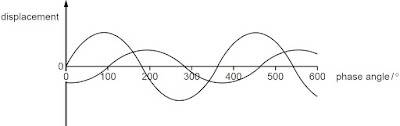
Capture.jpg


i found that the phase difference between them is 100º
but how is the answer 260
can someone please explain?
 
on Phys.org
BvU said:
Since 100 is not in the list, you need to pick another. And there is a best candidate.
is it 150º ? because it is the closest to 100º
 
BvU said:
Guessing, are we?
It is not 150, you already have the correct answer as quoted in #1
i dont know how it came to be the answer...
 
BvU said:
As a useful exercise you could draw 4 graphs, each with two waves. The first one with a phase difference of150 degrees, the others with 220, 260 and 330
drawing them, give me 5 mins and ill get back to you
 
1710346517449.png

this is what i got for 260º
what next??
BvU said:
As a useful exercise you could draw 4 graphs, each with two waves. The first one with a phase difference of150 degrees, the others with 220, 260 and 330
 
Last edited:
hello478 said:
i still dont understand it... :(
The curves are ##\sin(\theta+\phi_1)## and ##\sin(\theta+\phi_2)##.
Suppose ##\phi_1+2\pi>\phi_2>\phi_1##. The phase difference is ##\phi_2-\phi_1##.
But ##\sin(\theta+\phi_1)=\sin(\theta+\phi_1+2\pi)##, so those are two representations of the same wave. So we could equally say the phase difference is ##\phi_1+2\pi-\phi_2##.
 
Reply
  • Wow
Likes   Reactions: hello478
hello478 said:
i still dont understand it... :(
My two-pennies-worth…

On the Post 1# diagram, call the larger-amplitude wave ‘A’ and the smaller-amplitude wave ‘B’.

A passes through (0, 0). The next 'matching' point on B is (100º,0). So the phase difference is (100 – 0 =) 100º.

But you could equally well say:

B passes through (100º, 0). The next 'matching' point on A is (360º, 0). So the phase difference is (360-100=) 260º.

Remember that an angle of (say) +260º is the same as an angle of -100º. You can choose which wave (A or B) is the reference.
 
Last edited:
Reply
  • Like
Likes   Reactions: BvU, hello478 and nasu