Phase Shift of IGMF Band-Pass Filter at Corner Freq: Solved Problem

Click For Summary

Discussion Overview

The discussion revolves around understanding the calculation of phase shift in an IGMF band-pass filter at its corner frequency, as presented in a solved problem. Participants seek clarification on the methodology used to derive the phase shift from the transfer function and explore various approaches to calculate gain and phase shift.

Discussion Character

  • Homework-related
  • Technical explanation
  • Debate/contested

Main Points Raised

  • One participant requests clarification on how the phase shift of π was determined from the transfer function of the filter.
  • Another participant suggests replacing s with jω and rewriting the transfer function to identify real and imaginary components for calculating gain and phase.
  • Some participants express confusion regarding the phase shift at the corner frequency, noting that the imaginary part becomes zero, leading to a phase calculation of 0 using the tangent formula.
  • A participant introduces a formula from a textbook for phase shift in VCVS circuits, questioning its applicability to IGMF configurations and the appropriate value of k to use.
  • There is a discussion about the implications of a gain of -1/2 versus +1/2 on phase shift, with some asserting that a negative gain indicates a phase shift of 180°.
  • One participant highlights the need to consider the quadrant of the angle when using the tangent formula, as it can yield two possible phase values that are 180° apart.
  • Another participant mentions that a zero adds a positive phase shift of 90 degrees while a pole adds a negative phase shift of 90 degrees, discussing the effects on phase around the corner frequency.

Areas of Agreement / Disagreement

Participants do not reach a consensus on the correct method for calculating phase shift or the implications of gain on phase. Multiple competing views and uncertainties remain regarding the application of formulas and the interpretation of results.

Contextual Notes

Participants express uncertainty about the assumptions underlying the formulas used for phase shift calculations and the specific definitions of corner frequency versus center frequency in the context of band-pass filters.

roam
Messages
1,265
Reaction score
12

Homework Statement


I need some help understanding how the phase shift was calculated in the following solved problem:

Shown below is an IGMF band-pass filter:
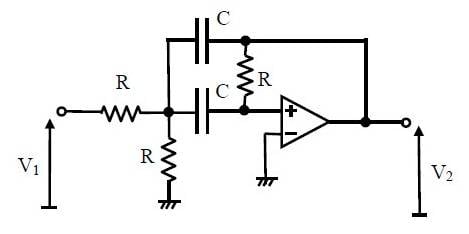
2ue1ds6.jpg


Its transfer function is given by: ##\frac{V_2}{V_1}=\frac{-\omega_0}{\sqrt{2}} \frac{s}{s^2+\sqrt{2} \omega_0 s + \omega_0^2}## where ##\omega_0 = \frac{\sqrt{2}}{RC}##

Calculate the gain (in dB) and phase shift of the filter at the corner frequency ##\omega_0##.

Solution:

##\frac{V_2}{V_1}(\omega_0) = - \frac{1}{RC} \frac{j \omega_0}{\sqrt{2} j \omega_0^2} = - \frac{-1}{RC} \frac{1}{\sqrt{2} \omega_0} = - \frac{1}{2}##

##\implies |\frac{V_2}{V_1} (\omega_0)| = 20 \log(1/2) = -6 \ dB##,

##phase |\frac{V_2}{V_1}(\omega_0)|= \pi##

So how did they work out the phase shift to be π?

The Attempt at a Solution


What formula have they used to find the phase shift? :confused:

I couldn't find any notes in my coursebook on finding phase shift once you have the gain. Any help or explanation is greatly appreciated.
 
Last edited:
Physics news on Phys.org
I'm a bit rusty but as I recall you..

1) Replace s with jω
2) Re-write the transfer function in the form Re(ω) + jIm(ω) where Re(ω) and Im(ω) are the real and imaginary parts.
3) The gain is Sqrt{Re(ω)2 + Im(ω)2}
4) The phase is Tan-1{Im(ω)/Re(ω)}
 
CWatters said:
I'm a bit rusty but as I recall you..

1) Replace s with jω
2) Re-write the transfer function in the form Re(ω) + jIm(ω) where Re(ω) and Im(ω) are the real and imaginary parts.
3) The gain is Sqrt{Re(ω)2 + Im(ω)2}
4) The phase is Tan-1{Im(ω)/Re(ω)}

Thank you for your input, but they ask for phase shift at the corner frequency ω0. At this frequency the transfer function reduces to ##-1/2##, the imaginary part is zero... so ##tan^{-1} (0)=0##. This is wrong.

Did you get ##\pi## using this method? :confused:

A textbook gives the formula:

##\phi_k = \frac{\pi}{n} \left( k- \frac{1}{2} \right)##

I've attached the formula page to this post. I'm not sure if this is the right formula, it is given for VCVS circuits (I'm not sure if it also holds for IGMF configurations).

I used the value ##n=1## (first order filter). If I use ##k=-1/2## I get ##\phi = - \pi##, and if I use ##k=n/2 = 1/2## I will get ##\phi = 0##. Is this the right equation to use, and what k should I be using?
 

Attachments

  • 2014-06-04 19.29.13.jpg
    2014-06-04 19.29.13.jpg
    22.2 KB · Views: 687
A pure inversion is a phase shift of 180°

For a bandass filter, ωo is normally referred to as the centre frequency, not the corner frequency.
 
NascentOxygen said:
A pure inversion is a phase shift of 180°

For a bandass filter, ωo is normally referred to as the centre frequency, not the corner frequency.

But what equation did they use to get the 180° in this problem? I'm a bit confused... once we have the gain from the transfer function at a particular frequency, what formula do we use to find the phase shift?
 
Think about the difference between a gain of +1/2 and -1/2. One has the input and output in phase, the other has them 180° out of phase.

The "formula" Tan-1{Im(ω)/Re(ω)} is a bit misleading, because for any given values of Im(ω) and Re(ω) it always gives you two possible answers, 180° apart. You need to draw a diagram to see which quadrant the angle is in, depending on whether Im(ω) and Re(ω) are positive or negative.
 
Yes, and this is what I've done:

First I've substituted the frequency of interest ω0 into the transfer function, and I've got a gain of +1/2. So Re(ω) is positive, whereas Im(ω)=0, right?

I used the tangent formula to find the phase shift:

##\phi=tan^{-1} (Im/Re) = tan^{-1} (0/(1/2))=0##

So why do I get the wrong answer?

We would always get ##\phi(0)=0°## and ##\phi(\infty)=90°## (or other values in other cases, etc).

So how can I possibly get -π using this formula when the imaginary part is 0? :confused:
 
roam said:
Yes, and this is what I've done:

First I've substituted the frequency of interest ω0 into the transfer function, and I've got a gain of +1/2.
The formula in your first post in this thread shows a gain of -1/2. So which is it??

tan 180 = 0
tan 0 = 0

So you need to look at the sign of the real component to see which side of the x-axis it lies.
 
  • Like
Likes   Reactions: 1 person
NascentOxygen said:
The formula in your first post in this thread shows a gain of -1/2. So which is it??

tan 180 = 0
tan 0 = 0

So you need to look at the sign of the real component to see which side of the x-axis it lies.

Thank you. Oops, sorry I meant -1/2. So basically every time the imaginary part is 0 and we have a negative or positive gain, the phase will be ##-180°## or ##180°## respectively? Is this right?

I'm still not 100% sure why the sign of gain determines the location of ##\phi## on the tangent graph.
 
  • #10
roam said:
Thank you. Oops, sorry I meant -1/2. So basically every time the imaginary part is 0 and we have a negative or positive gain, the phase will be ##-180°## or ##180°## respectively? Is this right?
No.

-180° and +180° are equivalent.

Negative gain at 0° is equivalent to positive gain with 180° phase shift. For a sinewave you'll see no difference between the two.
 
  • Like
Likes   Reactions: 1 person
  • #11
Using methods previously mentioned can get you the exact phase at any frequency. However there is an easy way to determine the approximately phases at different points.

A zero will always add a positive phase shift of 90 degrees.
A pole will always add a negative phase shift of 90 degrees.

The effect of the pole/zero on face begins 1 decade before the pole/zero, and ends 1 decade after the pole/zero.

if there is a pole/zero that is equal to zero, that is the phase of the system at DC.

So the circuit you posted has a zero at 0 and 2 poles at (1\pmj)*wo/sqrt(2)
that means the phase will start at 90. It will begin breaking about 1 decade before wo, and end breaking 1 decade after wo. each pole will effect the phase by 90 degrees, the the phase will be -90 1 decade after the break point
 
  • Like
Likes   Reactions: 1 person

Similar threads

  • · Replies 3 ·
Replies
3
Views
4K
  • · Replies 11 ·
Replies
11
Views
4K
Replies
30
Views
7K
  • · Replies 3 ·
Replies
3
Views
3K
  • · Replies 3 ·
Replies
3
Views
2K
Replies
1
Views
1K
  • · Replies 11 ·
Replies
11
Views
2K
  • · Replies 12 ·
Replies
12
Views
4K
Replies
13
Views
7K
  • · Replies 3 ·
Replies
3
Views
3K