Phase voltages in line-to-neutral fault

  • Thread starter Thread starter Frank Coutinho
  • Start date Start date
  • Tags Tags
    Fault Phase
Click For Summary
SUMMARY

The discussion focuses on understanding phase voltages during a line-to-ground (L-G) fault in a power system with a solidly grounded neutral. Specifically, it addresses the scenario where Phase B and C are open, and Phase A is shorted through zero impedance. Participants clarify that during such faults, the phase voltages do change due to the influence of zero-sequence and negative-sequence components generated by unbalanced currents in the generator. The conversation emphasizes the importance of considering voltage drops in zero-sequence impedances and the role of synchronous machines in generating these components.

PREREQUISITES
  • Understanding of symmetrical components in power systems
  • Knowledge of line-to-ground fault analysis
  • Familiarity with synchronous machine operation and characteristics
  • Basic principles of electrical impedance and voltage drops
NEXT STEPS
  • Study the application of symmetrical components in fault analysis
  • Learn about zero-sequence and negative-sequence voltage components
  • Investigate the effects of armature reaction in synchronous machines
  • Explore voltage drop calculations in zero-sequence impedances
USEFUL FOR

Electrical engineers, power system analysts, and students studying fault analysis and synchronous machine behavior will benefit from this discussion.

Frank Coutinho
Messages
4
Reaction score
0
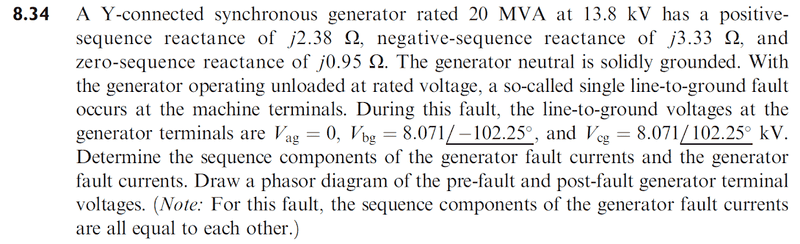
Hello, I'm a very slow learner! I try to understand every piece of the information that is given. And recently I was solving some problems involving symmetrical components and I couldn't figure this one out:
Haha.png


-The neutral is solidly grounded.
-Phase B and C are open.
-You're shorting Phase A trough a zero impedance.

My question is:

How the he$£ those phase voltages become that?

I mean, I would expect Phase A and B voltage (Vag, Vbg) to be equal to before the fault, since it is open circuit and the neutral is solidly grounded.

Plus, a zero-sequence and negative-sequence voltage components are present in that. Wasn't the generator suppose to only supply positive-sequence voltage?

Despite all that, I'm sure the exercise is correct, but I do not know why is that.

Hope you can help me :) !
 
Engineering news on Phys.org
What is normally neglected in the calculation is the current in the healthy phases, hence they are "open" compared to the faulty one. But I agree with you, the phase voltajes are the same (if neutral displacement, voltage drops by homopolar currents, and other phenomena are not considered).
 
Sadly, It is not what happen. I saw more exercises like this one (LN fault) and the phase voltages do change, a lot.
But still don't know why kkkkkkk.
Pretty interesting stuff.

If someone has any idea why, it would be very appreciated
 
In a L-G fault, when you apply the symmetrical components matrix to the calculation to get the voltages after the currents are calculated, they are affected by the SC in the other phase. One cause is the voltage drops in the zero sequence impedances which in normal balanced conditions have no current.
The synchronous machines have inverse and zero sequence, of the same magnitude order of the transient direct impedance. When there are unbalanced currents, it is the alternator which generates them, with an inverse and a zero sequence mmf in the airgap, thus with inverse and zero components in the electromotive force also.
 
xareu said:
In a L-G fault, when you apply the symmetrical components matrix to the calculation to get the voltages after the currents are calculated, they are affected by the SC in the other phase. One cause is the voltage drops in the zero sequence impedances which in normal balanced conditions have no current.
The synchronous machines have inverse and zero sequence, of the same magnitude order of the transient direct impedance. When there are unbalanced currents, it is the alternator which generates them, with an inverse and a zero sequence mmf in the airgap, thus with inverse and zero components in the electromotive force also.

Thanks a lot for your reply!

I think I understand what you are saying. So, you do have zero sequence and negative sequence voltages created by unbalanced currents in the generator? Is that right? And if yes, would you know how they actually create this voltages? You some things about the mmf in the airgap but I couldn't quite get that.

Thanks a lot
 
Well, as you have negative and zero sequences currents, you have negative and zero sequence voltages and armature reaction, thus mmf in the airgap and electromotive force
 
I recommend you the group Power System Analysis in Linkedin for more expertise than I have.
 

Similar threads

  • · Replies 1 ·
Replies
1
Views
3K
Replies
14
Views
5K
  • · Replies 3 ·
Replies
3
Views
3K
  • · Replies 10 ·
Replies
10
Views
5K
  • · Replies 1 ·
Replies
1
Views
2K
  • · Replies 4 ·
Replies
4
Views
3K
  • · Replies 1 ·
Replies
1
Views
2K
  • · Replies 9 ·
Replies
9
Views
5K
  • · Replies 17 ·
Replies
17
Views
3K
Replies
12
Views
5K