Photoelectric effect : retarding potential with back current

Click For Summary
SUMMARY

The discussion focuses on the determination of Planck's constant (h) using the photoelectric effect with LEDs of different frequencies (ν1 and ν2). The method proposed involves calculating the stopping potential (V0) where the total photocurrent is zero, using the equation h = e(V0_1 - V0_2) / (ν2 - ν1). However, the presence of dark current or back current complicates the results, as it can lead to negative photocurrent values. The validity of this method hinges on the assumption of a linear relationship between stopping potential and frequency, which cannot be confirmed with only two data points.

PREREQUISITES
  • Understanding of the photoelectric effect and its principles.
  • Familiarity with the concept of stopping potential in photoelectric experiments.
  • Knowledge of LEDs and their frequency characteristics.
  • Basic understanding of linear regression and data fitting techniques.
NEXT STEPS
  • Research the implications of dark current in photoelectric experiments.
  • Learn about linear regression methods to analyze experimental data.
  • Explore advanced techniques for measuring stopping potential in photoelectric setups.
  • Investigate the Einstein photoelectric effect equation and its applications in modern experiments.
USEFUL FOR

Physicists, experimental researchers, and students studying quantum mechanics or the photoelectric effect, particularly those involved in experimental design and data analysis.

crick
Messages
39
Reaction score
4
In the experiment of the determination of ##h## using the photoelectric effect produced by light emitted by led's there is the systematic problem of the "dark current" or "back current", i.e. the current caused by photoelectric effect on the anode of the system which is used in the expreriment.

This current is opposite to the "normal" photocurrent and its effect is to make the I-V curves not going but keep decreasing (slightly).
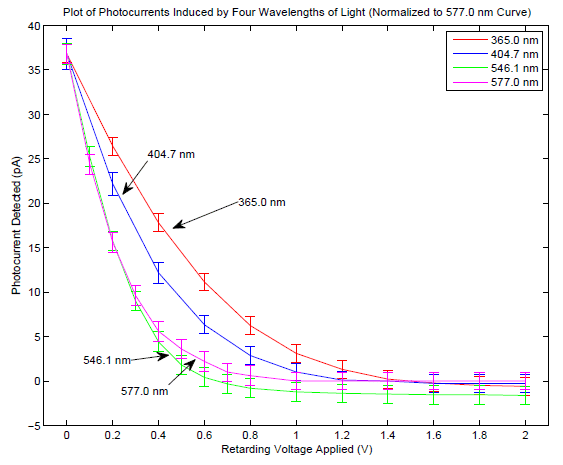
qfeg.png


Suppose that one wants to determine $h$ using two different led's of frequencies ##\nu_1## and ##\nu_2## using the following method (I know about other methods but I would like to know about this one).

Let's call ##V_{0_1}## and ##V_{0_2}## the values of ##V## where the (total) photocurrent is ##0## (for led ##1## and led ##2##). And suppose that the relation used is $$h=\frac{e(V_{0_1}-V_{0_2})}{(\nu_2-\nu_1)} \tag{1}$$

(work function is not involved at all)

My question is: under what theoretical assymptions and explanations is ##(1)## suitable to calculate ##h## (i.e. when to determine ##V_0##, even if current does not go asymptitically to zero but becomes negative, is still a good method to determine $h$ using ##(1)##)?

My guess is that this is a "good" method only if ##V_0##Vis such that it "brakes" all the electrons always in the same way, i.e. it makes them reach the same kinetic energy, for any frequency ##\nu## that is being used.

But how is this confermed/denied theoretically?
 
Physics news on Phys.org
crick said:
In the experiment of the determination of ##h## using the photoelectric effect produced by light emitted by led's there is the systematic problem of the "dark current" or "back current", i.e. the current caused by photoelectric effect on the anode of the system which is used in the expreriment.

This current is opposite to the "normal" photocurrent and its effect is to make the I-V curves not going but keep decreasing (slightly).
View attachment 200294

Suppose that one wants to determine $h$ using two different led's of frequencies ##\nu_1## and ##\nu_2## using the following method (I know about other methods but I would like to know about this one).

Let's call ##V_{0_1}## and ##V_{0_2}## the values of ##V## where the (total) photocurrent is ##0## (for led ##1## and led ##2##). And suppose that the relation used is $$h=\frac{e(V_{0_1}-V_{0_2})}{(\nu_2-\nu_1)} \tag{1}$$

(work function is not involved at all)

My question is: under what theoretical assymptions and explanations is ##(1)## suitable to calculate ##h## (i.e. when to determine ##V_0##, even if current does not go asymptitically to zero but becomes negative, is still a good method to determine $h$ using ##(1)##)?

My guess is that this is a "good" method only if ##V_0##Vis such that it "brakes" all the electrons always in the same way, i.e. it makes them reach the same kinetic energy, for any frequency ##\nu## that is being used.

But how is this confermed/denied theoretically?

Please note that for Eq. 1 to be valid, you must have a linear relationship between the stopping potential and frequency. That equation is nothing more than calculating the slope of V vs frequency.

Unfortunately, since you only have two data points, there is no way for you to verify if this relationship is valid. It is valid "on paper" per the Einstein's photoelectric effect equation, but it is not known if it is valid in your experiment due to the inadvertent photoemission off the anode. And as far as experimental methodology goes, it is a BAD experiment to only collect two data points.

I do not know to what extent the negative value of the stopping potential will affect the result. If you can show, with more data, that what you have can be represented by a linear fit, then the negative potential will not matter since all you care about is the slope of this line.

Zz.
 

Similar threads

  • · Replies 16 ·
Replies
16
Views
3K
  • · Replies 12 ·
Replies
12
Views
2K
  • · Replies 4 ·
Replies
4
Views
2K
  • · Replies 1 ·
Replies
1
Views
3K
  • · Replies 2 ·
Replies
2
Views
10K
  • · Replies 1 ·
Replies
1
Views
2K
  • · Replies 7 ·
Replies
7
Views
5K
Replies
3
Views
3K
  • · Replies 11 ·
Replies
11
Views
2K
  • · Replies 2 ·
Replies
2
Views
2K