Physical pendulum: frequency of rotated square

Join the discussion
Registration is free. Ask a follow-up in this thread, or start your own.
22 replies · 24K views
emr13
Messages
33
Reaction score
0
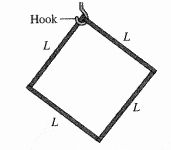
1. A square object of mass m is constructed of four identical uniform thin sticks, each of length L, attached together. This object is hung on a hook at its upper corner. If it is rotated slightly and then released, at what frequency will it swing back and forth?
hooksquare.gif


Homework Equations


frequency of a physical pendulum:

Untitled1.png


parallel-axis theorem:

I=Icm+MD2

The Attempt at a Solution


Each thin stick has an I of (1/12)ML2. There are four of them, and the distance from the center of mass of each rod to the center of the square is L/2 so the I for the square (using parallel-axis theorem) is I=(4)((1/12)mL2)+m(L/2)2

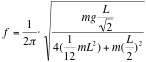
Then plug it into the frequency equation...d here is from the axis of rotation to the center of mass, so L/sqrt(2)
Untitled2.png


Simplified a little:

Untitled3.png


Is this right at all? Thanks.
 
Physics news on Phys.org
I guess it should be the point of support...
 
so Icm=(4)((1/12)mL2)+m(L/2)2

which simplifies to (7/12)mL2.

Then the "new" I would be

I=(7/12)mL2 + m(L/sqrt(2))2 ?
 
m/4...which m is that though? My first thought is that it's the first one in the "old" inertia equation...is that the only one I would need to switch? Because the others reflect the mass of the entire object, and I'm pretty sure they're correct.
 
emr13 said:
m/4...which m is that though? My first thought is that it's the first one in the "old" inertia equation...is that the only one I would need to switch? Because the others reflect the mass of the entire object, and I'm pretty sure they're correct.
Pretend that each arm has mass m,i.e. symbol "m" stands for the "mass of one side", then find the moment of inertia of the square about its CM correctly. (It is not (7/12)mL2)
Use the parallel axis theorem consistently (i.e. pretend that the square's mass is 4m) to find Isupport. Having done that, divide all occurrences of m by 4 to take into account the fact that each side does not have mass m but m/4.
 
It would be a bit simpler to derive the moment of inertia directly from its definition.

[tex]I = \int{\rho s^2 dl}[/tex]

where q is the density of the rods, and s is the distance of a small piece of length dl from the axis and the integration goes around the rectengular frame.

ehild
 
I am really confused now. I thought in the parallel axis theorem, m was supposed to be the entire mass of the object...I understand that each stick is m/4, but after that, you've lost me.

And my professor isn't big on calculus, so I don't think I'm supposed to integrate anything...
 
emr13 said:
I am really confused now. I thought in the parallel axis theorem, m was supposed to be the entire mass of the object...I understand that each stick is m/4, but after that, you've lost me.

And my professor isn't big on calculus, so I don't think I'm supposed to integrate anything...
Then follow my suggestion. It completes what you started, but correctly, so it should be easy for you to finish.
 
Okay, trying again:

Icm=4(1/12)(m/4)(L2)+(m/4)(L/2)2
Icm=(7/48)mL2

then

Isupport=(7/48)mL2+4m(L/sqrt(2))2
Isupport=(103/48)mL2

then divide m by 4 so

Isupport=(103/192)mL2

But that seems weird...so another way:

Icm=4(1/12)(m/4)(L2)+(4m)(L/2)2
Icm=(13/12)mL2

then

Isupport=(13/12)mL2+4m(L/sqrt(2))2
Isupport=(37/12)mL2

then divide m by 4 so

Isupport=(37/48)mL2

Are either of those correct?
 
Where do you get the 7?

Icm=(4)(1/12)(m/4)(L2)+(m/4)(L/2)2
=(1/3)(m/4)(L2)+(m/4)(L2)(1/4)
=(1/12)mL2+(1/16)mL2
=(16/192)mL2+(12/192)mL2
=(28/192)mL2
=(7/48)mL2
 
So I=(1/3)mL^2

Then Isupport is (partially simplified)

(1/3)mL^2 + 2mL^2
=(7/3)mL^2

Then if I divide that by 4, it's (7/12)mL^2...
 
emr13 said:
So I=(1/3)mL^2
That is correct.

Then Isupport is (partially simplified)
(1/3)mL^2 + 2mL^2
=(7/3)mL^2
I don't think so. Please show me exactly how you got this result.
Then if I divide that by 4, it's (7/12)mL^2...
Why would you do that? One more time, when you write

ICM=4*[(1/12)(m/4)(L2)+(m/4)(L/2)2],

the symbol "m" stands for the mass of the four sides combined. Each side has mass m/4, that's why m/4 appears in the above expression. The overall factor of 4 is there because you have four sides to the square. In other words,

ICM = 4*(Iof one side about the center of the square).
 
Last edited:
I don't know why I divided by four...thanks for being so patient with me.

The Isupport I did before is wrong (found a mistake in my work) so

Trying again:
Isupport= (1/3mL^2) + m(L/sqrt(2))^2
= 5/6mL^2
 
Okay. and then I just plug that into the frequency equation:

Untitled8.png
 
Okay. Thank you so much for all your help!
 
I={(1/12)mL^2}+{m(L^2)/4}=(mL^2)/3
then you should multiply it by 4 so:

I=(4/3)*(mL^2) this is for the center of mass of the square and for the support you should just add 4m{(L/2)sqrt(2)}^2