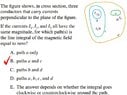
Physics-Anybody explain why B is correct?

  • Context:
  • Thread starter Thread starter yakin
  • Start date Start date
  • Tags Tags
    Explain
Join the discussion
Registration is free. Ask a follow-up in this thread, or start your own.
6 replies · 2K views
yakin
Messages
42
Reaction score
0

Attachments

  • Capture.JPG
    Capture.JPG
    61.2 KB · Views: 122
Mathematics news on Phys.org
I don't remember exactly, but I think there was law regarding the sum of currents inside a closed loop. If it sums zero, then the magnetic field was zero. Note that the sum has tobe zero. If you have many currents coming in and many others coming out such that their sum is zero, even with different magnitudes, then the total magnetic field will be zero.

I hope one of the http://mathhelpboards.com/members/ackbach/ http://mathhelpboards.com/members/i-like-serena/ http://mathhelpboards.com/members/supersonic4/ with a more detailed explanation.

Best wishes :).
 
I hope too, thanks though!
Yakin

P.S: By the way, anyone knows how this "reply with quote" option works bcos everytime i try to do that i get "message is too short" box.
 
Yes, this is the integral version of the static electric field version of Ampere's Law:
$$\oint \mathbf{B} \cdot d \mathbf{l}= \mu_{0} I_{ \text{enc}}.$$
In words, the line integral of the magnetic field around a closed loop is equal to the permeability of free space times the enclosed current. By "enclosed current", we mean the total current enclosed by the closed loop of the line integral. This law invites us to dream up what Griffiths calls an "Amperian Loop", quite analogous to a "Gaussian surface". The loop does not have to correspond to any physical object - it just needs to be closed (and there probably are some regularity conditions that those pesky mathematicians want to impose, hehe).

Note that Gauss's Law is to electrostatics what Ampere's Law is to magnetism: if you have sufficient symmetry, Ampere's Law provides by far the easiest way to compute the magnetic field. If you don't have sufficient symmetry, you have to fall back on the Law of Biot and Savart, just as when you don't have sufficient symmetry to use Gauss's Law, you have to fall back on the more direct methods for finding the electric field.

In practice, Ampere's Law is useful for four basic kinds of current distributions: straight wire, infinite sheet of current, solenoid, and toroidal solenoid.
 
yakin said:
I hope too, thanks though!
Yakin

P.S: By the way, anyone knows how this "reply with quote" option works bcos everytime i try to do that i get "message is too short" box.

Normally, when you use the "reply with quote" option, you get the usual editing box, with the quoted post's text in quote BBCodes. I'm doing it now, in fact. Do you get this message right when you click the button, or when you click "Submit Reply"?
 
This is what i get when try to use option "Reply with quote" and i get this message when i click on "submit"
Refer to pic to what i get.

View attachment 2281
 

Attachments

  • Capture.JPG
    Capture.JPG
    76.6 KB · Views: 91
yakin said:
This is what i get when try to use option "Reply with quote" and i get this message when i click on "submit"
Refer to pic to what i get.

View attachment 2281

The reason it's doing that is because you haven't entered any text of your own. Everything there is in quotes, which doesn't count towards the minimum 3 original characters per post. Try typing at least three characters outside any quotes.