Physics Experiment: Jerk & Inertia | Solving for dA/dt

Click For Summary
SUMMARY

The discussion focuses on a physics experiment demonstrating the effects of jerk and inertia using two strings under tension. The experiment illustrates that a gradual pull on the top string results in its breakage, while a sudden jerk causes the bottom string to break. The user seeks to incorporate the rate of change of acceleration (jerk) into the equations governing the system, specifically using tension models and elasticity equations. Key equations include the tension in the top string modeled as T2 = k(x - L) and the mass dynamics expressed as M g + T1 - T2 = M d²x/dt².

PREREQUISITES
  • Understanding of Newton's laws of motion
  • Familiarity with free body diagrams
  • Knowledge of tension and elasticity equations
  • Basic calculus for solving differential equations
NEXT STEPS
  • Study the application of delta functions in physics, particularly in tension modeling
  • Learn about simple harmonic motion and its mathematical representation
  • Explore the concept of impulse and its effects on mass dynamics
  • Investigate advanced elasticity theories relevant to string tension
USEFUL FOR

Physics students, educators, and anyone interested in the dynamics of tension and inertia in mechanical systems will benefit from this discussion.

Pax
Messages
3
Reaction score
1
There is this experiment my high school teacher showed in physics class. You are probably aware of it
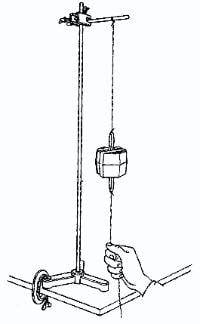
More%20inertia%20experiments2_720.jpg
(from practicalphysics.org)

There is a video of a teacher actually doing the experiment here:
https://sites.google.com/site/haatscience/physics/221-the-effect-of-inertia

Gradually pull the thread and the top thread breaks, jerk the thread and the bottom one breaks.

I tried to set up a free body diagram to show how this works, and most specifically to solve for the rate of change of acceleration (jerk) that will be the threshold between the top string breaking and the bottom.

I am at a loss, how do you put dA/dt into the equations?

Any ideas?
 

Attachments

  • More%20inertia%20experiments2_720.jpg
    More%20inertia%20experiments2_720.jpg
    7.3 KB · Views: 900
  • Like
Likes   Reactions: FactChecker
Physics news on Phys.org
This one seems to be an experiment where you could model it as a tension that is applied. With a sudden jerk, the tension in the bottom string could be modeled as a delta function: ## T_1(t)=T_{10} \delta (t) ##. Because much of this is absorbed by the acceleration of the mass, the tension in the top string ## T_2 ## never reaches anywhere near the large value, basically infinite, of the ## T_1(t) ## with its delta function. ## \\ ## (In principle, you could limit ## T_1(t) ## to a finite value, by using some other function with characteristics similar to a delta function. For what gets transferred to the mass with a quick jerk, it is basically the impulse which is the integral ## I=\int T_1(t) \, dt ##).## \\ ## Meanwhile, elasticity equations are needed for the top string: ## T_2=k (x-L) ## where ## x ## is the position of the mass ## M ## (with origin ## x=0 ## at the top position of the attachment of the string), and ## L ## is the length of the string with no mass attached. ## \\ ## The mass ## M ## has ## Mg+T_ 1-T_2=M \ddot{x}=Mg+T_{10} \delta(t)-k(x-L) ## , with initial conditions that ## Mg= k(x_o-L) ##. ## \\ ## You can solve for ## x(t) ## , and then for ## T_2(t)=k(x-L) ##. ## \\ ## Anyway, I haven't solved these equations, but I think they would give the necessary result. ## \\ ## Edit, along with a correction to my first attempt at a solution here: ## \\ ## I get for ## t \leq 0 ##, that ## x(t)= \frac{Mg}{k}+L##, and ## T_2(t)=Mg ## , ## \\ ## and for ## t>0 ##, an impulse has been added to the mass ## M ##, giving it an initial velocity, but no immediate change in position occurs. After that mass ## M ## performs simple harmonic motion with this energy that it has acquired. You can compute the maximum ## x ## that occurs in the simple harmonic motion, and thereby compute ## T_{2 \, max}=k (x_{max}-L) ##. I get, with a quick calculation, that the simple harmonic motion (at frequency ## \omega=\sqrt{\frac{k}{M}} ## ) has amplitude ## \frac{T_{10}}{\sqrt{kM}} ##, so that ## \\ ## ## x_{max}-L=\frac{T_{10}}{\sqrt{kM}} +\frac{Mg}{k} ##, and that ## T_{2 \, max}=T_{10} \sqrt{ \frac{k}{M}}+Mg ##. ## \\ ## For most cases, with a quick jerk, ## T_{2 \, max} <<T_{1 \, max} ##. ## \\ ## Meanwhile, with a steady pull on ## T_1 ## the tension ## T_2=T_1+Mg ##, and ## T_2 ## (the tension in the upper string) is larger and the upper string breaks.
 
Last edited:

Similar threads

  • · Replies 5 ·
Replies
5
Views
3K
  • · Replies 30 ·
2
Replies
30
Views
9K
  • · Replies 4 ·
Replies
4
Views
2K
  • · Replies 1 ·
Replies
1
Views
2K
  • · Replies 27 ·
Replies
27
Views
11K
  • · Replies 2 ·
Replies
2
Views
3K
  • · Replies 2 ·
Replies
2
Views
3K
  • · Replies 5 ·
Replies
5
Views
5K
  • · Replies 2 ·
Replies
2
Views
4K
  • · Replies 4 ·
Replies
4
Views
9K