PIN photodiode forward bias capacitance

Click For Summary
SUMMARY

The discussion centers on the capacitance behavior of a photovoltaic PIN photodiode when forward biased. Participants clarify that forward biasing reduces the depletion width, leading to negligible capacitance, as the device behaves more like a conductor than a capacitor. The conversation highlights the importance of understanding the operational characteristics of PIN photodiodes, particularly in applications requiring oscillation at frequencies around 100 kHz. Participants suggest measuring time constants with resistors and oscilloscopes to gain insights into capacitance effects.

PREREQUISITES
  • Understanding of PIN photodiode operation and characteristics
  • Familiarity with forward and reverse biasing concepts
  • Knowledge of capacitance in semiconductor devices
  • Experience with circuit design and analysis, particularly in oscillators
NEXT STEPS
  • Research the capacitance behavior of PIN photodiodes under various bias conditions
  • Learn about the impact of depletion width on capacitance in semiconductor devices
  • Investigate analytical models for capacitance in forward-biased diodes
  • Explore practical measurement techniques for capacitance using oscilloscopes
USEFUL FOR

Electrical engineers, circuit designers, and researchers working with photodiodes, particularly those focused on high-frequency applications and capacitance effects in semiconductor devices.

decaf14
Messages
23
Reaction score
7
TL;DR
Calculate the capacitance of a PIN photodiode in the forward bias region
Hello!

I've done tons of research on a problem and can't seem to figure something out. I'm looking at operating a photovoltaic PIN photodiode. Since it's operating in photovoltaic mode, it will produce a current when light hits it, and this will produce a forward voltage.

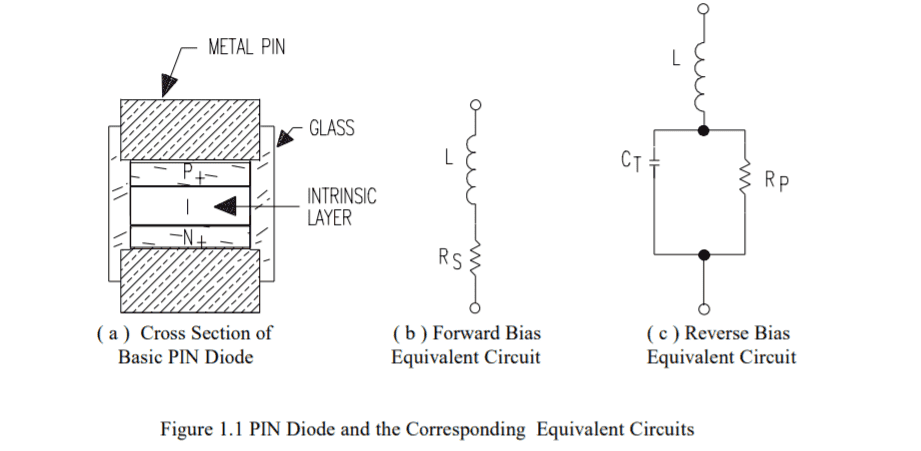
I've researched models of PIN photodiodes, and the forward-bias model seems to simply be an inductor and resistor in series. The reverse-bias model includes a capacitance. See below.
245459

What I cannot wrap my head around is why there is no capacitance (negligible) when the PIN device is forward biased. I would think that forward biasing the device reduces the depletion width, thereby increasing capacitance. In a pn junction device, there is an equation relating forward voltage bias to capacitance caused by diffusion.

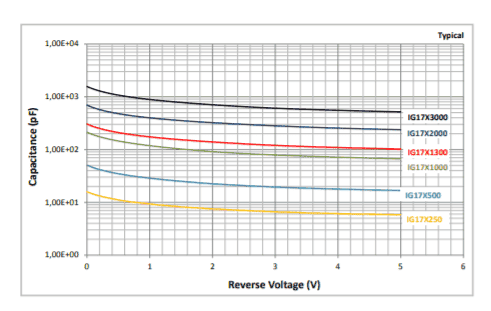
What's even more confusing is that following the trend of PIN photodiodes in datasheets, capacitance INCREASES as reverse voltage bias is decreased. I would think that this trend would continue into forward bias, but I cannot find any datasheets describing this. See below datasheet for an InGaAs PIN photodiode.
245460


I must be wrong, but I cannot figure out why. I would greatly appreciate any help.
 
Engineering news on Phys.org
decaf14 said:
Summary: Calculate the capacitance of a PIN photodiode in the forward bias region

What I cannot wrap my head around is why there is no capacitance (negligible) when the PIN device is forward biased.
Yeah, that sounds wrong. We reverse bias PIN photodiode detectors to minimize their capacitance to increase their bandwidth. I'll look more at your post...
 
berkeman said:
Yeah, that sounds wrong. We reverse bias PIN photodiode detectors to minimize their capacitance to increase their bandwidth. I'll look more at your post...
I think when it is forward biased the low effective resistance swamps any concerns about capacitance. Or am I mis-remembering?. What you say about reverse bias is certainly true.
 
  • Like
Likes   Reactions: berkeman
Tom.G said:
Forward bias, conducting, reduces the depletion width towards zero... making more of a conductor, not a capacitor.

See:
https://www.microsemi.com/document-portal/doc_download/134814-micronote-701-pin-diode-fundamentals

Thanks for your response. This makes good sense, but I'm confused on why we can no longer use a parallel plate model to model capacitance as is done in reverse bias. If the depletion width gets smaller, shouldn't the capacitance get larger according to the parralel plate model because the area is shrinking? We see this effect in pn junction diodes below.
245487
 
Alternatively, if anyone has any good texts to learn more about PIN devices, that would be great. I have scoured Sedra and Smiths microelectronic circuits, Chaung's optoelectronics, and Streetman's Solid State Devices. None of them have the information I'm interested in.
 
decaf14 said:
Alternatively, if anyone has any good texts to learn more about PIN devices, that would be great. I have scoured Sedra and Smiths microelectronic circuits, Chaung's optoelectronics, and Streetman's Solid State Devices. None of them have the information I'm interested in.
What are you trying to do with photodiodes and in particular why do you care about the forward bias capacitance? I can't see an application where it would matter. I think it is not reported because there are recombination times that get in the way when you switch at all fast in photovoltaic. All of the "go- fast" applications I have designed are photoconductive.
I fear what I know about these devices has came from colleagues and app notes I will look to see if there is a good treatment somewhere. I remember one from Siemens...
 
That would be great!

I'm trying to use a photovoltaic to power a oscillator operating around 100 kHz, so the capacitance is critical. The oscillator is confirmed working at the voltage and current that the photovoltaic can produce (but powered from a DC power supply). However, the circuit will not oscillate when attached to the photovoltaic which makes me think that capacative effects are at play.
 
The DC level doesn't sag on DVM under load.? Do you have an Oscilloscope to look at the supply voltage under load?
 
  • #10
decaf14 said:
I'm trying to use a photovoltaic to power a oscillator operating around 100 kHz, so the capacitance is critical.
A PIN diode usually has a very small area so generates low current and switches fast.
What is the part number of the diode you are using?
Is there a circuit diagram of your circuit.
Why not place a capacitor across the photodiode to increase supply capacitance.
 
  • #11
decaf14 said:
That would be great!

I'm trying to use a photovoltaic to power a oscillator operating around 100 kHz, so the capacitance is critical. The oscillator is confirmed working at the voltage and current that the photovoltaic can produce (but powered from a DC power supply). However, the circuit will not oscillate when attached to the photovoltaic which makes me think that capacative effects are at play.
The PV capacitance is irrelevant—in fact, it’s a good idea to put a large capacitance across it to filter out noise. It’s more likely that you aren’t supplying enough current and/or voltage to power your oscillator. For that matter, replace it with solar cells.
 
  • Like
Likes   Reactions: Tom.G
  • #12
Thank you for all your responses! I really appreciate all the input.

I'm using a colleagues custom-fabricated pin diode, so there is no part number, but I have all of the design considerations like doping/lengths/areas/materials. That's why I'm hunting for an analytical equation. Naturally, I have discussed this with him and he is puzzled as well. I'm not a solid state device designer by profession, so this is all very new to me.

We are operating the photodiode not in full-throttle forward bias , but in the low-current area of a diode I-V curve where it's forward-biased but not conducting fully, so I don't think capacitance would be negligible. I also don't understand why it wouldn't be negligible even if it was fully conducting.

The area of our diode is indeed very small, but obtaining oscillations around ~100 kHz requires small capacitors. I could use a smaller resistor, but this would request more current than the photodiode could provide. Like every circuit design, it's a large balancing act, and I want to determine exactly where the "balance point" is. I think it hinges on the capacitance, but I've been wrong many times before...

I am worried that attaching a filtering capacitor would add a large capacitance in parallel with the oscillator. This would increase oscillation period, which is undesirable. In the circuit diagram below, you can see that the load acts in parallel with the current from the photo diode. It seems like a capacitance also acts in parallel, but can be negligible.
245528


Ultimately, this is an easy thing to measure. I will place a large resistor in parallel with the photodiode, and measures it's time constant on an oscilloscope in response to an optical pulse. I can calculate capacitance from that. I can use multiple resistors to ensure that the relationship is linear as expected. I'd still like an analytical model of it so I can increase my understanding of the topic and have something to back my measurements up, though.

I will report back and let everyone know what I discovered. In the meantime, thank you again for your input. I'm still open to suggestion for literature reading on PIN diodes.
 

Attachments

  • 1561225477220.png
    1561225477220.png
    7.7 KB · Views: 381
  • #13
1. The schematic you provide shows a symbolic model of a forward biased PV diode. Is RLoad in your circuit where you connect the oscillator module ?

2. Is the frequency of the oscillator module fixed, or is it supply current dependent? A fixed frequency oscillator takes Q cycles of time to begin oscillating. We need to know Q.

3. What output voltage is expected from the PV module? Are there many PV diodes in series, or is there only a very low voltage available to run the oscillator module. I would like to know how the oscillator module can operate on such a low supply voltage. I suspect it would need to be some form of tunnel diode oscillator.

4. The supply current requirement for an oscillator is time dependent and repeats every cycle. I assume the current you measure when testing the oscillator on a fixed supply voltage, is the average over a full cycle. An oscillator that runs on a low impedance fixed supply voltage may not operate when connected to a high impedance current source, as it may short circuit itself once every cycle.
A schematic for the oscillator module is needed before it can be simulated as a load being supplied with current from a photodiode.
There may be some possible modification to the oscillator circuit that will allow it to operate from the high impedance PV diode without a long start delay.

5. If you asked the right question, you could answer it. Without an oscillator schematic we cannot identify the question you should have asked.
 

Similar threads

Replies
8
Views
6K
Replies
3
Views
2K
  • · Replies 7 ·
Replies
7
Views
3K
  • · Replies 1 ·
Replies
1
Views
3K
  • · Replies 1 ·
Replies
1
Views
2K
  • · Replies 4 ·
Replies
4
Views
4K
Replies
7
Views
3K
Replies
16
Views
10K
  • · Replies 4 ·
Replies
4
Views
2K
  • · Replies 3 ·
Replies
3
Views
3K