Plate with hole, mechanics problem

Click For Summary
SUMMARY

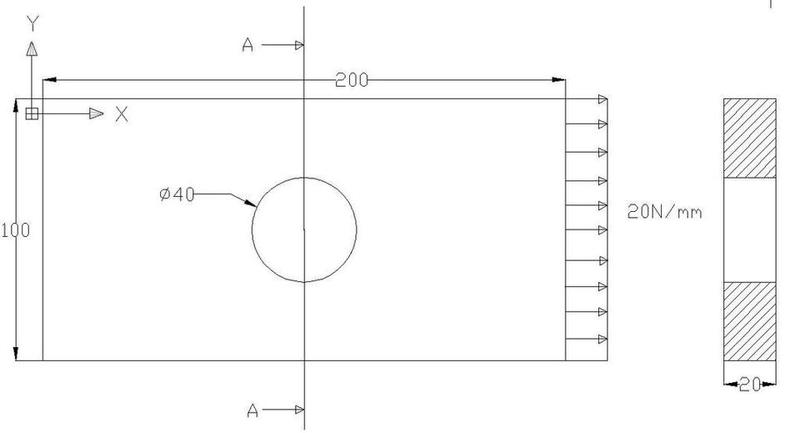
The discussion focuses on calculating the maximum stress in a plate with a hole, specifically at the top and bottom of the hole. The average tensile stress in section A is calculated as 1.67 N/mm² using the formula sigma = F/A, where F is the force of 2000N and A is the area adjusted for the hole dimensions. A critical point raised is the need to include the stress concentration factor, which depends on the plate width and hole diameter, to determine the peak stress accurately.

PREREQUISITES
  • Understanding of tensile stress calculations
  • Knowledge of stress concentration factors
  • Familiarity with mechanics of materials
  • Ability to perform area calculations for irregular shapes
NEXT STEPS
  • Research stress concentration factors for circular holes in plates
  • Learn about finite element analysis (FEA) for stress distribution
  • Study the effects of boundary conditions on stress calculations
  • Explore advanced mechanics of materials textbooks for in-depth examples
USEFUL FOR

Mechanical engineers, materials scientists, and students studying mechanics who are involved in stress analysis and design of structural components.

Dafe
Messages
144
Reaction score
0
Hey, I'm trying to solve a little mechanics problem and I'm stuck.
PlateWithHole.jpg


I want to find the maximum stress in the system. I know that it should be at the top and bottom of the hole. The plate is fully constrained at the left edge.

I find the average tensile stress in section A:

sigma = F/A = 2000N/(100-40)*2 = 1,67N/mm^2

I also know that the stress distribution in section A is not even.

Could someone give me a little hint?
Thanks
 
Engineering news on Phys.org
You're missing a 0 on the thickness for the area calculation. Once that is taken care of, you need the stress concentration factor that will be a function of the width of the plate and the hole diameter. That will multiply the average stress to get your peak stress.
 
I have encountered a vertically oriented hydraulic cylinder that is designed to actuate and slice heavy cabling into sections with a blade. The cylinder is quite small (around 1.5 inches in diameter) and has an equally small stroke. The cylinder is single acting (i.e. it is pressurized from the bottom, and vented to atmosphere with a spring return, roughly 200lbs of force on the spring). The system operates at roughly 2500 psi. Interestingly, the cylinder has a pin that passes through its...

Similar threads

Replies
8
Views
6K
Replies
10
Views
3K
  • · Replies 4 ·
Replies
4
Views
2K
  • · Replies 2 ·
Replies
2
Views
3K
  • · Replies 6 ·
Replies
6
Views
4K
Replies
8
Views
11K
Replies
3
Views
2K
  • · Replies 4 ·
Replies
4
Views
7K
  • · Replies 3 ·
Replies
3
Views
3K
  • · Replies 7 ·
Replies
7
Views
5K