Please teach me about the mass of Sgr A*

  • Context: Undergrad 
  • Thread starter Thread starter arcTomato
  • Start date Start date
  • Tags Tags
    Mass
Click For Summary
SUMMARY

The discussion centers on calculating the mass of the supermassive black hole Sgr A* using the orbital dynamics of the star S2. Participants explain that the ratio of the orbital velocities of S2 and Sgr A* is inversely proportional to their masses, allowing for mass estimation based on observed velocities. The measured velocity of Sgr A* is approximately 0.4 ± 0.9 km/s, which is uncertain but provides a basis for calculations. The conversation emphasizes the application of Kepler's laws and the conservation of angular momentum in determining these relationships.

PREREQUISITES
  • Understanding of Kepler's laws of planetary motion
  • Familiarity with the concept of center of mass in binary systems
  • Basic knowledge of orbital mechanics and velocity calculations
  • Awareness of stellar mass estimation techniques based on brightness
NEXT STEPS
  • Study the application of Kepler's laws to elliptical orbits
  • Learn about the conservation of angular momentum in astrophysical systems
  • Research methods for estimating stellar masses from luminosity
  • Explore the dynamics of binary star systems and their mass ratios
USEFUL FOR

Astronomers, astrophysics students, and anyone interested in the dynamics of black holes and stellar motion, particularly in the context of Sgr A* and its surrounding stars.

arcTomato
Messages
104
Reaction score
27
TL;DR
Please teach me about the mass of Sgr A*
Hello

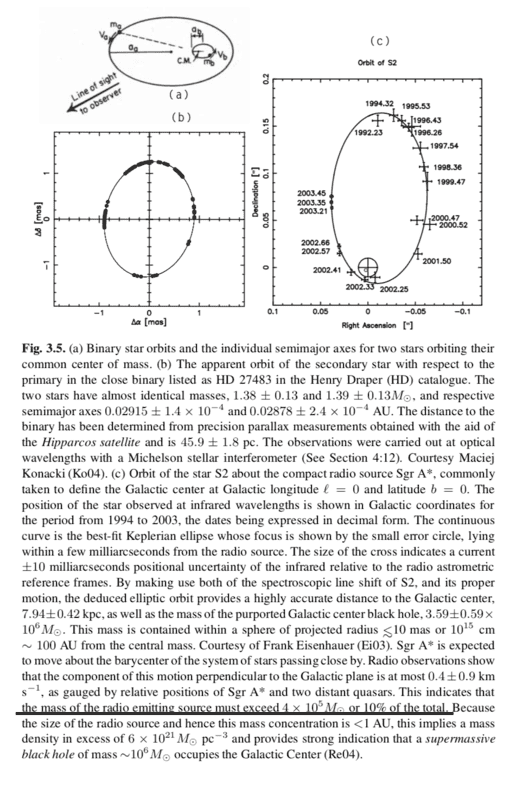
I have no idea why underline part of my pic says like that.
"Radio observations show that the component of this motion perpendicular to the Galactic plane is at most 0.4 ± 0.9 km s−1"
So What? Why this sentence shows the mass??
("The radio emitting source(underline part)" = Sgr A*?right??)

Sorry for my bad English. I'm grad if you teach me.
243817
 
Astronomy news on Phys.org
The star S2 and the radio source SgrA* are orbiting about their common center of mass. The ratio of their orbital velocities is inversely proportional to the ratio of their masses. In other words, the more massive one moves slower. We can see the motion of S2 so we know its orbital velocity about SgrA*. The radio observations put an upper limit on the speed of the orbital motion of SgrA*. We know (roughly) the mass of the star S2, so from the ratio of the orbital velocities we can put a lower limit on the mass of SgrA*. Does this make sense?
 
  • Like
Likes   Reactions: RayvenWolfe and arcTomato
Thanks for reply.

phyzguy said:
We can see the motion of S2 so we know its orbital velocity about SgrA*.

How can I calculate this??Law of angular momentum conservation and Law of energy conservation?

And Why dose orbital velocity connect the motion perpendicular to the Galactic plane ??
 
arcTomato said:
How dose it calculate??Law of angular momentum conservation and Law of energy conservation?
Are you asking how we calculate the velocity of S2? You can see its orbit, so you know the angular size of the orbit. You know how far away it is, so you can calculate the actual size of the orbit in km. You can see from the times how long it takes to orbit (about 20 years). So its a simple matter to calculate its orbital velocity. Is that your question?
 
  • Like
Likes   Reactions: arcTomato
??
I can't understand yet 😭
The velocity of S2 is not constant?right??

and how we know the mass of S2?
 
arcTomato said:
??
I can't understand yet 😭
The velocity of S2 is not constant?right??

and how we know the mass of S2?

I'm being approximate and trying to give you the idea of how it's done. Remember this is just an order-of-magnitude calculation, since the measured velocity of SgrA* was 0.4+/-0.9 km/s, and is very uncertain. If the orbit of S2 were circular, then the velocity would be constant. It's actually an ellipse, so the velocity varies, but from Kepler's second law this is easy to calculate. As for the mass, S2 is a star. We know the masses of stars and how the masses depend on how bright they are. We know how far away it is and we know how bright it is, so we know about how massive it is.
 
  • Like
Likes   Reactions: arcTomato
phyzguy said:
I'm being approximate and trying to give you the idea of how it's done. Remember this is just an order-of-magnitude calculation, since the measured velocity of SgrA* was 0.4+/-0.9 km/s, and is very uncertain. If the orbit of S2 were circular, then the velocity would be constant. It's actually an ellipse, so the velocity varies, but from Kepler's second law this is easy to calculate. As for the mass, S2 is a star. We know the masses of stars and how the masses depend on how bright they are. We know how far away it is and we know how bright it is, so we know about how massive it is.

Ok I think I can do this now, thanks for your kindness!
 
P.S.
Finally I can understand almost this sentence!
thank you!
But I do not know only one place that
phyzguy said:
The ratio of their orbital velocities is inversely proportional to the ratio of their masses. In other words, the more massive one moves slower.
.
How can I lead this ratio?
243829
EDIT: Someone who can teach me , PLEASE! 🙃
 
Last edited:
arcTomato said:
How can I lead this ratio?
Let's pretend that the orbital eccentricity is low, so we approximate the orbit as circular. Then, what is the relationship between the tangent (orbital) speed ##v## of an object, the radius of its orbit (semi-major axis) ##a## and its orbital period ##P##?
Once you figure this out for both objects and combine it with the fact that they are orbiting about their common center of mass, you will find what you are looking for.
Hint: Obviously, the more massive object must be closer to the center of mass of the binary system.
 
  • Like
Likes   Reactions: arcTomato
  • #10
Wow lomidrevo it's you!, thank you again!

lomidrevo said:
what is the relationship between the tangent (orbital) speed ##v## of an object, the radius of its orbit (semi-major axis) ##a## and its orbital period ##P##?
I think ##P=2πa/v##,and
243837

Is it right??

but this orbit is ellipse, Why this ratio still works?
 
  • #11
arcTomato said:
but this orbit is ellipse, Why this ratio still works?
This ratio is just saying that in the center of mass of the system the total momentum is zero, so p(sgrA*) = -p(S2).
 
  • Like
Likes   Reactions: arcTomato
  • #12
phyzguy said:
This ratio is just saying that in the center of mass of the system the total momentum is zero, so p(sgrA*) = -p(S2).
y I realize it now.
Thank you!
 
  • #13
arcTomato said:
Is it right??
perhaps it could be reduced to fewer steps, but the result is ok. E.g. the employment of the third Kepler's law would not be needed. Remember you want to find a ratio of velocities, so quantities like ##P## and ##a## cancel out.
Anyway, the argument provided by @phyzguy is far more elegant and generalizes to eccentric orbits as well.
 
  • Like
Likes   Reactions: arcTomato
  • #14
OK, Thank you so much @lomidrevo and @phyzguy.
Your explanation are so easy to understand.
 
  • Like
Likes   Reactions: RayvenWolfe

Similar threads

  • · Replies 48 ·
2
Replies
48
Views
6K
  • · Replies 25 ·
Replies
25
Views
2K
  • · Replies 86 ·
3
Replies
86
Views
8K
  • · Replies 6 ·
Replies
6
Views
915
Replies
2
Views
720
  • · Replies 4 ·
Replies
4
Views
2K
  • · Replies 27 ·
Replies
27
Views
5K
  • · Replies 10 ·
Replies
10
Views
4K
  • · Replies 8 ·
Replies
8
Views
948
  • · Replies 14 ·
Replies
14
Views
2K