Happiness
- 686
- 30
Consider a circle rotating about a point X on its circumference at ##\omega = 2## rad/s. That means all points on and in the circle rotate at the same ##\omega = 2## rad/s.
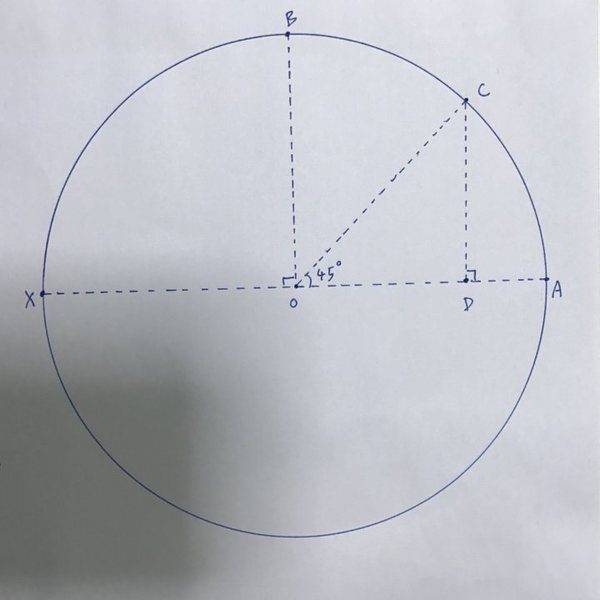
What are the angular velocities of various different points, say points A, B and C, with respect to the centre O of the circle? At first thought, different points with the same ##\omega## with respect to point X should probably have different ##\omega##'s (from one another) with respect to a different point O, because if those points are rotating in sync about point X, they may not necessarily be rotating in sync about point O. But to my surprise, they do have the same ##\omega## and worse, their ##\omega## is still ##2## rad/s!
Why so? Any mathematical proof or intuitive explanations?
Some notes on my calculations:
To calculate the ##\omega## of a point A relative to point O, I take the velocity of A relative to that of O divided by the distance between A and O.
I also calculated the ##\omega##'s of points A, B and C relative to point D. They are equal to ##2## rad/s too!
What are the angular velocities of various different points, say points A, B and C, with respect to the centre O of the circle? At first thought, different points with the same ##\omega## with respect to point X should probably have different ##\omega##'s (from one another) with respect to a different point O, because if those points are rotating in sync about point X, they may not necessarily be rotating in sync about point O. But to my surprise, they do have the same ##\omega## and worse, their ##\omega## is still ##2## rad/s!
Why so? Any mathematical proof or intuitive explanations?
Some notes on my calculations:
To calculate the ##\omega## of a point A relative to point O, I take the velocity of A relative to that of O divided by the distance between A and O.
I also calculated the ##\omega##'s of points A, B and C relative to point D. They are equal to ##2## rad/s too!
Last edited: