MHB Polar Graphs and a question about their poles

Click For Summary
In polar graphs, the pole is the origin, and the maximum and minimum values of r are determined based on the function's characteristics. For limacons without an inner loop, the max and min values can be the same, while for those with loops, they differ. Evaluating cosine functions at 0 and π gives the max and min, while sine functions are evaluated at π/2 and 3π/2. The discussion also touches on specific examples, clarifying that for a cardioid, the max is 2 and the min is 0. Understanding these evaluations helps in accurately determining the properties of polar graphs.
m3dicat3d
Messages
19
Reaction score
0
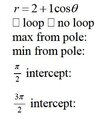
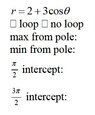
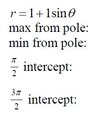
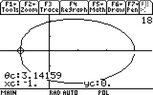
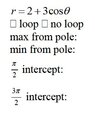
Trying to help someone out with their assignments on basic polar graphs. This first question is very easy to determine the poles from as the limacon has an inner loop.

View attachment 829

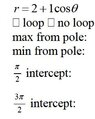
But when you have a limacon WITHOUT (below) an inner loop, how does the "max from pole" and "min from pole" figure? It's been years since I've done this, but my gut is saying it has simply one pole, and the "max" and "min" are the same. For example:

View attachment 830

So in the case of the above problem, wouldn't bot "max" and "min be 4?

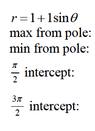
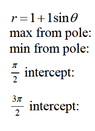
And if this is case, would you handle a cardioid the same way, for instance:

View attachment 831
Would this have both "max" and "min" as 2?

Thanks again :)
 

Attachments

  • limacon.JPG
    limacon.JPG
    10.6 KB · Views: 90
  • limacon no loop.JPG
    limacon no loop.JPG
    10.7 KB · Views: 82
  • Cardioid.PNG
    Cardioid.PNG
    3.8 KB · Views: 84
Mathematics news on Phys.org
Hi m3dicat3d! :)

The pole is simply the origin.
See for instance wiki about the Polar coordinate system:
The fixed point (analogous to the origin of a Cartesian system) is called the pole, and the ray from the pole in the fixed direction is the polar axis. The distance from the pole is called the radial coordinate or radius, and the angle is the angular coordinate, polar angle, or azimuth.


The max from pole and min from pole are the maximum and minimum values for r.
 
Thanks so much!

Let me try to clarify here so I'm not explaining this to the person I'm trying to help incorrectly.

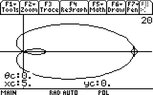
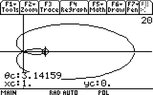
Since the pole is analogous to the origin of a Cartesian system, we are finding the max and min values of r from the pole for the given function. In the case of a cosine function, considering that cosine has its max and min values at 0 radians and pi radians respectively, we would evaluate any of the three given equations at 0 and pi to determine max and min for cosine polar graphs.

Similarly, for sine polar graphs, we would evaluate max and mins at pi/2 and 3pi/2.

View attachment 835View attachment 833View attachment 834

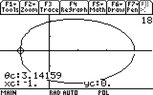
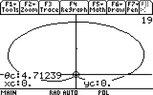
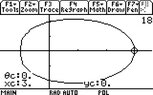
So for the polar equation given above, the max at 0pi is 5 and the min at pi is 1.View attachment 836View attachment 837View attachment 838

Likewise our max is 3 and min is 1 here...

View attachment 842View attachment 840View attachment 841

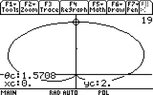
And for the above Cardiod, the max is 2 (evaluated at pi/2) and the min is 0 (evaluated at 3pi/2)Am I understanding this better now?

P.S. Sorry about the attached thumbnail below, don't know how I managed that :p
 

Attachments

  • SCREEN01.JPG
    SCREEN01.JPG
    19.7 KB · Views: 96
  • SCREEN02.JPG
    SCREEN02.JPG
    20.2 KB · Views: 101
  • limacon.JPG
    limacon.JPG
    10.6 KB · Views: 80
  • limacon no loop.JPG
    limacon no loop.JPG
    10.7 KB · Views: 86
  • SCREEN03.JPG
    SCREEN03.JPG
    20 KB · Views: 74
  • SCREEN04.JPG
    SCREEN04.JPG
    20.6 KB · Views: 89
  • Cardioid.PNG
    Cardioid.PNG
    3.8 KB · Views: 78
  • SCREEN05.JPG
    SCREEN05.JPG
    19.9 KB · Views: 83
  • SCREEN06.JPG
    SCREEN06.JPG
    20 KB · Views: 78
  • Cardioid.JPG
    Cardioid.JPG
    8.1 KB · Views: 79
m3dicat3d said:
View attachment 835View attachment 833View attachment 834

So for the polar equation given above, the max at 0pi is 5 and the min at pi is 1.
Hello m3dicat3d,
you got a typo there :) it should be min is $$-1$$:)
edit: Should you not answer if it is a loop or no loop and $$\frac{\pi}{2}$$ intercept as well?

Regards,
$$|\pi\rangle$$
 
Thanks Petrus!

Sounds as if I'm on the right track here. Yes, the intercept and loop questions we are working through, I just didn't include them here as I understand what we needed to do with those, and just focused on what I was unsure of.

View attachment 843View attachment 844View attachment 845

As far as the min @ -1 typo, were you referring to the no loop limacon above? If you meant the cardioid then I may be missing something else. Thanks :)
 

Attachments

  • limacon no loop.JPG
    limacon no loop.JPG
    10.7 KB · Views: 81
  • SCREEN03.JPG
    SCREEN03.JPG
    20 KB · Views: 78
  • SCREEN04.JPG
    SCREEN04.JPG
    20.6 KB · Views: 81
Here is a little puzzle from the book 100 Geometric Games by Pierre Berloquin. The side of a small square is one meter long and the side of a larger square one and a half meters long. One vertex of the large square is at the center of the small square. The side of the large square cuts two sides of the small square into one- third parts and two-thirds parts. What is the area where the squares overlap?

Similar threads

Replies
1
Views
2K
  • · Replies 40 ·
2
Replies
40
Views
3K
  • · Replies 4 ·
Replies
4
Views
3K
  • · Replies 2 ·
Replies
2
Views
2K
  • · Replies 4 ·
Replies
4
Views
5K
  • · Replies 8 ·
Replies
8
Views
3K
  • · Replies 7 ·
Replies
7
Views
2K
  • · Replies 1 ·
Replies
1
Views
1K
  • · Replies 3 ·
Replies
3
Views
1K
  • · Replies 2 ·
Replies
2
Views
4K