Polarity of back EMF in an inductor....

Click For Summary
SUMMARY

The discussion centers on the polarity of back electromotive force (emf) in inductors, specifically how it opposes changes in current. When the rate of change of current (dI/dt) is positive, the induced current flows in the opposite direction, while a negative dI/dt results in the induced current flowing in the same direction as the main current. The participants clarify that the back emf creates a virtual battery effect, where the induced voltage (V_ab) is opposite in sign to the back emf, leading to potential differences that can cause sparks when devices are unplugged.

PREREQUISITES
  • Understanding of electromagnetic induction principles
  • Familiarity with inductors and their behavior in circuits
  • Knowledge of voltage, current, and potential difference concepts
  • Basic circuit theory, including battery interactions
NEXT STEPS
  • Study the principles of Faraday's Law of Electromagnetic Induction
  • Learn about the behavior of inductors in AC and DC circuits
  • Explore the concept of virtual batteries in circuit analysis
  • Investigate the effects of back emf on circuit components during switching events
USEFUL FOR

Electrical engineers, physics students, and anyone interested in understanding the dynamics of inductors and back emf in electrical circuits.

fog37
Messages
1,566
Reaction score
108
Hello Forum,
the law of electromagnetic induction states that a time-changing current causes a back (counter) emf in an inductor. The back emf opposes the change in current by generating an induced current I_ind.

If dI/dt>0, the induced current is opposite in direction to the main changing current. If dI/dt<0, the induced current is in the same direction as the changing current trying to keep it going.

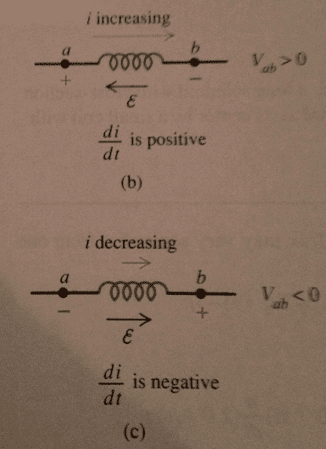
That said, I am confused about the polarity of the emf (please see figure below): the emf points to the left and that makes sense since the induced current must oppose the increasing current. A current always moves from high potential to lower potential.
But why is V_ab positive and directed opposite to the emf? Point a has a higher potential than point b. Current usually goes from high potential to lower potential (unless it is traversing the inside of a battery)...
upload_2015-11-9_16-17-17.png
Thanks,
fog37
 
Engineering news on Phys.org
Hello,

Just found an old book with the following explanation: if the increasing current is going from left to right, the induced emf generates an induced current that carries positive charges to the right and leaves negative the right side of the inductor. That is equivalent to having a virtual battery with V_a > V_b. This battery is is parallel with the actual battery in the circuit and opposes it (the batteries fight each other).

If the current decreased, the induced current would make V_a< V_b, which is equivalent to having a battery in series with the actual battery in the circuit. These two series batteries have their voltages added together. When we unplug a device, we see a spark because of this large voltage that is generated at the opening point...

So the emf and the virtual battery with voltage V_ab =V_a-V_b are opposite in sign...

Did I answer myself correctly?
 
fog37 said:
Hello,

Just found an old book with the following explanation: if the increasing current is going from left to right, the induced emf generates an induced current that carries positive charges to the right and leaves negative the right side of the inductor. That is equivalent to having a virtual battery with V_a > V_b. This battery is is parallel with the actual battery in the circuit and opposes it (the batteries fight each other).

If the current decreased, the induced current would make V_a< V_b, which is equivalent to having a battery in series with the actual battery in the circuit. These two series batteries have their voltages added together. When we unplug a device, we see a spark because of this large voltage that is generated at the opening point...

So the emf and the virtual battery with voltage V_ab =V_a-V_b are opposite in sign...

Did I answer myself correctly?
Is there a mistake here? Otherwise it reads okay. The back emf always opposes the applied external voltage.
 

Similar threads

  • · Replies 4 ·
Replies
4
Views
2K
Replies
10
Views
2K
  • · Replies 38 ·
2
Replies
38
Views
5K
  • · Replies 16 ·
Replies
16
Views
1K
  • · Replies 1 ·
Replies
1
Views
7K
Replies
64
Views
8K
  • · Replies 4 ·
Replies
4
Views
2K
Replies
23
Views
2K
  • · Replies 13 ·
Replies
13
Views
3K
Replies
8
Views
2K