Polylogarithms integrals in Nastase QFT book

  • Context: Graduate 
  • Thread starter Thread starter Pnin
  • Start date Start date
  • Tags Tags
    Book Integrals Qft
Click For Summary
SUMMARY

The discussion focuses on the manipulation of equations in Horatio Nastase's "Intro to Quantum Field Theory" (Cambridge University Press, 2019), specifically transitioning from equation (3) to equation (4) using polylogarithm formulas. Participants identify a typo in equation (1), where the exponent should be (n-2) instead of (n-1). Integration by parts is suggested as a method to approach the problem, with specific integrals being evaluated for various values of k. The conversation highlights the complexity of the integrals and the need for careful handling of terms to achieve the desired results.

PREREQUISITES
  • Understanding of polylogarithm functions and their properties
  • Familiarity with integration techniques, particularly integration by parts
  • Knowledge of calculus, specifically handling improper integrals
  • Basic concepts of Quantum Field Theory as presented in Nastase's book
NEXT STEPS
  • Study the properties of polylogarithm functions in detail
  • Practice integration by parts with various functions and limits
  • Explore advanced calculus techniques for handling divergent integrals
  • Review Quantum Field Theory concepts relevant to Nastase's equations
USEFUL FOR

This discussion is beneficial for physicists, mathematicians, and students engaged in Quantum Field Theory, particularly those working with polylogarithmic integrals and advanced calculus techniques.

Pnin
Messages
20
Reaction score
1
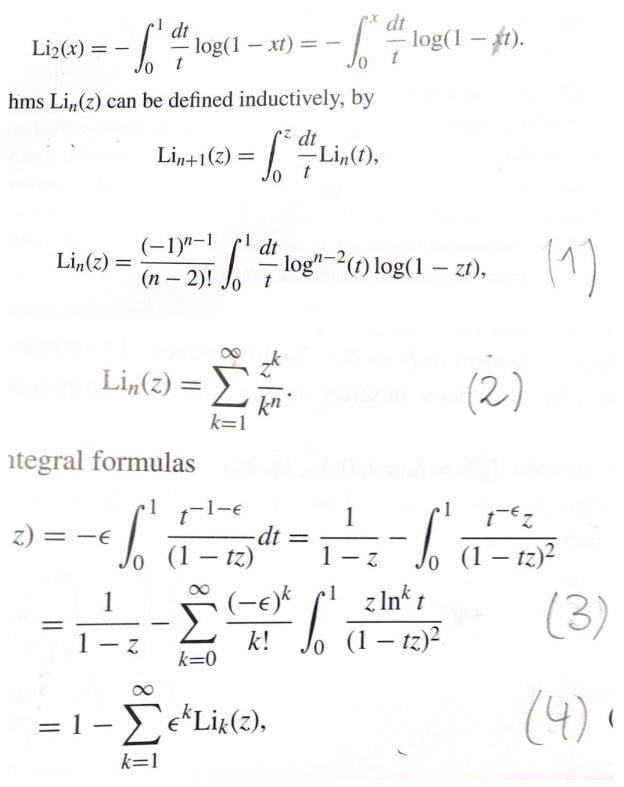
This is from Horatio Nastase "Intro to Quantum Field Theory" book (Cambridge University Press, 2019) , chapter 59. The reader is supposed to massage equation (3) into equation (4) with the help of the given polylogarithm formulas (1) and (2). I do not see at all how that's possible.

Unfortunately, the book (first edition) seems to have some fair amount of typos, as far as I can tell. The exponent (n-1) above -1 in equation (1) should be (n-2), as on the polylogarithm wiki page noted under integral representation, no. 5.

Has someone an idea what the author does to get from equation (3) to (4)?
polylog.JPG
 
Physics news on Phys.org
You should move the question to calculus forum.
 
mathman said:
You should move the question to calculus forum.
Good idea. How do I do that? Or could some admin move my question? thank you
 
I moved it.

Did you try integration by parts? Take the integral of 1, take the derivative of the lnk(t).
 
  • Like
Likes   Reactions: Pnin
I assume repeated (twice) integration by parts. That makes me believe the integral in (3) can be morphed into the integral in (1). With surface terms disappearing somehow. But where does the sum sigma come from?
 
Let's look at $$\int_0^1 \frac{z\ln^k(t)}{(1-tz)^2} dt$$
For k=0, we get $$\int_0^1 \frac{z}{(1-tz)^2} dt = \frac{-z}{z-1}$$
Subtracting that from 1/(1-z) we get 1, as expected.

For k>0 I confirmed the first cases with WolframAlpha (e.g. k=3). I started integration by parts but I'm not sure if the diverging first term will cancel later:

Let k>0. As the integrand diverges for t->0, set the lower bound to ##\epsilon## for now. Define ##f'(t)=\frac{z}{(1-tz)^2}##, ##g(t)=\ln^k(t)##. Then $$\int_\epsilon^1 f'(t)g(t) dt = [f(t)g(t)]_\epsilon^1-\int_\epsilon^1 f(t)g'(t) dt \\
= \left[\frac{z}{1-tz}\ln^k(t)\right]_\epsilon^1 - \int_\epsilon^1 \frac{k}{t} \frac{z}{1-tz}\ln^{k-1}(t) \\
= \dots$$

Edit: Forgot a 1/t term.
 
Last edited:
  • Like
Likes   Reactions: Auto-Didact and Pnin
Thanks, mfb. Much appreciated.
 
  • Like
Likes   Reactions: jim mcnamara
Unfortunately, still a bit unclear.

If f'(t) = z/(1-zt)^2, shouldn't it be f(t) = z⋅(z/(1-zt)?

Also, what next? I need to integrate one more time by parts. But I have a new 1/t term. I want that term in my final result (4), not now.

Integrating by parts without the 1/t would give me k(k-1)ln^(k-2)(t)⋅ln(1-tz). And since k(k-1) =k!/(k-2)!, that starts to look good. Still, I need that 1/t term, but in the final equation, not in the step before..

And what about those z‘s. They appear only in ln(1-tz) in equation (1) and (4).
 

Similar threads

  • · Replies 1 ·
Replies
1
Views
2K
  • · Replies 5 ·
Replies
5
Views
2K
  • · Replies 4 ·
Replies
4
Views
3K
  • · Replies 15 ·
Replies
15
Views
3K
  • · Replies 4 ·
Replies
4
Views
2K
  • · Replies 5 ·
Replies
5
Views
2K
  • · Replies 12 ·
Replies
12
Views
3K
  • · Replies 3 ·
Replies
3
Views
3K
  • · Replies 2 ·
Replies
2
Views
2K
  • · Replies 2 ·
Replies
2
Views
2K