Pool Ball Physics: Questions on Impact Spins

Click For Summary

Discussion Overview

The discussion revolves around the physics of pool ball interactions, specifically focusing on the potential for spin to be imparted during collisions between balls and when balls contact cushions. Participants explore the mechanics of these interactions, questioning whether spin can be generated beyond the expected behaviors observed in typical gameplay.

Discussion Character

  • Exploratory
  • Technical explanation
  • Debate/contested

Main Points Raised

  • One participant questions whether contact between two pool balls can impart spin other than around the horizontal axis due to friction with the table surface.
  • Another participant provides examples of shots where a cue ball appears to arc after bouncing off a cushion, suggesting that spin may be involved.
  • Concerns are raised about the mechanics of spin transfer during ball collisions, with one participant asserting that forces act through the centers of mass, implying no spin can be imparted.
  • Another participant counters that friction can impart spin, challenging the notion that no additional spin is transferred during ball-to-ball contact.
  • There is a discussion about the duration of contact between balls and the implications for spin transfer, with one participant expressing skepticism about significant spin being transferred due to short contact times.
  • Participants discuss the relative friction coefficients between ball-to-ball and ball-to-cushion interactions, suggesting that different outcomes in spin transfer may occur based on these factors.

Areas of Agreement / Disagreement

Participants do not reach a consensus on whether spin can be imparted during ball collisions or cushion contacts. Multiple competing views remain regarding the mechanics of spin transfer and the role of friction in these interactions.

Contextual Notes

Participants express uncertainty about the duration of contact during collisions and the effectiveness of friction in transferring spin. There are also assumptions about the nature of spin and its dependence on various factors, including the initial conditions of the balls involved.

noname12345
Messages
31
Reaction score
4
1) Can the contact between two pool balls impart any kind of spin, other that about its horizontal axis due friction contact with the table surface?

2) If a ball is in motion (traveling in a straight line) and contacts a cushion, can that contact impart spin to the ball such that when leaving the cushion, is path (when viewed from above) forms an arc?

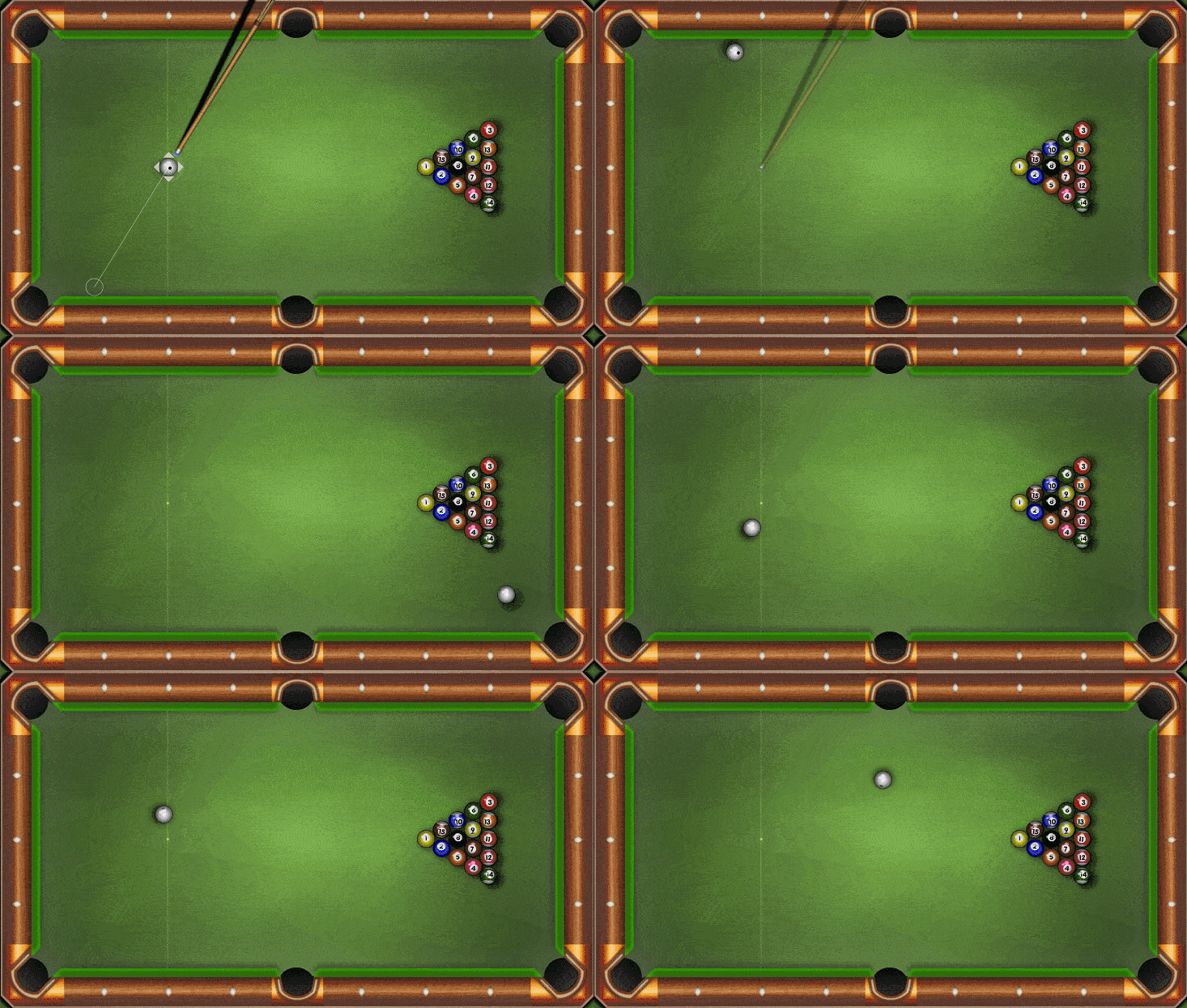
Background: I love playing pool, but in lock-down I've taken to playing pool against my computer. I've found a version that isn't to annoying, but in addition to various simple bugs (like a ball managing to end up balanced on the frame of the table) is has this curious behavior that if you hit a ball hard such that it ricochets around that table without contacting any other balls or going in a pocket, after the second or third contact, it starts moving in an arc.

Including a couple of times when it skipped along a long cushion much like a stone skipped on a pond. Ie.Hitting a cushion, bouncing away and then moving in an arg to come back to the same cushion without hitting anything else. Two and even three times.

I am pretty sure I've never seen this IRL; and my instinct says that it is physically possible. I'm seeking to verify that instinct.

My thoughts on the two questions above:

1) When two smooth surfaced balls contact each other, the forces always act directly through the centers of mass, thus no spin can be imparted.

2) When a ball hits a cushion, any existing spin (about its vertical axis), will act to change the angle at which it leaves the cushion; and the contact will reduce the moment about that vertical axis -- friction lost to the cushion -- but no additional spin (about the vertical axis) will be imparted to the ball by the contact.

Thoughts?
bad pool physics.gif
 
Last edited:
Physics news on Phys.org
I'm aware of (and can do IRL) swerve & masse shot by applying spin (English) to the cue ball when you strike it; but despite that I used the cue ball in the demo above, (its much easier to capture) no spin was applied.

Also, if you look closely, the ball's path from the strike to the first cushion -- and between the first and second, and the second and third contacts -- is straight.

It is only after the third cushion contact that the curved path appears, implying that it is contact with the cushion that is adding the spin. And I believe that to be physically impossible.

Here's another, more extreme example, also using the cue ball for convenience, but this time I've included the spin control showing the red contact spot is dead central, so no spin applied. I've also slowed it down x10:
bad pool physics 2.gif
 
Buk said:
1) When two smooth surfaced balls contact each other, the forces always act directly through the centers of mass, thus no spin can be imparted.
This ignores friction, which can impart spin, because it doesn't act through the center of mass

Buk said:
2) When a ball hits a cushion, any existing spin (about its vertical axis), will act to change the angle at which it leaves the cushion; and the contact will reduce the moment about that vertical axis -- friction lost to the cushion -- but no additional spin (about the vertical axis) will be imparted to the ball by the contact.
Depending on the initial spin direction and the relative collision velocities, the spin can be increased or decreased by a collision
 
This ignores friction, which can impart spin, because it doesn't act through the center of mass
Can I take that you are suggesting that if (say) the cue ball has spin around its vertical axis at the moment it hits the object ball; some portion of that spin will be transferred to the object ball (presumable in the opposite rotation like meshing gears) during that brief moment of contact between them?

Let's assume for now that the cue ball is spinning at 60rpm around its vertical axis. And the contact between the two balls lasts 0.1s. If the friction contact between them was perfect (gear mesh line) then both balls would rotate 36° in opposite directions during that 0.1s.

But I believe (but cannot currently cite) that the contact period is far, far less; and that the percentage of that period when friction between them is sufficient to transmit motion less still.

I find really hard to imagine any significant amount of spin being transferred; but it'll have to wait until my lock-down ends before I can get near a pool table to experiment.

Thanks for the thought experiment.
 
Buk said:
Can I take that you are suggesting that if (say) the cue ball has spin around its vertical axis at the moment it hits the object ball; some portion of that spin will be transferred to the object ball
Yes, but the friction coefficient between two balls is less than between ball and side cushion. So smaller spin changes are to be expected for ball on ball collisions.

Buk said:
But I believe (but cannot currently cite) that the contact period is far, far less; and that the percentage of that period when friction between them is sufficient to transmit motion less still.
In collisions, shorter contact period means also greater normal force, and thus greater frictional force.
 
Last edited:

Similar threads

  • · Replies 4 ·
Replies
4
Views
2K
  • · Replies 5 ·
Replies
5
Views
2K
  • · Replies 60 ·
3
Replies
60
Views
6K
  • · Replies 32 ·
2
Replies
32
Views
5K
Replies
2
Views
901
  • · Replies 1 ·
Replies
1
Views
2K
  • · Replies 1 ·
Replies
1
Views
1K
  • · Replies 62 ·
3
Replies
62
Views
10K
  • · Replies 35 ·
2
Replies
35
Views
5K
Replies
14
Views
3K