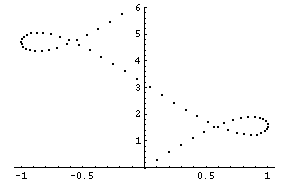
Possible equation for this graph?

  • Context: Undergrad 
  • Thread starter Thread starter rjmchung
  • Start date Start date
  • Tags Tags
    Graph
Click For Summary
SUMMARY

The discussion centers on deriving a parametric equation for a specific graph using the function g(n). The equation is defined as g(n) = sin(n*pi/31)*(i hat) + (sin(2*pi*n/31)+n/10)*(j hat). This formulation incorporates trigonometric functions and linear components to describe the graph's behavior across the horizontal and vertical axes, represented by (i hat) and (j hat), respectively.

PREREQUISITES
  • Understanding of parametric equations
  • Familiarity with trigonometric functions
  • Basic knowledge of graphing in a Cartesian coordinate system
  • Experience with mathematical notation and vector representation
NEXT STEPS
  • Explore the properties of parametric equations in detail
  • Study the behavior of sine functions in graphing
  • Learn about vector representation in two-dimensional space
  • Investigate the implications of adding linear components to trigonometric functions
USEFUL FOR

Mathematicians, physics students, and anyone interested in graph theory and parametric equations will benefit from this discussion.

rjmchung
Messages
1
Reaction score
0
What could be the equation (probably parametric) for this graph?

Screen Shot 2012-01-22 at 12.21.43 PM.png
 
Mathematics news on Phys.org
Let the horizontal axis be denoted by (i hat) and the vertical axis be (j hat) and call the function g(n). The function would be something like:

g(n) = sin(n*pi/31)*(i hat) + (sin(2*pi*n/31)+n/10)*(j hat)
 

Similar threads

  • · Replies 3 ·
Replies
3
Views
2K
  • · Replies 2 ·
Replies
2
Views
1K
  • · Replies 4 ·
Replies
4
Views
2K
  • · Replies 5 ·
Replies
5
Views
2K
  • · Replies 5 ·
Replies
5
Views
2K
  • · Replies 1 ·
Replies
1
Views
1K
  • · Replies 2 ·
Replies
2
Views
1K
  • · Replies 23 ·
Replies
23
Views
3K
  • · Replies 8 ·
Replies
8
Views
2K
  • · Replies 1 ·
Replies
1
Views
2K