Possible to calculate shear stress from this?

Click For Summary
SUMMARY

The discussion centers on calculating shear stress in a bamboo ring with a fabric-epoxy flange under compression. The primary failure occurs at the fabric-bamboo interface due to shear stress. Participants confirm that it is possible to determine this shear stress by analyzing the loading and response of curved beams, despite initial confusion about the methodology. A free body diagram of the curved piece is recommended as a starting point for analysis.

PREREQUISITES
  • Understanding of shear stress and its implications in material failure
  • Knowledge of curved beam analysis techniques
  • Familiarity with free body diagrams in mechanics
  • Basic principles of mechanics of materials
NEXT STEPS
  • Study curved beam analysis methods in mechanics of materials
  • Learn how to create and interpret free body diagrams
  • Research shear stress calculations specific to composite materials
  • Explore resources on failure mechanisms in composite structures
USEFUL FOR

Mechanical engineers, materials scientists, and students studying mechanics of materials who are interested in analyzing shear stress in composite structures.

EngChrisP
Messages
7
Reaction score
0
Ok, so I would like to know if something is possible.

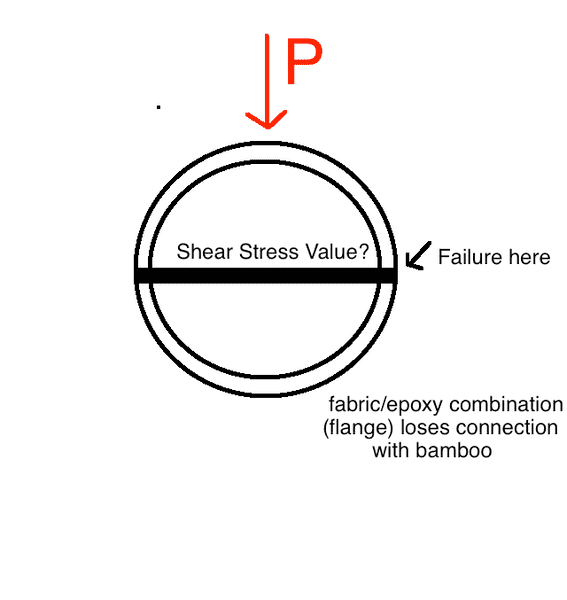
I have a bamboo ring, which has been cut in half, and had a piece of fabric soaked in epoxy placed in between to act as a flange.

Under compression, the main failure occurs at the fabric/bamboo connection, as a result of shear stress.

Is it possible to determine this shear stress value specific to the fabric and the bamboo from the applied load on top?

I have attached a diagram to try to explain things a bit better?
Flange_Bamboo.png


Many thanks for any help!
 

Attachments

  • Flange_Bamboo.png
    Flange_Bamboo.png
    11.9 KB · Views: 584
Engineering news on Phys.org
Who says that the failure mechanism is shear stress?
 
Chestermiller said:
Who says that the failure mechanism is shear stress?

I've done a lot of tests and it does seem to be the case. Let's assume it is even though it might not be, how could that value be determined, if it actually can?

Thanks
 
EngChrisP said:
I've done a lot of tests and it does seem to be the case. Let's assume it is even though it might not be, how could that value be determined, if it actually can?

Thanks
You are dealing with a curved beam. Do you know how to analyze a curved beam problem?
 
I do not, so I guess it is not possible to obtain shear stress from this problem? Thanks for the help anyway!
 
EngChrisP said:
I do not, so I guess it is not possible to obtain shear stress from this problem? Thanks for the help anyway!
It is possible, but you need to learn how to analyze loading and response of curved beams. Do you at least know how to analyze a straight beam?
 
Oh ok, I do know how to analyze a straight beam yes.
 
So now all you need to learn is how to extend this to cover curved beams.
 
anyone willing to help supply an answer and not try to make themselves out to be smarter than someone else please? =)
 
  • #10
Let me try. You state that you have a bachelor's degree and are working on a master's degree. I looked at two different undergrad mechanics of materials books, and both of them had a section on curved beams. At the master's degree level, you are expected to be able to read and learn material outside of what was covered in lecture. A quote from the forum rules: "Full solutions on a homework problem should never be given. Only hints and explanations are allowed."

We are trying to guide you through the process of solving this problem. We do this by helping you when you get stuck, or see you traveling down a mathematical dead end.

To answer your question in your first post: Yes, it is possible.
 
  • Like
Likes   Reactions: davenn
  • #11
Well I really don't know where to begin here to be honest!
 
  • #12
Start with a free body diagram of the top curved piece. Give it your best shot, and we'll help you from there.
 
  • #13
jrmichler said:
Start with a free body diagram of the top curved piece. Give it your best shot, and we'll help you from there.
Or start by googling curved beams
 
  • #14
nvm guys i see what the vibe here is like, if no one wants to help me that's cool. Of course I've googled curved beams, I'm completely lost, and I don't see myself getting much help here. Thanks anyway guys.
 
  • #15
EngChrisP said:
nvm guys i see what the vibe here is like, if no one wants to help me that's cool. Of course I've googled curved beams, I'm completely lost, and I don't see myself getting much help here. Thanks anyway guys.
Not so fast. We can still help you understand the development and application of the curved beam analysis. Please try to articulate for us the part of the development that you are having trouble with, and we will be glad to assist in getting you over the rough spots.
 
  • Like
Likes   Reactions: Tom.G

Similar threads

  • · Replies 1 ·
Replies
1
Views
2K
  • · Replies 2 ·
Replies
2
Views
3K
  • · Replies 1 ·
Replies
1
Views
1K
Replies
17
Views
5K
Replies
1
Views
2K
  • · Replies 5 ·
Replies
5
Views
2K
  • · Replies 5 ·
Replies
5
Views
2K
  • · Replies 1 ·
Replies
1
Views
6K
Replies
9
Views
5K
  • · Replies 2 ·
Replies
2
Views
2K