Potential difference across capacitor

Click For Summary
SUMMARY

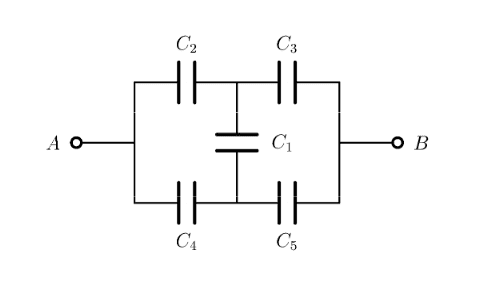
The potential difference across capacitor C1 in a bridge circuit can be zero under specific conditions, particularly when the voltages at both terminals are equal. In the discussed scenario, with capacitors C2 and C4 both at 1.0μF and C3 and C5 at 2.0μF, the voltage difference across C1 is zero when the voltage at the top equals the voltage at the bottom. If the values of C2 and C4 or C3 and C5 differ, the potential difference across C1 will no longer be zero. Understanding bridge circuits is essential for grasping these concepts.

PREREQUISITES
  • Bridge circuit theory
  • Capacitor behavior and characteristics
  • Basic electrical engineering concepts
  • Voltage measurement techniques
NEXT STEPS
  • Study the principles of bridge circuits in detail
  • Explore the effects of varying capacitor values on circuit behavior
  • Learn about voltage dividers and their applications
  • Investigate the use of simulation tools for circuit analysis
USEFUL FOR

Electrical engineering students, circuit designers, and anyone interested in understanding capacitor behavior in bridge circuits.
ShaddollDa9u
Messages
18
Reaction score
0
Member advised to use the homework template for posts in the homework sections of PF.
Hi, the solution of my exercise says that the potential difference in the capacitor C1 is zero.
1494361264-screenshot-from-2017-05-09-16-06-36.png

Can you please explain me why it's the case ?

Thank you.
 
Physics news on Phys.org
You don't have any values for those capacitors. This is an example of a bridge circuit. Read this article for some insight. https://en.wikipedia.org/wiki/Bridge_circuit

Resistors and capacitors work differently, but be assured that there are capacitor values which would result in the voltage at the top of the C1 to be the same voltage as the bottom of C1. For example, if we have 10.5 volts at the top and 10.5 volts at the bottom, then 10.5-10.5 = 0.
 
Owwww I'm sorry, I forgot to give the values !

In fact, we have C2=C4 = 1.0μF and C3=C5 = 2.0μF.
 
However what if, in this case, we have C2 =/= C4 OR C3 =/=C5, C1 wouldn't be equal to zero anymore, right ?
 
ShaddollDa9u said:
However what if, in this case, we have C2 =/= C4 OR C3 =/=C5, C1 wouldn't be equal to zero anymore, right ?
Correct.
 
ShaddollDa9u said:
However what if, in this case, we have C2 =/= C4 OR C3 =/=C5, C1 wouldn't be equal to zero anymore, right ?
You should really take a look at the article on Bridge circuits, which I pointed to in the earlier post. Once you understand how resistor bridge circuits work, it will not be much of a stretch to understand other components, such as capacitors.
 

Similar threads

  • · Replies 6 ·
Replies
6
Views
2K
Replies
2
Views
927
  • · Replies 15 ·
Replies
15
Views
894
  • · Replies 7 ·
Replies
7
Views
2K
Replies
11
Views
3K
Replies
5
Views
2K
Replies
9
Views
2K
  • · Replies 11 ·
Replies
11
Views
4K
Replies
4
Views
2K