Potential Divider: Explaining How Energy is Lost & Given to Components

Click For Summary
SUMMARY

The discussion centers on the concept of potential dividers in electrical circuits, specifically how energy is transferred through resistors. Participants clarify that while resistors dissipate energy as heat, the voltage drop across a resistor is equal to the voltage drop across the components in the branch. This is due to the principle that electric potential remains consistent across two points in a circuit. The conversation emphasizes understanding energy per charge rather than energy loss, highlighting the importance of resistor values in circuit design.

PREREQUISITES
  • Understanding of basic electrical concepts, including voltage and current.
  • Familiarity with Ohm's Law and power calculations in circuits.
  • Knowledge of potential dividers and their function in circuit design.
  • Basic principles of energy conservation in electrical systems.
NEXT STEPS
  • Study the function and design of potential dividers in detail.
  • Learn about power dissipation in resistors and its implications for circuit efficiency.
  • Explore Ohm's Law applications in real-world circuit scenarios.
  • Investigate the relationship between voltage, current, and resistance in various circuit configurations.
USEFUL FOR

Electrical engineering students, circuit designers, and hobbyists interested in understanding voltage division and energy transfer in electrical circuits.

adjacent
Gold Member
Messages
1,552
Reaction score
62
This is how my teacher drew the potential divider.
attachment.php?attachmentid=66698&stc=1&d=1392630405.png


And told that the energy lost by the resistor is equal to the energy given to the components on the branch.

Or the voltage of the resistor is equal to the voltage given to the components in the branch.

How does the energy of the resistor go to the components??I thought energy is lost as heat.
 

Attachments

  • PD.png
    PD.png
    768 bytes · Views: 640
Physics news on Phys.org
hi adjacent! :smile:
adjacent said:
How does the energy of the resistor go to the components??I thought energy is lost as heat.

yes :smile:

i suspect your teacher was talking about the potential energy (ie energy per charge) …

voltage drop is the same as loss in potential energy

so let's rewrite …
… my teacher … told that the energy lost by the resistor is equal to the energy given to the components on the branch.

Or the voltage of the resistor is equal to the voltage given to the components in the branch.

as:
the potential energy lost (the voltage drop) across the resistor is equal to the potential energy lost across the components on the branch.

Or the voltage drop across the resistor is equal to the voltage drop across the components in the branch. :wink:

(i don't like this "lost" versus "given" terminology …

potential energy doesn't work like that :redface:)
 
Oh,I used my own terms.Thanks for the correction.
But I still don't know why voltage drop across the resistor is equal to the voltage drop across the components in the branch.
How is the energy transferred?Resistors normally waste it as heat.Am I wrong?
 
hi adjacent! :smile:
adjacent said:
But I still don't know why voltage drop across the resistor is equal to the voltage drop across the components in the branch.
How is the energy transferred?Resistors normally waste it as heat.Am I wrong?

forget energy!

this has (almost) nothing to do with energy

this is about energy per charge

the charge going through the resistor each second (ie the amps) is much less than the charge going through the components

so the energy going through the resistor each second is much less than the energy going through the componentsit is only the energy per charge that is the same

(i suspect you are missing the point that a general principle of voltage, or electric potential, is that it is always the same between any two points, in this case through the resistor and through the components …

ie, the same charge would do the same work going along either route)

btw, energy ~ V2/R, so it pays (literally!) to have the resistor R as large as possible, to keep the energy loss very small
 
tiny-tim.I know that.Sorry I wrote energy.
Why do we use a resistor there?To divide the voltages between two branches.So the voltage drop of the resistor is equal to the voltage drop of the components in the branch.

I understand this,but how?My main concern is resistors waste energy.
(Forgive me.Try to think in my perspective about resistors wasting "energy")

aaaaa.I have made myself more confused. :confused: :confused: :confused:
 
adjacent said:
Why do we use a resistor there?To divide the voltages between two branches.So the voltage drop of the resistor is equal to the voltage drop of the components in the branch.

I understand this,but how?My main concern is resistors waste energy.
(Forgive me.Try to think in my perspective about resistors wasting "energy")

yes, they do waste energy, you can't avoid it

if you have a 240 V source, and your components will only take 120 V, you can use two equal resistors R in series, with the components parallel to resistor (and nothing parallel to the other resistor) …

then all the current will go through the second resistor and waste a lot of energy if R is large, but if R is small too much current will go through the first resistor and waste a lot of energy, so you can't win :redface:

i'm not familiar with circuit design …

would anyone who is like to step in here and say something practical? :smile:
 
adjacent said:
tiny-tim.I know that.Sorry I wrote energy.
Why do we use a resistor there?To divide the voltages between two branches.So the voltage drop of the resistor is equal to the voltage drop of the components in the branch.

I understand this,but how?My main concern is resistors waste energy.
(Forgive me.Try to think in my perspective about resistors wasting "energy")

aaaaa.I have made myself more confused. :confused: :confused: :confused:

The word 'waste' is a bit of a value judgement. Resistors transfer electrical power to Heat. That may be desired or not, according to the circumstances.

The function of a resistor in a circuit is usually to cause a current of a specific value to flow or, in association with some other component (resistor, Capacitor, Transistor, Inductor), to produce a desired voltage somewhere. Resistors are the foot soldiers of circuit design; well behaved and robust.
Your example of a Potential Divider is a very common circuit element.
This link more or less says all you need to know about the how it works. Choosing what actual values to use to do a particular job (as well as their relative values) needs a bit of care or you can (literally) "waste" some power, when they're lower valued than necessary or don't do their job because they cannot supply enough current to maintain the wanted voltage.

The problem when you are taught this stuff for the first time, you tend not to see any reason for it. IF it were possible to deliver electronics along with a project, then you would want to achieve things and those boring laws and formulae would actually appear to be much more worth while because they would actually help you. There's a 'critical mass' of experience needed before Electronics starts to have enough context for beginners. Jusgt stick with it and you will find it comes, eventually.
 
Last edited:
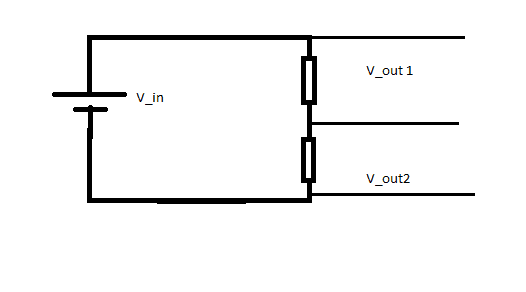
Perhaps it is easier if you consider the current flowing as well... Let's say the current flowing is I. Then...

The power delivered by the battery is:

P_in = V_in * I

The power dissipated/wasted in each resistor is:

P_r1 = V_out1 * I
P_r2 = V_out2 * I

The law of conservation of energy means that the power dissipated in the resistors must equal that delivered by the battery. I think this is what you mean by...

... the energy lost by the resistor is equal to the energy given to the components on the branch.

So...

P_in = P_r1 + P_r2

Substituting..

V_in * I = (V_out1 * I) + (V_out2 * I)

I cancels so...

V_in = V_out1 + V_out2

I think this is what you mean by...

the voltage of the resistor is equal to the voltage given to the components in the branch.

Your last question is..

How does the energy of the resistor go to the components??I thought energy is lost as heat.

It is lost as heat.

In this circuit the power dissipated in the resistors is equal to that delivered by the battery. This is because there is nothing connected to V_out1 or 2.
 

Attachments

  • Divider.png
    Divider.png
    2.4 KB · Views: 551

Similar threads

  • · Replies 4 ·
Replies
4
Views
14K
  • · Replies 6 ·
Replies
6
Views
11K
  • · Replies 4 ·
Replies
4
Views
1K
  • · Replies 9 ·
Replies
9
Views
4K
  • · Replies 2 ·
Replies
2
Views
1K
  • · Replies 5 ·
Replies
5
Views
2K
  • · Replies 22 ·
Replies
22
Views
2K
Replies
7
Views
2K
  • · Replies 48 ·
2
Replies
48
Views
5K
  • · Replies 16 ·
Replies
16
Views
3K