Potential energy as a function of the square of this angle

Click For Summary

Homework Help Overview

The discussion revolves around the potential energy of a system expressed as a function of the angle θ, specifically focusing on how to represent this potential energy in terms of θ squared. The context involves gravitational potential energy and its derivation from geometric considerations.

Discussion Character

  • Exploratory, Mathematical reasoning, Assumption checking

Approaches and Questions Raised

  • Participants discuss using Taylor expansion to express the potential energy function in terms of θ squared. There are questions about the underlying logic of this approach, particularly regarding the significance of derivatives in the context of potential energy.

Discussion Status

Participants are exploring different methods to derive the potential energy function. Some have provided insights into Taylor expansion, while others are reflecting on the consistency of their approaches and the implications of their findings. There is an ongoing examination of the mathematical reasoning involved.

Contextual Notes

There appears to be some confusion regarding the relationship between derivatives of the potential energy and the physical interpretation of those derivatives. Additionally, the discussion hints at inconsistencies in the methods used to arrive at potential energy expressions.

Tony Hau
Messages
107
Reaction score
30
Homework Statement
Define the angle measured from the vertical to the line connecting the center of the
circle and the contact point of cube to the circle as 𝜃. Expand the potential energy as
a function of 𝜃 to the second order; i.e. 𝜃^2, around its stable equilibrium for 𝑅 = 𝑏.
Relevant Equations
U(𝜃) = mgh(𝜃) = mg[(R+b/2)cos𝜃 +R𝜃sin𝜃]
The problem of my question is the b part below:
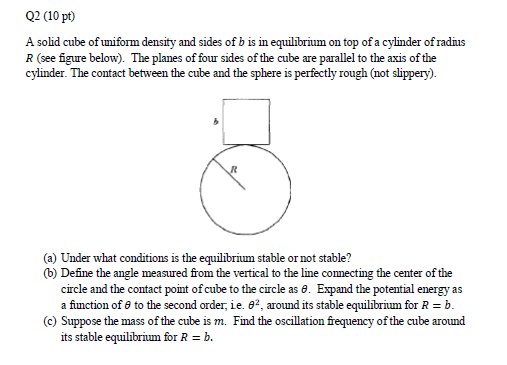
1585890029251.png

I know that the potential energy is just the gravitational potential energy, which is mgh(𝜃) = mg[(R+b/2)cos𝜃 +R𝜃sin𝜃], derived from the geometry. The equilibrium point is at 𝜃=0 and the system is a stable equilibrium for R>b/2. However, I have no idea how I can convert the potential energy as a function of the square of 𝜃, as stated by the question.
 

Attachments

  • 1585890074811.png
    1585890074811.png
    13.6 KB · Views: 234
Physics news on Phys.org
Do Taylor expansion of
\cos\theta and \theta \sin \theta
in ##U(\theta)## up to ##\theta^2##.
 
mitochan said:
Do Taylor expansion of
\cos\theta and \theta \sin \theta
in ##U(\theta)## up to ##\theta^2##.
Thanks. It sounds reasonable! Here is the answer of the question. I am thinking why this method also works. Basically I don't quite get the logic behind. I know that the first order derivative of U is force. But I don't understand what 1/2 of the second order derivative represents.
1585900387935.png
 
Here is my solution for the two methods. They are inconsistent.
 

Attachments

  • 2020-04-03 16.44.03.jpg
    2020-04-03 16.44.03.jpg
    43.4 KB · Views: 247
The both coincide in the exact calculation. Please try again.
 
  • Like
Likes   Reactions: Tony Hau

Similar threads

  • · Replies 14 ·
Replies
14
Views
3K
  • · Replies 2 ·
Replies
2
Views
1K
  • · Replies 2 ·
Replies
2
Views
1K
  • · Replies 2 ·
Replies
2
Views
2K
  • · Replies 2 ·
Replies
2
Views
2K
  • · Replies 7 ·
Replies
7
Views
620
Replies
12
Views
2K
Replies
15
Views
2K
  • · Replies 3 ·
Replies
3
Views
1K
  • · Replies 2 ·
Replies
2
Views
1K