Potential energy harmonic oscillator

Click For Summary

Discussion Overview

The discussion revolves around the derivation of potential energy in the context of a mass-spring system, focusing on the mathematical formulation and interpretation of potential energy as a function of position. Participants explore the implications of force direction and the dot product in the context of potential energy calculations.

Discussion Character

  • Technical explanation
  • Mathematical reasoning
  • Debate/contested

Main Points Raised

  • One participant expresses confusion about deriving potential energy from its definition, particularly regarding the sign of the derivative when the mass moves through its equilibrium position.
  • Another participant argues that the negative sign in the derivative is consistent with the force direction and potential energy changes.
  • A participant questions their derivation leading to a negative potential energy, suggesting a loss of the negative sign in their calculations.
  • Concerns are raised about the interpretation of the negative potential energy and whether it should be viewed as an absolute value due to sign conventions in the dot product.
  • Some participants discuss the importance of consistent sign conventions when dealing with vectors and scalars in the context of potential energy calculations.
  • There is a suggestion that the angle between force and displacement vectors can complicate the sign of the potential energy, depending on the chosen convention for positive directions.
  • A participant indicates they have resolved their confusion after receiving assistance from others in the thread.

Areas of Agreement / Disagreement

Participants express differing views on the interpretation of negative potential energy and the implications of sign conventions in their calculations. The discussion remains unresolved regarding the best approach to derive potential energy consistently.

Contextual Notes

Participants highlight potential limitations in their assumptions regarding vector directions and the interpretation of the dot product in the context of potential energy. There is an acknowledgment that the angle between vectors can affect the sign of the results, which remains a point of contention.

HWGXX7
Messages
46
Reaction score
0
Hello,

I have this problem with deriving the formule from de definition of potential energy

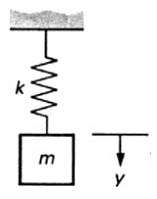
Picture show a mass-spring system in rest position:
Untitled1.png


In general potential energy can be written as dot product: \frac{dE_{P}}{d\overrightarrow{y}}=-\overrightarrow{F}.

Potential energy wil rise if, y rises. Because the direction of F is always inverse of y, this is correct.

But when the mass wil move upward trough it's equilibrium the potential energy will also rises, while y will decline. The derivative is negative, so the formule potential energy doesn't count anaymore.


How to fix this problem?

Also if you can look to my derivation of potential energy:
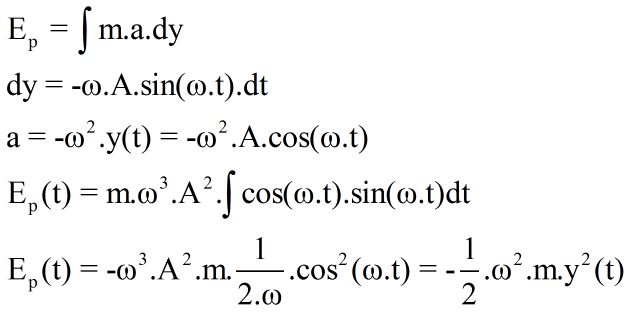
Untitled2.png


ty&grtz
 
Physics news on Phys.org
I don't see a problem. When y goes negative F will be positive, so -F is negative. That's consistent with the derivative being negative, as required.
 
When y goes negative F will be positive, so -F is negative. That's consistent with the derivative being negative, as required.
Yes, I must have missed this :redface:

But in my derivation I get a negative result...How fix this?

ty&grtz
 
You're puzzled that you get a negative potential energy?

You wrote correctly that
dEp/dy=−F
But in the very first line of your derivation you lost the - sign, making it
Ep = ∫m.a.dy
where F = m.a
 
There is difference between: -dF.dy=dE_{p}and -d\overrightarrow{F}.d\overrightarrow{y}=dE_{p}

Second thing is a dot product, force vector opposes the direction of the position vector. So I get: -d\overrightarrow{F}.d\overrightarrow{y}=-dF.dy.cos(\theta)

The angle bewteen those is \pi, so I get: -d\overrightarrow{F}.d\overrightarrow{y}=dF.dy

Therefore: E_{p}=\int m.a.dy
and the potential energy will be negative. My question: how do I have to interprete this minus sign? Is this because of the sign convection in my dot product, are do I (may I) have to interprete the potential energy as an absolute value...

ty
 
HWGXX7 said:
force vector opposes the direction of the position vector. So I get: -d\overrightarrow{F}.d\overrightarrow{y}=-dF.dy.cos(\theta)

ty

Even in scalars, it helps to be consistent about the positive and negative directions.
By saying that the angle between the F and dy vectors is pi, you are effectively choosing to measure F and y in opposite directions. As a consequence, you have a and y in opposite directions, so you end up with the wrong sign on Ep.
Better to say the angle between the vectors is zero, and an upward F (in the diagram) will have a negative value.
 
The mass is moving downwards to the position where its potential energy is maximum. Potential energy will rise becasue of:
\frac{d\overrightarrow{E_{p}}}{d\overrightarrow{y}}=-d\overrightarrow{F}

energie.png


The dot product d\overrightarrow{F}.d\overrightarrow{y} is negative because force vector ans position vector opposes...

Can I use this interpretation to derive the potential energy as function of position y(t)?
If not: what do I have to change in the assumptions and why ?

ty&grtz
 
I have no problem with your vector equation (except that lately you've taken to writing dF where you mean F). I will use italics for vectors - it's easier.
So -F.dy will be positive, as required.

The mistake you made was in converting to scalar form. Strictly it becomes
dE = -|F||dy|cos(θ) (1)
but this is awkward because as the object oscillates θ will flip between π and 0.
To get around that, choose as convention that scalars F and y are measured in specific directions. They don't have to be the same direction, but if they're not you're likely to get confused, so let's take downwards as positive for both.
When θ = π, F and dy have opposite sign, so F.dy = -|F|.|dy| = |F|.|dy|.cos(θ).
When θ = 0, F and dy have the same sign, so F.dy = +|F|.|dy| = |F|.|dy|.cos(θ).
So either way, F.dy = |F|.|dy|.cos(θ).
Substituting in (1) we get
dE = -F.dy

(I think the lesson here is not to start in vectors for a problem which can easily be managed with scalars!)
 
Oké, think I got it. Thank you for the help!

grtz
 

Similar threads

  • · Replies 2 ·
Replies
2
Views
2K
  • · Replies 1 ·
Replies
1
Views
1K
  • · Replies 9 ·
Replies
9
Views
2K
Replies
6
Views
2K
  • · Replies 46 ·
2
Replies
46
Views
5K
  • · Replies 31 ·
2
Replies
31
Views
4K
  • · Replies 11 ·
Replies
11
Views
2K
  • · Replies 3 ·
Replies
3
Views
2K
  • · Replies 2 ·
Replies
2
Views
2K
  • · Replies 3 ·
Replies
3
Views
1K