epsilon
- 29
- 1
I am having some difficulty understanding the Pound-Drever-Hall frequency stabilisation technique, when locking a laser to a stable cavity.
As far as I understand:
From what I've read, the two different frequency signals produce the beats phenomenon in the mixer, with an internal frequency (f0 + fm) and the envelope/amplitude frequency (f0 - fm). This is low-pass filtered to keep the (f0 - fm) component, and this is the error signal needed to correct the frequency emitted to correctly match the resonant frequency of the Fabry-Perot cavity.
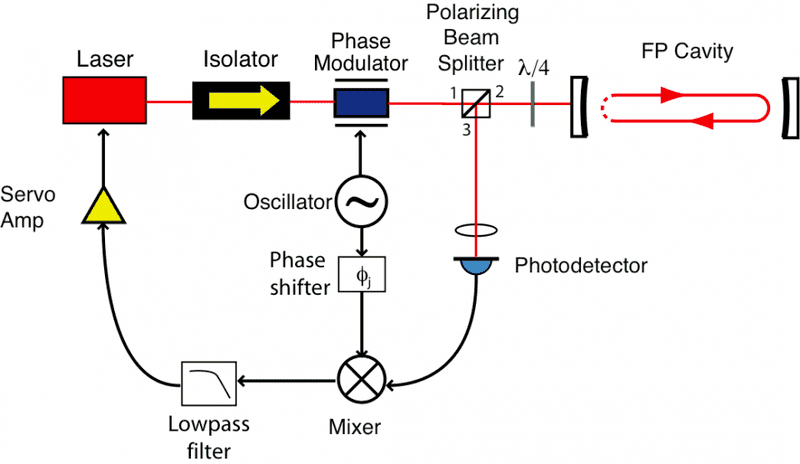
But we want the error signal to be the difference between the resonant frequency and input frequency. I don't understand why we have used the modulation frequency/sidebands at all! Please answer using similar level of language as I have used here. I have attached a schematic of the Pound-Drever-Hall system from Wikipedia below.
Many thanks in advance!
As far as I understand:
- We emit the laser frequency, f0.
- This signal is modulated with sideband frequencies, ± fm.
- This is fired towards the Fabry-Perot cavity, which has a resonant frequency fc.
- As f0 ≠ fc, some of the light is reflected at the entrance to the Fabry-Perot cavity, known as the "promptly reflected beam", picking up a phase shift of π/2 like any standard mirror reflection.
- The rest of the f0 signal is transmitted into the cavity (sidebands are never transmitted).
- As f0 is close to fc, the light is able to somewhat resonate in the cavity, with a phase shift of almost 2π picked up on each complete transit of the cavity (it would be exactly 2π at perfect resonance).
- Small amounts of the light periodically escape the cavity, called the "leakage beam".
- There is therefore a phase difference between the promptly reflected beam and the leakage beam, which is just under π (if it were π, such as at perfect resonance, these two beams would cancel exactly).
- Hence the two beams interfere - very close to antiphase - to produce a wave with the two sidebands unchanged and the f0 peak reduced in amplitude and phase-shifted sideways (does the shift directly depend on being above or below resonance?).
- This signal is now incident on a photodetector.
- This signal is now mixed with the modulation frequency.
From what I've read, the two different frequency signals produce the beats phenomenon in the mixer, with an internal frequency (f0 + fm) and the envelope/amplitude frequency (f0 - fm). This is low-pass filtered to keep the (f0 - fm) component, and this is the error signal needed to correct the frequency emitted to correctly match the resonant frequency of the Fabry-Perot cavity.
But we want the error signal to be the difference between the resonant frequency and input frequency. I don't understand why we have used the modulation frequency/sidebands at all! Please answer using similar level of language as I have used here. I have attached a schematic of the Pound-Drever-Hall system from Wikipedia below.
Many thanks in advance!