Power Rule Proof: Get Help with Line 3 to Line 4

Click For Summary

Homework Help Overview

The discussion revolves around a proof involving the power rule in calculus, specifically the transition from line 3 to line 4 in a mathematical expression. Participants are examining the implications of the ellipsis in the expression and how it relates to the number of terms involved in the proof.

Discussion Character

  • Exploratory, Conceptual clarification, Mathematical reasoning, Assumption checking

Approaches and Questions Raised

  • Participants are attempting to clarify the meaning of the ellipsis in the expression and how it affects the total number of terms. Questions are raised about the correctness of exponent addition and the significance of the terms in the context of the proof.

Discussion Status

There is an ongoing exploration of the mathematical reasoning behind the expressions. Some participants have provided guidance on understanding the ellipsis and its implications, while others are still questioning their understanding of the terms and the overall proof structure.

Contextual Notes

Participants express concerns about the learning process, with some suggesting that the original poster reflect on their understanding of previous problems before seeking further help. There is a recognition of the need for patience and deeper engagement with the material.
member 731016
Homework Statement
Pls see below
Relevant Equations
Pls see below
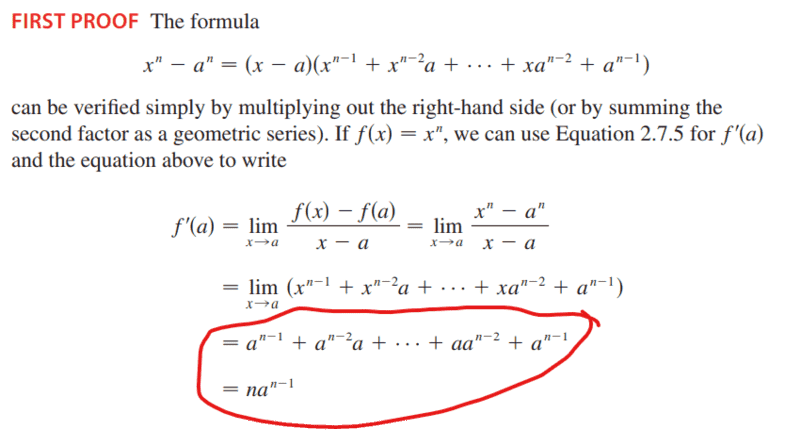
For this proof,
1677285643462.png

I am unsure how they got from line 3 to line 4.

If I simplify and collect like terms for line 3 I get ##f'(a) = 4a^{n-1}##

Would some please be able to help?

Many thanks!
 
Physics news on Phys.org
What does ##a^n## mean? It is ##\underbrace{a\cdot a\cdot \ldots\cdot a}_{n\text{ times}}.## Hence for ##n=i+j## we get $$a^n=\underbrace{a\cdot a\cdot \ldots\cdot a}_{n\text{ times}}=\underbrace{a\cdot a\cdot \ldots\cdot a}_{i \text{ times}} \cdot \underbrace{a\cdot a\cdot \ldots\cdot a}_{j\text{ times}}=a^i \cdot a^j =a^{i+j}$$
 
  • Like
Likes   Reactions: member 731016
fresh_42 said:
What does ##a^n## mean? It is ##\underbrace{a\cdot a\cdot \ldots\cdot a}_{n\text{ times}}.## Hence for ##n=i+j## we get $$a^n=\underbrace{a\cdot a\cdot \ldots\cdot a}_{n\text{ times}}=\underbrace{a\cdot a\cdot \ldots\cdot a}_{i \text{ times}} \cdot \underbrace{a\cdot a\cdot \ldots\cdot a}_{j\text{ times}}=a^i \cdot a^j =a^{i+j}$$
Thank you for your reply @fresh_42!

Did I not add the exponents correctly? For example, ##a^{n-2}a^1 = a^{n-1}##

Many thanks!
 
Callumnc1 said:
If I simplify and collect like terms for line 3 I get
##f'(a) = 4a^{n-1}##

Would some please be able to help?

Callumnc1 said:
Did I not add the exponents correctly?
That's not at all what you did wrong. You missed the significance of the ... in the first of the expressions you circled.
The expression ##a^{n-1} + a^{n-2}a + \dots + aa^{n-2} + a^{n-1}## does NOT have just four terms in it. The ... in the middle is called an ellipsis, and means "continuing the same pattern." In fact, this pattern indicates that there are n terms in all, thus leading to the conclusion that ##f'(a) = na^{n - 1}##.
 
  • Like
Likes   Reactions: member 731016
Mark44 said:
That's not at all what you did wrong. You missed the significance of the ... in the first of the expressions you circled.
The expression ##a^{n-1} + a^{n-2}a + \dots + aa^{n-2} + a^{n-1}## does NOT have just four terms in it. The ... in the middle is called an ellipsis, and means "continuing the same pattern." In fact, this pattern indicates that there are n terms in all, thus leading to the conclusion that ##f'(a) = na^{n - 1}##.
Thank you for your reply @Mark44 !

I see what you mean about me missing the dots.

However how dose,

##a^{n-1} + a^{n-2}a + \dots + aa^{n-2} + a^{n-1} = na^{n-1}##?

Many thanks!
 
Callumnc1 said:
Thank you for your reply @Mark44 !

I see what you mean about me missing the dots.

However how dose,

##a^{n-1} + a^{n-2}a + \dots + aa^{n-2} + a^{n-1} = na^{n-1}##?

Many thanks!
Try writing it out explicitly for n=5.
 
Last edited:
  • Like
Likes   Reactions: member 731016
Callumnc1 said:
Thank you for your reply @Mark44 !

I see what you mean about me missing the dots.

However how dose,

##a^{n-1} + a^{n-2}a + \dots + aa^{n-2} + a^{n-1} = na^{n-1}##?

Many thanks!

\begin{multline*}<br /> \overbrace{a^{n-1} + aa^{n-2} + \dots + a^{k}a^{n-1-k} + \dots + a^{n-2}a + a^{n-1}}^{\mbox{$n$ terms}} \\<br /> = \overbrace{a^{n-1} + a^{n-1} + \dots + a^{n-1} + \dots + a^{n-1} + a^{n-1}}^{\mbox{$n$ terms}} = na^{n-1}\end{multline*}
 
  • Like
Likes   Reactions: member 731016
@Callumnc1 I worry about how much you are learning given the large number of problems you are posting. I would suggest going back and looking at the problems you have posted and seeing if you can solve them without help. If you have issues with many of them, then all PF is doing is helping you solve problems, not learn the material.
 
  • Like
Likes   Reactions: SammyS, member 731016 and Mark44
pasmith said:
\begin{multline*}<br /> \overbrace{a^{n-1} + aa^{n-2} + \dots + a^{k}a^{n-1-k} + \dots + a^{n-2}a + a^{n-1}}^{\mbox{$n$ terms}} \\<br /> = \overbrace{a^{n-1} + a^{n-1} + \dots + a^{n-1} + \dots + a^{n-1} + a^{n-1}}^{\mbox{$n$ terms}} = na^{n-1}\end{multline*}
Thank you for your reply @pasmith ! Sorry, how did you get you last result:

pasmith said:
\begin{multline*}<br /> \\<br /> = \overbrace{a^{n-1} + a^{n-1} + \dots + a^{n-1} + \dots + a^{n-1} + a^{n-1}}^{\mbox{$n$ terms}} = na^{n-1}\end{multline*}

Many thanks!
 
  • #10
Frabjous said:
@Callumnc1 I worry about how much you are learning given the large number of problems you are posting. I would suggest going back and looking at the problems you have posted and seeing if you can solve them without help. If you have issues with many of them, then all PF is doing is helping you solve problems, not learn the material.
Thank you for your reply @Frabjous ! Yes I agree with you suggestion! I will definitely try to solve the old threads!

Many thanks!
 
  • #11
Frabjous said:
Try writing it out explicitly for n=5.
Thank you for your reply @Frabjous !

For n = 5, then

##a^{n-1} + a^{n-2}a + \dots + aa^{n-2} + a^{n-1} = a^4 + a^4 + a^4 + a^4 = 4a^4## (I am unsure what the dots mean)

Many thanks!
 
  • #12
Callumnc1 said:
For n = 5, then ##a^{n-1} + a^{n-2}a + \dots + aa^{n-2} + a^{n-1} = a^4 + a^4 + a^4 + a^4 = 4a^4## (I am unsure what the dots mean)
No, that's wrong. You should not have the dots (ellipsis) here. For n = 5, and writing all of the terms in the first expression you circled, we have:
##a^4 + a^3a + a^2a^2 + aa^3 + a^0a^4 = ##
##a^4 + a^4 + a^4 + a^4 + a^4 = 5a^4##
This means that if ##f(x) = x^5##, then ##f'(x) = 5x^4## and ##f'(a) = 5a^4##.
As for the meaning of the dots, please reread post #4 in which I explained what they mean.
 
  • Like
Likes   Reactions: Frabjous and member 731016
  • #13
Mark44 said:
No, that's wrong. You should not have the dots (ellipsis) here. For n = 5, and writing all of the terms in the first expression you circled, we have:
##a^4 + a^3a + a^2a^2 + aa^3 + a^0a^4 = ##
##a^4 + a^4 + a^4 + a^4 + a^4 = 5a^4##
This means that if ##f(x) = x^5##, then ##f'(x) = 5x^4## and ##f'(a) = 5a^4##.
As for the meaning of the dots, please reread post #4 in which I explained what they mean.
Thank you for your help @Mark44!

Sorry, so for n = 5, continuing the pattern will give ##a^2a^{n-3} = a^4##, correct? Now I need to generalize that for n which is hard.

EDIT: That's what @pasmith has done, I understand now :)

Many thanks!
 
  • #14
pasmith said:
\begin{multline*}<br /> \overbrace{a^{n-1} + aa^{n-2} + \dots + a^{k}a^{n-1-k} + \dots + a^{n-2}a + a^{n-1}}^{\mbox{$n$ terms}} \\<br /> = \overbrace{a^{n-1} + a^{n-1} + \dots + a^{n-1} + \dots + a^{n-1} + a^{n-1}}^{\mbox{$n$ terms}} = na^{n-1}\end{multline*}
Thank you for help @pasmith ! I understand now :)
 
  • #15
Callumnc1 said:
Thank you for your help @Mark44!

Sorry, so for n = 5, continuing the pattern will give ##a^2a^{n-3} = a^4##, correct? Now I need to generalize that for n which is hard.

EDIT: That's what @pasmith has done, I understand now :)

Many thanks!
The thing to notice is that the exponents go from (n-1) to 0 and 0 to (n-1) which is n terms.

In general, you need to spend more time staring at and manipulating things. Be patient. Problems take time to solve, otherwise we would call them easies.
 
  • Like
Likes   Reactions: member 731016 and Mark44
  • #16
Frabjous said:
The thing to notice is that the exponents go from (n-1) to 0 and 0 to (n-1) which is n terms.

In general, you need to spend more time staring at and manipulating things. Be patient. Problems take time to solve, otherwise we would call them easies.
Thank you for you reply @Frabjous!

I agree with your advice! How long should try solving the problem for before looking at the solution?

Many thanks!
 
  • #17
Until you have run out of ideas. Ideally, you would go away for a while and try again before looking. Part of problem solving is to figure out different ways of going after a problem. Hopefully one of them will work. When you get a hint from PF, play with it for a while before asking for additional help.

For this problem, you should have tried to solve it for a specific value of n starting at the xn-an stage. You would have at least learned what an ellipsis is.
 
  • Like
Likes   Reactions: member 731016
  • #18
Frabjous said:
Until you have run out of ideas. Ideally, you would go away for a while and try again before looking. Part of problem solving is to figure out different ways of going after a problem. Hopefully one of them will work. When you get a hint from PF, play with it for a while before asking for additional help.

For this problem, you should have tried to solve it for a specific value of n starting at the xn-an stage. You would have at least learned what an ellipsis is.
Thank your for your advice @Frabjous! I will try to do that more!
 

Similar threads

  • · Replies 9 ·
Replies
9
Views
2K
Replies
7
Views
2K
  • · Replies 3 ·
Replies
3
Views
1K
Replies
12
Views
4K
  • · Replies 3 ·
Replies
3
Views
2K
  • · Replies 3 ·
Replies
3
Views
1K
  • · Replies 9 ·
Replies
9
Views
4K
  • · Replies 4 ·
Replies
4
Views
1K
Replies
8
Views
2K
  • · Replies 2 ·
Replies
2
Views
2K