Power transformed when resistance is zero and infinite

Click For Summary
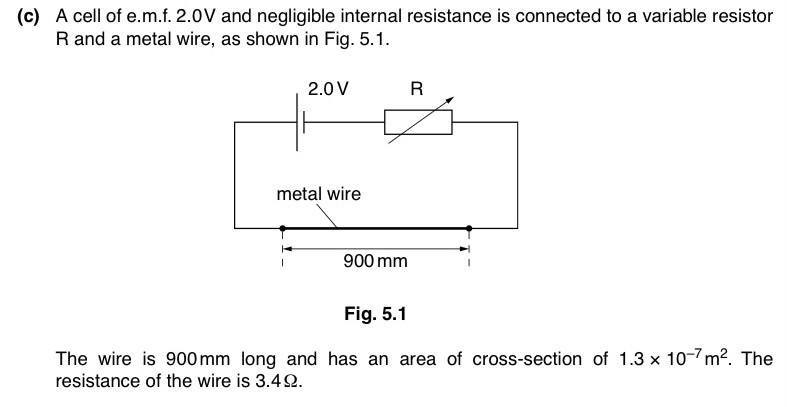
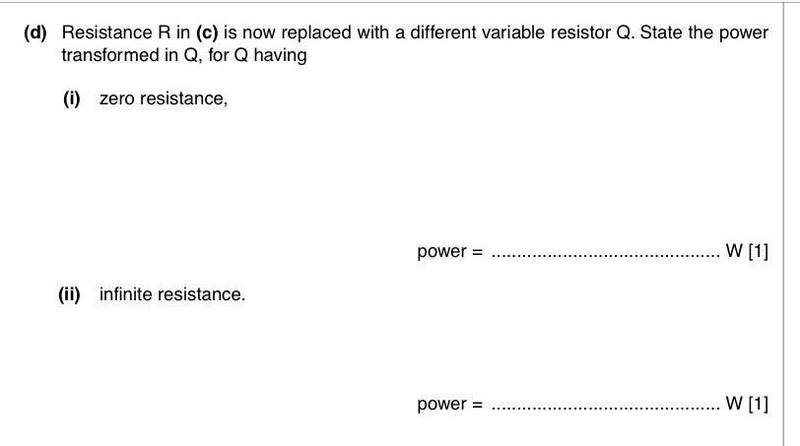
The discussion centers on the calculation of power in electrical circuits under conditions of zero and infinite resistance. For zero resistance, using the formula P=V²/R leads to an undefined situation (0/0), while P=I²R results in zero power, indicating the need to use the appropriate equation based on the context. When resistance is infinite, power tends to zero, and the voltage cannot exceed the source voltage, as this would imply zero current. Participants clarify the relationship between voltage, current, and resistance, emphasizing that V=IR holds true only at fixed current levels. The conversation concludes with an acknowledgment of the complexities involved in these calculations.
Janiceleong26
Messages
276
Reaction score
4
1. Homework Statement
image.jpg

image.jpg

Homework Equations


P=IV,
=I2R
=V2/R

The Attempt at a Solution


For zero resistance, I used P=V2/R formula, and sub. R=0 , power would be infinite. But if I sub. Into P=I2R, power will be zero. The correct answer should be zero. But why do we need to use the second relevant equation I typed above?
For infinite resistance, I used P=V2/R and so will result in power tending to zero.
I am confused on when to we use which equations to calculate power
 
Physics news on Phys.org
Janiceleong26 said:
For zero resistance, I used P=V2/R formula, and sub. R=0 , power would be infinite.
Both R and V go to zero, so you have "0/0" which is undefined. You cannot use this formula.
 
mfb said:
Both R and V go to zero, so you have "0/0" which is undefined. You cannot use this formula.
Oh I see.. Thanks
 
mfb said:
Both R and V go to zero, so you have "0/0" which is undefined. You cannot use this formula.
But if resistance is infinite, then shouldn't voltage be infinite too?
 
No. Why do you expect this?
 
mfb said:
No. Why do you expect this?
Because V=IR, V α R, though I feel that it doesn't make sense to have an infinite voltage..
 
Remember we are talking about the voltage drop across Q.
 
Janiceleong26 said:
Because V=IR, V α R, though I feel that it doesn't make sense to have an infinite voltage..
V α R is only true at fixed current.
What is the current you expect for infinite resistance?
And, as cross-check, can the voltage at the resistor exceed the source voltage?
 
mfb said:
V α R is only true at fixed current.
What is the current you expect for infinite resistance?
And, as cross-check, can the voltage at the resistor exceed the source voltage?
Zero current :biggrin:
Oh yeah.. Never thought of that too, thanks!
 

Similar threads

Replies
5
Views
2K
  • · Replies 3 ·
Replies
3
Views
1K
  • · Replies 3 ·
Replies
3
Views
1K
Replies
10
Views
2K
  • · Replies 42 ·
2
Replies
42
Views
5K
  • · Replies 24 ·
Replies
24
Views
5K
Replies
1
Views
1K
  • · Replies 1 ·
Replies
1
Views
2K
  • · Replies 11 ·
Replies
11
Views
6K
Replies
2
Views
1K