Precision Microwave-Background Fluctuations

  • Context: Undergrad 
  • Thread starter Thread starter sevensages
  • Start date Start date
sevensages
Messages
205
Reaction score
59
TL;DR
What does "Angular wavelength" mean in the diagram in Figure 4.2?

What is the point of the diagram in Figure 4.2?
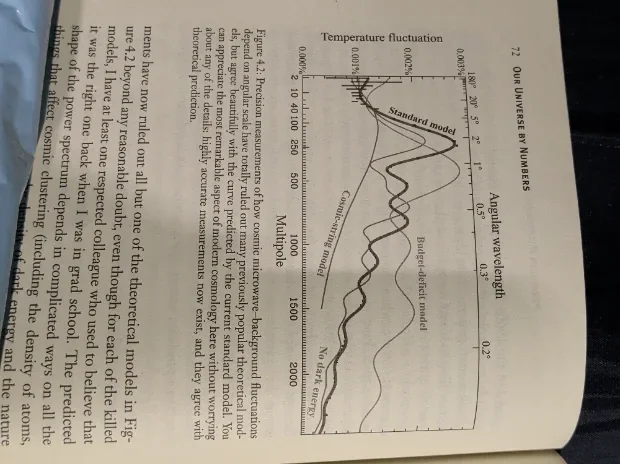
I just finished reading Max Tegmark's book Our Mathematical Universe. There is a diagram on page 72 of Our Mathematical Universe that I don't understand. The diagram shows the temperature fluctuation of four different models: 1# the standard model 2# Budget-deficit model 3# An unnamed model and 4# the Cosmic string model. The standard model and the unnamed model have peak temperature fluctuation at around 1.8 degrees. The budget deficit model has peak temperaure fluctuation at around 0.8 degrees. The cosmic string model has peak temperature fluctuation at around 2.2 degrees. All four models tend to have lower temperature fluctuation with a lower angular wavelength.

Here is a photograph of the diagram in Figure 4.2:
17811374463194154052950259548587.webp


I don't know how to post the photograph right side up. You should be able to read it sideways though.

Another clue to this might be the bottom of the diagram. The bottom of the diagram says "Multipoles". The standard model and the unnamed model peak at around 250 multipoles.

I know that a wavelength is measured from the crest to crest of a wave. But I don't know what "Angular wavelength" means. What does "Angular wavelength" mean in the diagram in Figure 4.2? I am not a physicist. I need you to explain this to me like I am a five year old. If you use a lot of technical jargon, I probably won't understand it. That's why I had to create this thread in the first place.

What is the point of the diagram in Figure 4.2?
 
Last edited:
  • Like
Likes   Reactions: 256bits
Physics news on Phys.org
17811387153828527027173216691221.webp

17811387524253644768142468839552.webp


Here is some context. This is pages 71 and 72
 
@berkeman you are knowledgeable about physics . What is your opinion on this?
 
sevensages said:
Here is some context. This is pages 71 and 72
Does not the first paragraph on page 72 explain the monopole as being the size partitions into which the map is broken up ie if the map is sliced into 2 hemispheres the monopole number is 2, and the angular wavelength is 180 degrees. I do not know the formula used to calculate the the angular wavelength - monopole as the whole map is spherical. ( for a waveform that we are used to, there is a relationship between frequency f, wavelength λ, and angular frequency ω --- for some reason the angular wavelength is in degrees, rather than radians ( as a length ( width ), representing the size of each monopole)
The temperature fluctuations are then plotted against the monopole-angular wavelength.
 
  • Like
Likes   Reactions: sevensages
256bits said:
Does not the first paragraph on page 72 explain the monopole as being the size partitions into which the map is broken up ie if the map is sliced into 2 hemispheres the monopole number is 2, and the angular wavelength is 180 degrees.

No. First of all, I am guessing that you mean page 71. Page 72 does not even have the word maps or map on it.

Neither page 71 nor page 72 say that the multipole is the size partitions into which the map is broken up. Neither page 71 nor page 72 say that if the map is sliced into two hemispheres, the multipole number is 2, and the angular wavelength is 180 degrees


I do not know the formula used to calculate the the angular wavelength - monopole as the whole map is spherical. ( for a waveform that we are used to, there is a relationship between frequency f, wavelength λ, and angular frequency ω --- for some reason the angular wavelength is in degrees, rather than radians ( as a length ( width ), representing the size of each monopole)
The temperature fluctuations are then plotted against the monopole-angular wavelength.
 
sevensages said:
First of all, I am guessing that you mean page 71.
I could't see which page was which.

sevensages said:
the map is sliced into two hemispheres, the multipole number is 2, and the angular wavelength is 180 degrees
One can get the relationship from the graph for those items as the example given. A line drawn from monopole 2 will match up with angular wavelength 180 degrees. The formula may involve a square root or something else for spherical coordinates. The text says "...can be decomposed into a sum of many different component maps called monopoles, which in essence, contain the contributions of spots of different sizes."
It goes on to explain that this is similar to the size of spots on a Dalmation, with some of the spots of the sky being 1 degree, others 2 degree, and so on.

Granted we do need a better explanation from someone in the actual field.


1781154979680.webp

That picture is from Wiki on Wavenumber
https://en.wikipedia.org/wiki/Wavenumber
 
Last edited:
Imagine a straight piece of string. You can shake one end of it to get waves travelling along it. You can measure the distance between similar points on each cycle of the wave, and that is the wavelength.

Now suppose the string was laid out in a circle. Your waves will travel along the string and you can still measure their wavelength. But you can also measure how many degrees around the circle each wave covers. A 1m wavelength wave on a 10m circumference circle is 36° long, for example. That would be an angular wavelength.

In the context of the CMB, they're (roughly speaking) talking about how many degrees on the sky the typical fluctuations cover. About 2° is popular.
 
  • Like
Likes   Reactions: 256bits
Adding to the above, for something like the CMB fluctuations, it's far better to talk about their angular scale than about their size in meters (or light years or whatever). The angular size is a direct measure, whereas a linear scale depends on your choice of cosmological model. So if the cosmologists wake up tomorrow and decide that they're completely wrong and the observable universe is 100 Gly in radius instead of 45 Gly, the scale on that graph is still just fine.

Also, in the example I talked about of the string, I talked about forming a circle. But the sky is a sphere. It's possible that if you take two different slices across the sky (say following the equator and around the Greenwich meridian) that you would get different typical scales of fluctuation. The correct way to handle this is to express the fluctuations in terms of spherical harmonics, and this analysis is where the language of monopole, dipole, quadrupole etc comes from. Doing it for the CMB shows that you don't need the more complex approach (any slice through the sky is much like any other), but you do have to do it to check that you don't need it.
 
  • Like
Likes   Reactions: 256bits

Similar threads

  • · Replies 29 ·
Replies
29
Views
5K
  • · Replies 13 ·
Replies
13
Views
8K
  • · Replies 8 ·
Replies
8
Views
3K
  • · Replies 1 ·
Replies
1
Views
4K
  • · Replies 7 ·
Replies
7
Views
3K
  • · Replies 0 ·
Replies
0
Views
4K
  • · Replies 4 ·
Replies
4
Views
4K
  • · Replies 4 ·
Replies
4
Views
5K
  • · Replies 62 ·
3
Replies
62
Views
13K
  • · Replies 1 ·
Replies
1
Views
4K