sevensages
- 233
- 68
- TL;DR
- What does "Angular wavelength" mean in the diagram in Figure 4.2?
What is the point of the diagram in Figure 4.2?
I just finished reading Max Tegmark's book Our Mathematical Universe. There is a diagram on page 72 of Our Mathematical Universe that I don't understand. The diagram shows the temperature fluctuation of four different models: 1# the standard model 2# Budget-deficit model 3# An unnamed model and 4# the Cosmic string model. The standard model and the unnamed model have peak temperature fluctuation at around 1.8 degrees. The budget deficit model has peak temperaure fluctuation at around 0.8 degrees. The cosmic string model has peak temperature fluctuation at around 2.2 degrees. All four models tend to have lower temperature fluctuation with a lower angular wavelength.
Here is a photograph of the diagram in Figure 4.2:
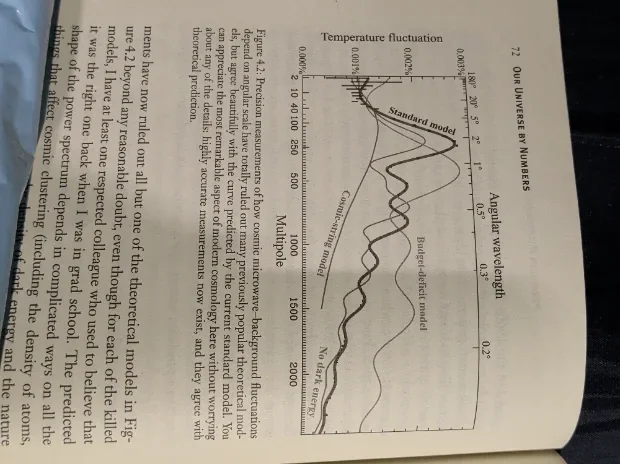
I don't know how to post the photograph right side up. You should be able to read it sideways though.
Another clue to this might be the bottom of the diagram. The bottom of the diagram says "Multipoles". The standard model and the unnamed model peak at around 250 multipoles.
I know that a wavelength is measured from the crest to crest of a wave. But I don't know what "Angular wavelength" means. What does "Angular wavelength" mean in the diagram in Figure 4.2? I am not a physicist. I need you to explain this to me like I am a five year old. If you use a lot of technical jargon, I probably won't understand it. That's why I had to create this thread in the first place.
What is the point of the diagram in Figure 4.2?
Here is a photograph of the diagram in Figure 4.2:
I don't know how to post the photograph right side up. You should be able to read it sideways though.
Another clue to this might be the bottom of the diagram. The bottom of the diagram says "Multipoles". The standard model and the unnamed model peak at around 250 multipoles.
I know that a wavelength is measured from the crest to crest of a wave. But I don't know what "Angular wavelength" means. What does "Angular wavelength" mean in the diagram in Figure 4.2? I am not a physicist. I need you to explain this to me like I am a five year old. If you use a lot of technical jargon, I probably won't understand it. That's why I had to create this thread in the first place.
What is the point of the diagram in Figure 4.2?
Last edited: