Discussion Overview
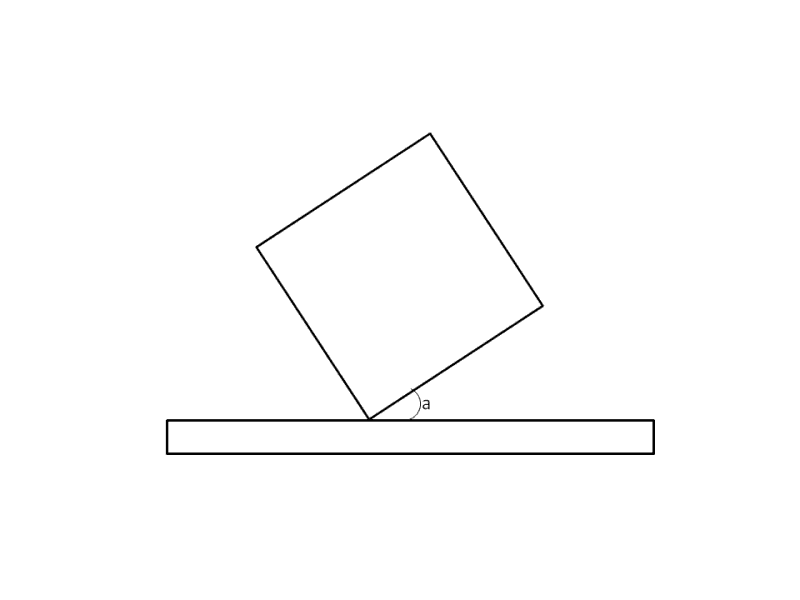
The discussion revolves around predicting the post-impact motion of a 2D object, specifically focusing on whether it will roll or bounce after colliding with a flat surface. Participants explore various factors influencing this motion, including inertia, angle of impact, and pre-impact velocities.
Discussion Character
- Exploratory
- Technical explanation
- Debate/contested
Main Points Raised
- One participant inquires about the necessary parameters to predict the post-impact motion of a square object, mentioning inertia, angle of impact, and velocities.
- Another participant questions the necessity of all mentioned parameters by suggesting a practical experiment with different materials (glass and rubber) and asks what is truly important for prediction.
- A participant proposes an analytical approach to predict outcomes based on energy ratios, suggesting that a threshold could determine whether the object will bounce or roll.
- One reply challenges the idea of creating a simplified analytical formula, implying that such an approach may not capture the complexities of the situation.
- Another participant expresses the need for quantifiable results for programming purposes, indicating a desire for a simplified model despite its potential inaccuracies.
- A later reply emphasizes the definition of rolling and points out that the motion of a square object upon impact may not meet the criteria for rolling due to its contact points not having zero velocity.
- One participant shares personal experimental observations, noting that the angle of impact significantly affects whether the object bounces or drops without bouncing.
- Another participant suggests utilizing existing physics engines for programming needs, indicating that there are resources available that could provide the necessary calculations.
Areas of Agreement / Disagreement
Participants express differing views on the importance of various parameters for predicting post-impact motion, with some advocating for a more analytical approach while others question its feasibility. The discussion remains unresolved regarding the best method to predict the outcomes.
Contextual Notes
There are limitations in the discussion regarding assumptions about material properties, the complexity of motion, and the definitions of rolling versus bouncing. The proposed analytical methods may depend on specific conditions that are not fully explored.