Pressure delta 1.0 bar: 0.0 to 1.0 vs 1.0 to 2.0

Click For Summary

Discussion Overview

The discussion revolves around the concept of pressure, specifically examining the implications of achieving a delta pressure of 1.0 bar in two different configurations of closed cylinders. Participants explore the nature of forces acting on the pipe walls under varying absolute pressures and the theoretical limits of creating a vacuum.

Discussion Character

  • Exploratory
  • Technical explanation
  • Conceptual clarification
  • Debate/contested

Main Points Raised

  • One participant questions whether the only force acting in a closed cylinder with a delta pressure of 1.0 bar is the delta pressure itself, suggesting a thought experiment about approaching absolute vacuum.
  • Another participant notes that differential pressure is typically what matters, and highlights the challenge of reaching deep vacuum due to the scarcity of gas molecules rather than energy expenditure.
  • There is a query about whether the forces on the pipe walls remain the same with a delta pressure of 1.0 bar, regardless of the absolute pressures inside and outside the cylinder.
  • A participant suggests that the internal stresses and strains within the pipe walls could differ if the wall material is compressible or if wall thickness is significant compared to the radii.
  • One participant proposes that isolating a volume of interstellar space could theoretically achieve 0.0 bar, prompting a discussion about the feasibility of cleaning out a container to reach such a state.
  • Another participant questions the relationship between pressure and energy, drawing parallels to reaching absolute zero temperature and the speed of light, suggesting an exponential energy requirement to approach these limits.
  • There is a discussion about the undefined nature of temperature in a vacuum and the implications of internal stresses in materials when external pressure is absent.
  • One participant advises consulting literature on the strength of materials to better understand the relationship between pressures, stresses, and strains.

Areas of Agreement / Disagreement

Participants express differing views on the feasibility of achieving absolute vacuum and the implications of pressure on material properties. There is no consensus on the nature of forces acting on the pipe walls or the relationship between pressure and energy requirements.

Contextual Notes

Participants discuss various assumptions related to the compressibility of materials and the significance of wall thickness in determining internal stresses. The conversation includes speculative scenarios about achieving extreme conditions, which remain unresolved.

kaare_t
Messages
4
Reaction score
11
TL;DR
Approaching absolute vacuum versus not absolute vacuum with the same delta P, forces involved
Hi,

New member here. I have no higher education, please excuse me if I'm asking an obvious question, and feel free to reply with more questions if my post is unclear! And please feel free to correct me if I'm using wrong term(s), or wrong assumptions.

My question is related to pressure, and more specifically if approaching an absolute vaccum (I know it's impossible to reach 0.0 bar, but my post is more of a thought-experiment).

My question is if there is any difference between two configurations where the delta pressure is 1.0 bar in both configurations (see picture). The picture is of two different cylinders that are closed, and in both examples my intention is to have a delta P of 1.0 bar. Are there any other forces than the delta pressure involved in such an example, or can I assume that the only force applied is the delta P?

My own wonderings are about approaching 0.0 bar, will the forces acting on the pipe-wall look similar to e.g. an object approaching the speed of light (a curve of applied energy that exponentially grows into infinity)? And if so, can I assume that pressure is related to energy in a sense that you would need infinite energy to create an absolute vacuum?
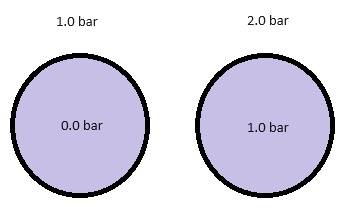
Example_Deltap_1.jpg
 
Science news on Phys.org
Welcome! :smile:

Normally, differential pressure is what matters.
Not if the machine doing the work has dissimilar conditions.
Are you familiar with the concepts of absolute and relative pressures?
The main problem with reaching deep vacuum is not energy used, but to catch the increasingly scarce molecules of the gas inside the container.
 
  • Like
Likes   Reactions: kaare_t
Hi, and many thanks! :smile:

I realize I'm asking two questions at the same time, I hope that's OK. I'm also interested in a bit more detailed answers, so I'm trying to be more precise below.

Lnewqban said:
Normally, differential pressure is what matters.
Not if the machine doing the work has dissimilar conditions.
I'm not sure what you mean by
  1. Normally, ......
  2. ....... dissimilar conditions
in my scenario, would you please specify a bit more?

Most importantly, are the forces acting on the pipe-wall the same, as long as the differential pressure is 1.0 bar, regardless of inner/outer absolute pressure? Mathematically I think the test-parameters would look like:
Inner absolute pressure = x, Outer absolute pressure = x+1​
X can be any number​
The forces acting on the pipe-wall will always be the same?​

Lnewqban said:
The main problem with reaching deep vacuum is not energy used, but to catch the increasingly scarce molecules of the gas inside the container.
Thanks. But the process of creating a vacuum requires energy, and to my understanding reaching 0.0 bar is not possible just like reaching 0.0 Kelvin is not possible. I made an assumption that both of these might be in the same category as reaching the speed of light. To my understanding
{\displaystyle E=mc^{2}}
can be translated to accelleration requires energy, but it requires an infinite amount of energy to reach the speed of light for any object with a mass. Hence the exponential graph.

To try and visualize, if we had graphs of consumed energy for theoretically reaching:
  1. c (speed of light)
  2. 0.0 Kelvin
  3. 0.0 bar
Would they basically look the same way (discarding the axis-values of speed, temperature and pressure)?

If energy is not the correct factor to describe the process of creating vacuum, would you please provide me the correct factor that limits the ability to create 0.0 bar?

Thanks for any help and pointers!
 
kaare_t said:
Hi, and many thanks! :smile:

I realize I'm asking two questions at the same time, I hope that's OK. I'm also interested in a bit more detailed answers, so I'm trying to be more precise below.I'm not sure what you mean by
  1. Normally, ......
  2. ....... dissimilar conditions
in my scenario, would you please specify a bit more?

Most importantly, are the forces acting on the pipe-wall the same, as long as the differential pressure is 1.0 bar, regardless of inner/outer absolute pressure? Mathematically I think the test-parameters would look like:
Inner absolute pressure = x, Outer absolute pressure = x+1​
X can be any number​
The forces acting on the pipe-wall will always be the same?T​
The net radial are the same in both cases, but the individual forces on the pipe surfaces are not the same. And the hoop forces within the pipe walls are the same. This is provided that the wall material is incompressible and the wall thicknesses are small compared to the radii. If not,, the internal stresses and strains within the walls will differ in the two cases
 
  • Like
Likes   Reactions: kaare_t
kaare_t said:
to my understanding reaching 0.0 bar is not possible
There is on average one atom per cubic centimeter in the interstellar space of the Milky Way. So, one could isolate a volume of this space with no atoms in it. Wouldn't it make 0.0 bar?
 
Hill said:
So, one could isolate a volume of this space with no atoms in it.
How would you clean out the inside of the container first? :wink:
 
berkeman said:
How would you clean out the inside of the container first? :wink:
I'd assemble the container in space.
 
Thanks for all inputs, I'm following up again with some additional wonderings.

Chestermiller said:
This is provided that the wall material is incompressible and the wall thicknesses are small compared to the radii. If not,, the internal stresses and strains within the walls will differ in the two cases
Does it mean that the delta pressure forces are always acting on the pipe-walls in the same way (as stated in the first reply to my post), but in the absence of pressure the material of the walls facing lach of pressure will suffer "more" from it's internal stresses in it's chemical bonds? Or in a different sentence; without external pressure, materials are "forced less together"?

If I understood the above correctly, it kind of answers both my questions I think. Does there exist any graphs or similar that shows these effects? And does there exist some kind of issue if we raised the pressure super-high (but still with a delta P of 1.0 bar)?
Hill said:
Wouldn't it make 0.0 bar?
Are you asking, or stating?🙃 I agree, but if you managed this you would also have 0.0 K in the container, so 2 for 1! :smile:
 
kaare_t said:
would also have 0.0 K in the container
I don't think so. If there is nothing in the container then the temperature is undefined.
 
  • Like
Likes   Reactions: kaare_t and jbriggs444
  • #10
kaare_t said:
Thanks for all inputs, I'm following up again with some additional wonderings.Does it mean that the delta pressure forces are always acting on the pipe-walls in the same way (as stated in the first reply to my post), but in the absence of pressure the material of the walls facing lach of pressure will suffer "more" from it's internal stresses in it's chemical bonds? Or in a different sentence; without external pressure, materials are "forced less together"?
Get yourself a book on "strength of materials" to understand how pressures, stresses, and strains are related. The average of the internal and external pressures determines how much on average the molecules are forced together radially. The difference of the internal and external pressures determines how much the molecules are stretched apart in the hoop direction. The forcing together- or pulling apart of the molecules is a directional effect.
kaare_t said:
If I understood the above correctly, it kind of answers both my questions I think. Does there exist any graphs or similar that shows these effects? And does there exist some kind of issue if we raised the pressure super-high (but still with a delta P of 1.0 bar)?
Are you asking, or stating?🙃 I agree, but if you managed this you would also have 0.0 K in the container, so 2 for 1! :smile:
 
  • Like
Likes   Reactions: kaare_t
  • #11
Chestermiller said:
Get yourself a book on "strength of materials" to understand how pressures, stresses, and strains are related.
Thanks for the tip, will do! And also thanks for your replies!
Hill said:
I don't think so. If there is nothing in the container then the temperature is undefined.
I do agree with you!
 

Similar threads

  • · Replies 20 ·
Replies
20
Views
4K
  • · Replies 2 ·
Replies
2
Views
2K
  • · Replies 16 ·
Replies
16
Views
3K
  • · Replies 20 ·
Replies
20
Views
3K
Replies
4
Views
636
  • · Replies 4 ·
Replies
4
Views
2K
  • · Replies 7 ·
Replies
7
Views
3K
  • · Replies 7 ·
Replies
7
Views
3K
  • · Replies 3 ·
Replies
3
Views
2K
  • · Replies 5 ·
Replies
5
Views
2K