Pressure/force calculation for combustion in a cylinder

Click For Summary
SUMMARY

The discussion focuses on calculating dynamic combustion pressure, force, and piston velocity in a cylinder for various fuels, specifically in applications like a fuel-driven nail gun using butane gas. Key parameters include the mass of the cylinder (M), spring constant (k), distance moved (x), cylinder diameter (D), and the initial volume and pressure of the fuel-air mixture. The compression ratio prior to ignition significantly influences the resultant force. For in-depth understanding, the book "Internal Combustion Engines" by Obert is recommended, despite being out of print.

PREREQUISITES
  • Understanding of combustion principles and thermodynamics
  • Knowledge of internal combustion engine mechanics
  • Familiarity with pressure and force calculations
  • Basic grasp of fuel properties and their combustion characteristics
NEXT STEPS
  • Research the effects of compression ratio on combustion efficiency
  • Study the principles of dynamic pressure calculations in cylinders
  • Explore the properties of butane and other fuels in combustion applications
  • Learn about the design and function of fuel-driven pneumatic tools
USEFUL FOR

Engineers, mechanical designers, and anyone involved in the design and optimization of combustion engines or pneumatic tools will benefit from this discussion.

Stormer
Messages
121
Reaction score
22
Hi. How do i calculate the dynamic combustion pressure, force and piston velocity for different fuels in a cylinder? Assuming perfect combustion and no thermal loss trough the walls and piston.

I am thinking about an application similar to for example a fuel driven nail gun that runs on a butane gas and air mixture.

The known parameters is:
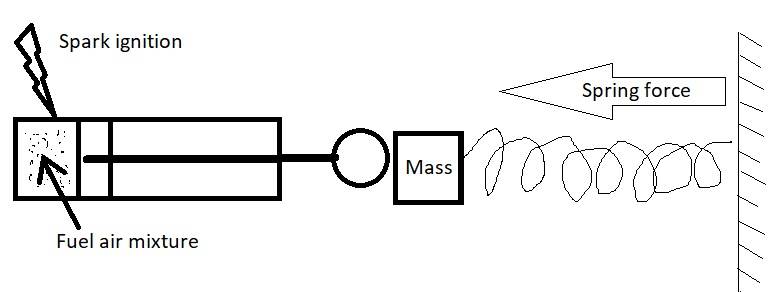
  • The mass the cylinder will move (M)
  • A spring constant and the distance the cylinder will move (F = kx)
  • The diameter of the cylinder (D)
  • The initial volume and pressure of fuel air mixture (in perfect ratio).
  • The fuel used (and that will give the combustion energy and therefore temperature and pressure rise in the cylinder)
Combustion cylinder.jpg
 
Last edited:
Engineering news on Phys.org
Get a book on internal combustion engines. I have a copy of Internal Combustion Engines by Obert that has a whole chapter that answers your question, but that book is long out of print. Search Amazon for internal combustion engines, and you will get a list of books that all look like they will answer your question.
 
  • Like
Likes   Reactions: Lnewqban

Similar threads

  • · Replies 2 ·
Replies
2
Views
2K
  • · Replies 18 ·
Replies
18
Views
670
  • · Replies 45 ·
2
Replies
45
Views
6K
Replies
0
Views
2K
  • · Replies 3 ·
Replies
3
Views
2K
  • · Replies 11 ·
Replies
11
Views
5K
Replies
7
Views
4K
  • · Replies 5 ·
Replies
5
Views
11K
Replies
4
Views
2K
Replies
5
Views
4K