Probability: pair of random variables

Join the discussion
Registration is free. Ask a follow-up in this thread, or start your own.
5 replies · 2K views · last reply
ashah99
Messages
55
Reaction score
2
Homework Statement
Problem shown below. Various topics related to the joint pdf and RVs
Relevant Equations
Equations used are shown in working attempt below.
Hello all, I would like to check my understanding and get some assistance with last part of the following question, please.
For part (d), would I use f(x | y) = f(x, y) / f(y) ?

Problem statement:
Problem statement: joint pdf f(x, y) = c x^2 (1 - x) y for x in (0,1) and y in (0,1), 0 elsewhere; parts (a) to (d) list finding c, the correlation coefficient, P(X + Y <= 1) and P(X + Y <= 1 | Y <= 0.5). Small sketch shows the unit square region in the first quadrant.


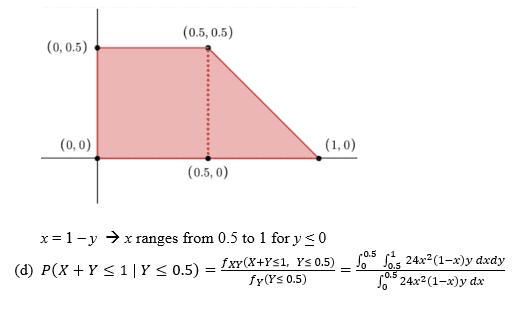
My attempt at a solution, not too confident in my set-up for part (d). I drew a sketch of the region of integration.
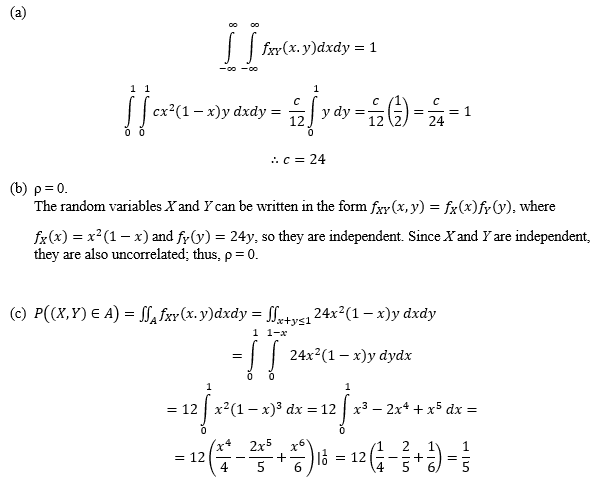
Worked solution with equations: (a) normalisation integral of c x^2(1-x)y over the unit square giving c = 24; (b) rho = 0 and independence of X and Y; (c) probability integral over x+y<=1 evaluated to 1/5.

Trapezoid-shaped region in the xy-plane with vertices at (0, 0), (1, 0), (0.5, 0.5) and (0, 0.5), shaded red, with a dotted vertical line at x = 0.5. Below it: x = 1 - y, x ranges from 0.5 to 1 for y ≤ 0, and the conditional probability P(X + Y ≤ 1 | Y ≤ 0.5) written as a ratio of integrals.
 
Physics news on Phys.org
Your approach is broadly correct, with a few glitches in implementation.

The denominator in the last line must be a double integral, otherwise you can't get a value for it. You need to integrate over the rectangle ##[0,1]\times [0,0.5]##.
You need to break the numerator into two separate integrals: one covering the square on the left and one covering the triangle on the right.

One does not write, as in your central expression on the last line:
$$\frac{f_{XY}(X+Y\leq 1, Y\leq 0.5)}
{f_Y(Y\leq 0.5)}$$
You should write something like
$$\frac{Pr(X+Y\leq 1\wedge Y\leq 0.5)}
{Pr(Y\leq 0.5)}$$
where the ##Pr## indicates 'probability of' and ##\wedge## means 'and'.
 
andrewkirk said:
Your approach is broadly correct, with a few glitches in implementation.

The denominator in the last line must be a double integral, otherwise you can't get a value for it. You need to integrate over the rectangle ##[0,1]\times [0,0.5]##.
You need to break the numerator into two separate integrals: one covering the square on the left and one covering the triangle on the right.

One does not write, as in your central expression on the last line:
$$\frac{f_{XY}(X+Y\leq 1, Y\leq 0.5)}
{f_Y(Y\leq 0.5)}$$
You should write something like
$$\frac{Pr(X+Y\leq 1\wedge Y\leq 0.5)}
{Pr(Y\leq 0.5)}$$
where the ##Pr## indicates 'probability of' and ##\wedge## means 'and'.

Thank you for the pointers. I very well could still be off on the integral bounds, but if I understood your reply correctly, I get an answer of 0.5875.

Worked solution for P(X + Y ≤ 1 | Y ≤ 0.5) as a ratio of double integrals of 24x²(1 − x)y, the final fraction (5/64 + 11/160) over 1/4 equal to 47/80 = 0.5875.
 
That's right. Note that you could have written the numerator as
$$\int_0^{1/2}\int_0^{1-y} f(x,y)\,dx\,dy.$$ Your original attempt just had the limits wrong. What @andrewkirk probably had in mind was
$$\int_0^{1/2}\int_0^{1/2} f(x,y)\,dy\,dx + \int_{1/2}^1 \int_0^{1-x} f(x,y)\,dy\,dx$$ The first integral is the square, and the second integral is the triangular region.
 
vela said:
That's right. Note that you could have written the numerator as
$$\int_0^{1/2}\int_0^{1-y} f(x,y)\,dx\,dy.$$ Your original attempt just had the limits wrong. What @andrewkirk probably had in mind was
$$\int_0^{1/2}\int_0^{1/2} f(x,y)\,dy\,dx + \int_{1/2}^1 \int_0^{1-x} f(x,y)\,dy\,dx$$ The first integral is the square, and the second integral is the triangular region.

Thank you for your explanation and the integral bounds that you proposed are more intuitive. Do you agree with the final answer for (d)? Also, are my answers for parts (a) - (c) correct? I realize that I have to split the constant c=24 between FX(x) and fY(y) such that both would integrate to 1, i.e. fX (x) = 12x^2(1-x) and fY(y) = 2y.
 
I got the same answer for (d). The rest looks good as well.