Problem in getting correct coefficients of frictional forces

Click For Summary

Discussion Overview

The discussion revolves around the application of Lagrangian mechanics in systems that include frictional forces. Participants explore the challenges of obtaining correct equations of motion when dissipative forces are present, particularly focusing on the coefficients of frictional forces and the use of generalized forces.

Discussion Character

  • Technical explanation
  • Debate/contested

Main Points Raised

  • One participant notes that while they can derive correct equations using the Lagrangian method in conservative systems, they encounter issues with frictional systems, particularly with the coefficients of frictional forces.
  • Another participant states that standard Lagrangian mechanics does not accommodate dissipative systems, suggesting a limitation in the method's applicability.
  • A participant clarifies that they are using a version of Lagrangian mechanics that incorporates generalized forces, indicating a distinction between regular and generalized forces.
  • There is a discussion about the definition of generalized forces, with a participant providing a formula that includes a factor of 2, which they believe is relevant to the problem at hand.
  • One participant expresses uncertainty about the term "standard" in the context of Lagrangian mechanics and mentions their experience using Lagrange for systems with losses, referencing a specific textbook.
  • Another participant questions the edition of the textbook being referenced, indicating a potential difference in content that may affect the discussion.

Areas of Agreement / Disagreement

Participants express differing views on the applicability of standard Lagrangian mechanics to systems with friction. There is no consensus on the correct approach or interpretation of generalized forces, and the discussion remains unresolved regarding the specific issues raised by the original poster.

Contextual Notes

Limitations include the potential misunderstanding of the definitions of generalized forces and the specific conditions under which Lagrangian mechanics can be applied to dissipative systems. Participants also reference different editions of a textbook, which may lead to variations in the content discussed.

Amitayas Banerjee
Messages
31
Reaction score
2
I am getting correct equations on using the Lagrangian method in Systems with no non conservative forces, but when I use it in Systems with friction, sometimes I get correct equations, and sometimes I do not. Most of the equations have some problem with the coefficients of the frictional forces.
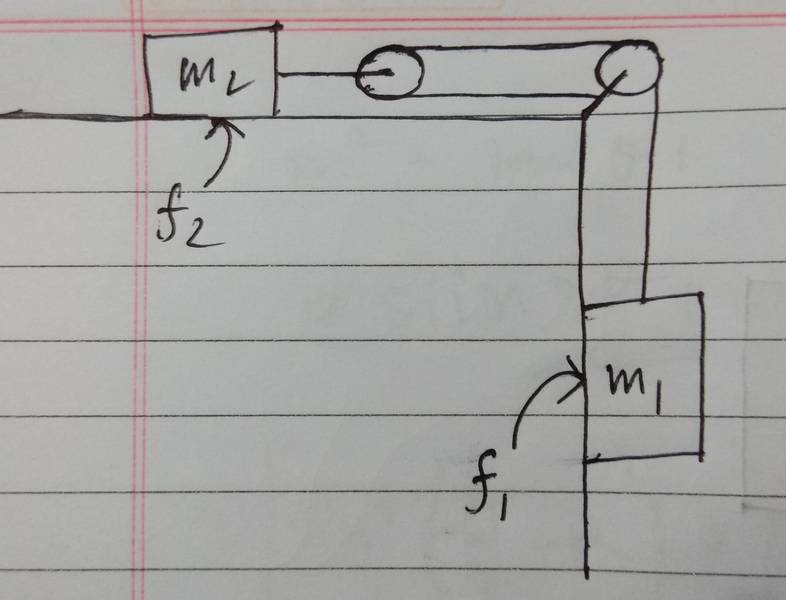
For example, let us take a look at this system...
ss3iS.jpg


Here f1,f2 are the frictional forces(and not the coefficients of friction)

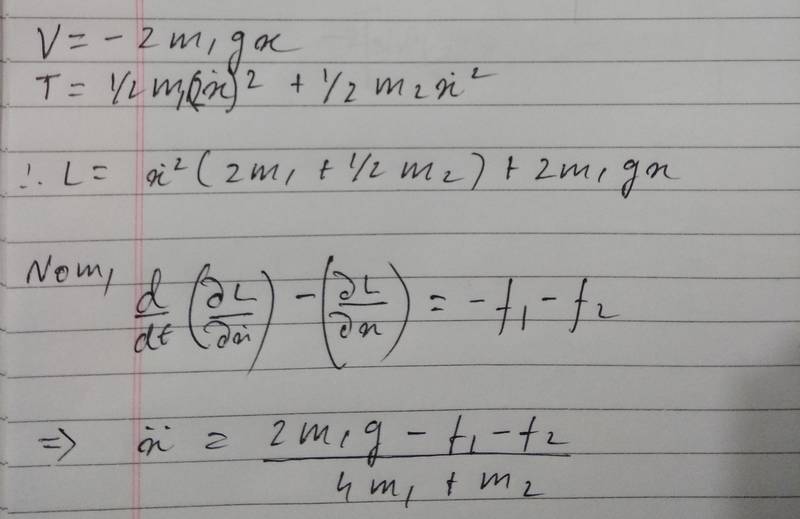
Now, let the block with mass $m_2$ move through a distance $x$ to ward the right.
Vqyxs.jpg


now, when we apply Newton's second law, we see that this is wrong and the coefficient of f1should have been 2
Why is the problem?...on the right hand side I have written the generalized force and the the two Lagrangian terms on the left hand side. Please help me out.
 

Attachments

  • ss3iS.jpg
    ss3iS.jpg
    31.5 KB · Views: 562
  • Vqyxs.jpg
    Vqyxs.jpg
    32.4 KB · Views: 551
Physics news on Phys.org
Standard Lagrangian mechanics does not handle dissipative systems.
 
Orodruin said:
Standard Lagrangian mechanics does not handle dissipative systems.
I have not used that...I have used the version with generalized forces(RHS has got -f1-f2)
 
Amitayas Banerjee said:
I have not used that...I have used the version with generalized forces(RHS has got -f1-f2)
The RHS that you wrote is not the generalized forces, it is the regular forces. The generalized forces are
$$F_i \cdot \frac{\partial v_i}{\partial \dot{q_j}}$$
That is where the factor of 2 comes in
 
  • Like
Likes   Reactions: Amitayas Banerjee
Dale said:
The RHS that you wrote is not the generalized forces, it is the regular forces. The generalized forces are
$$F_i \cdot \frac{\partial v_i}{\partial \dot{q_j}}$$
That is where the factor of 2 comes in
Sirl, is that vi=xdot i?
 
Orodruin said:
Standard Lagrangian mechanics does not handle dissipative systems.

I'm not sure what "standard" means in this context, but I use Lagrange frequently for systems involving losses. See Goldstein, pp. 38 - 40.
 
Amitayas Banerjee said:
Sirl, is that vi=xdot i?
@Dr.D Sir, can you clarify this?
 
Amitayas Banerjee said:
Sirl, is that vi=xdot i?
Yes
 
Dr.D said:
I'm not sure what "standard" means in this context, but I use Lagrange frequently for systems involving losses. See Goldstein, pp. 38 - 40.
What edition are you using? Pages 38 to 40 in my Goldstein is just general variational calculus.

Anyway, I read the OP and replied a bit fast it seems. By "standard" I was meaning only letting the variation of an action be equal to zero, which is what most students learn first and many do not go beyond. For some reason I thought the OP was trying to do something like trying to introduce friction forces in the Lagrangian.
 
  • #10
Orodruin said:
What edition are you using?
There is no edition number in my copy, only a 1959 copyright date and the notation 6th printing. For this reason, I presume it is a 1st edition. I used it as a textbook in the school year 1963-64. I've been using this to good effect ever since.
 

Similar threads

  • · Replies 8 ·
Replies
8
Views
6K
  • · Replies 17 ·
Replies
17
Views
3K
  • · Replies 35 ·
2
Replies
35
Views
5K
  • · Replies 8 ·
Replies
8
Views
2K
  • · Replies 4 ·
Replies
4
Views
2K
  • · Replies 5 ·
Replies
5
Views
2K
  • · Replies 7 ·
Replies
7
Views
18K
  • · Replies 13 ·
Replies
13
Views
3K
  • · Replies 2 ·
Replies
2
Views
4K
  • · Replies 11 ·
Replies
11
Views
3K