Problem integrating with the disk method

Click For Summary
The discussion revolves around challenges faced in integrating a problem using the disk method versus spherical coordinates. The user initially divided the integration region into two parts, A1 and A2, but struggled with the integration limits and calculations. Clarifications were provided regarding the correct limits for integration, specifically that r should be integrated from 0 to √z rather than 0 to z. After correcting the algebraic errors in the integrals, the user confirmed that they had resolved their issues with the integration. The conversation highlights the importance of accurately defining integration regions and limits in multivariable calculus.
Amaelle
Messages
309
Reaction score
54
Homework Statement
look at the image
Relevant Equations
polar coordinates
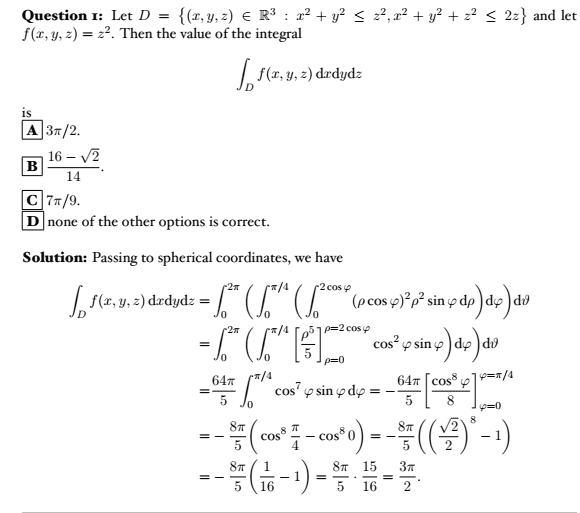
Good day I have the following exercice and it's solved using spherical coordinates
1613318590947.png

I totally agree with the solution but I have issue to find out why mine does not work
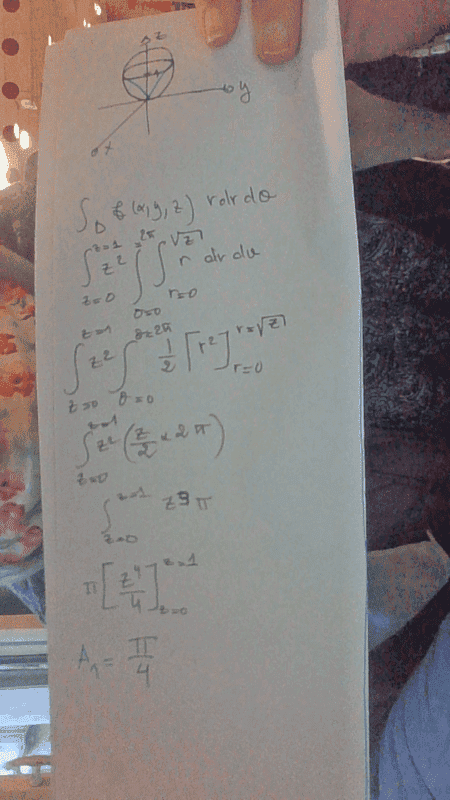
I used the the integration by disk
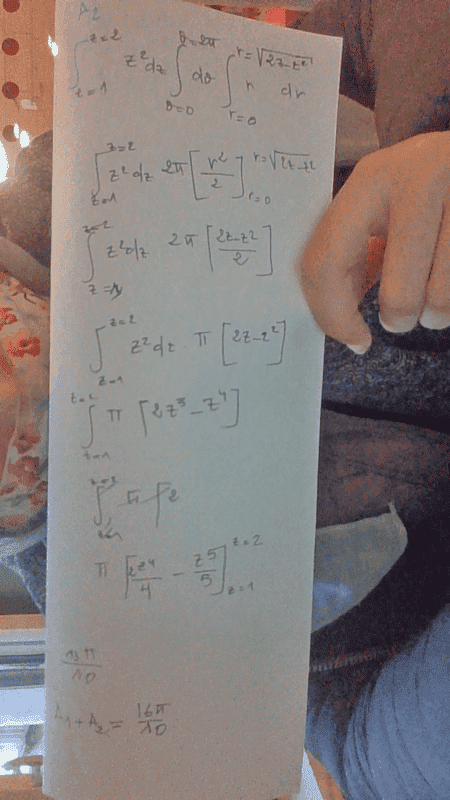
I divided the region of integration to 2 A1 and A2 (A2 is the upper half sphere and A1 is the region delimitated by the cone
1613318883639.png

1613318937608.png
Many thanks in advance!
 
Physics news on Phys.org
How did you decide that those two regions A1 and A2 were the correct regions to plot? Try plotting r = \sqrt{x^2 + y^2} vs z for the two conditions given. What is the shape of the resulting region?

Ignore that post. I think you have the regions correct. Another question. Why did you integrate from r=0 to r=√z in the first integral. Shouldn't it be from r=0 to r=z?

Also, I think you just did the algebra wrong in the second integral. I get \frac {13 \pi}{10}
 
Last edited:
1613324424788.png


this is the region I'm getting
the cone region I have gotten by calculation the integral from r= 0 to r=sqrt(z)
and the half sphere region that I got from r=0 to r=sqrt(2z-z^2)
I know something is wrong here
thanks
 
Please look at the edits to my post. I agree the regions look correct, but I think you made two errors in evaluating the integrals. Correct those and see what you get.
 
Also, you should learn to input the math in latex. It is much easier for us to read than pictures of your hand-written work.
 
thanks a million! it's ok now my mistake was that r=sqrt(z)!
you saved my life!
 
Question: A clock's minute hand has length 4 and its hour hand has length 3. What is the distance between the tips at the moment when it is increasing most rapidly?(Putnam Exam Question) Answer: Making assumption that both the hands moves at constant angular velocities, the answer is ## \sqrt{7} .## But don't you think this assumption is somewhat doubtful and wrong?

Similar threads

  • · Replies 1 ·
Replies
1
Views
1K
  • · Replies 2 ·
Replies
2
Views
1K
  • · Replies 2 ·
Replies
2
Views
1K
  • · Replies 4 ·
Replies
4
Views
1K
Replies
3
Views
2K
  • · Replies 7 ·
Replies
7
Views
1K
Replies
4
Views
1K
  • · Replies 4 ·
Replies
4
Views
2K
Replies
5
Views
3K
  • · Replies 2 ·
Replies
2
Views
2K