Problem using Pulleys with Weight in Equilibrium

11 replies · 4K views · last reply
Tygra
Messages
55
Reaction score
8
Homework Statement
Calculate angle of mast and the compression force in the mast
Relevant Equations
In the question
Dear all,

I have the following problem:

Free-body diagram of a symmetric two-mast frame with pulleys at the mast tops, a 5 kN load hanging from a rope, and cables at 45 deg and 30 deg angles; the masts are labelled C and hinged at the base at X deg.

I need to find the compression "C" in the mast and the angle that the masts makes with the horizontal (X degrees).

I know that the tension in the ropes "T" are of the same magnitude on both sides of the pulley, but I am struggling with finding C and X.

Could someone help please?
 
Attachments
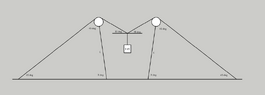
  • Free-body diagram of a pulley system: two pulleys on tall masts with a 5 kN load hanging from a rope joint; cables run at 45 deg to the ground and 30 deg from horizontal, masts labelled C at angle X deg.
    Screenshot 2024-10-30 225617.png
    5.3 KB · Views: 111
  • Free-body diagram of a pulley system with a 5 kN load hung from a rope over two pulleys at the top, with two inclined masts hinged at the ground, labelled 45 deg, 30 deg, X deg and C.
    Screenshot 2024-10-30 230624.png
    5.2 KB · Views: 114
If nothing is moving, all forces are in balance.
What have you done so far in terms of free body diagrams?
 
Hi Lnewqban,

this is how I attempt the question:

Handwritten statics working on ruled paper: (1/2)T + (√2/2)T - 5 = 0, giving 1.21T = 5 and T = 4.13 kN, followed by force equilibrium equations ΣFy and ΣFx with C sin x and C cos x terms.

When I do the final algebra, I am way off.
 
Tygra said:
Hi Lnewqban,

this is how I attempt the question:

View attachment 352905
When I do the final algebra, I am way off.
Please share a Free body diagram of the hanging weight, and a separate FBD of the mast.
 
Lnewqban said:
It seems that the original diagram shows the top 45° angle in error, as its reference should be a vertical line rather than C.
So are you saying they did this on purpose?

Can I ask, how you would attempt this question?
 
No, I don’t.
Yes, you can: a free body diagram would be my very first step.
 
Lnewqban said:
No, I don’t.
Yes, you can: a free body diagram would be my very first step.
So it must be a typo in the book? This problem is from a book.

Here is my free body diagram:

Free-body diagram of a pulley system: a frictionless pulley at the top with a 45 deg rope segment labelled T to the ground on the left, a 30 deg rope segment labelled T carrying a 5 kN weight on the right, and a rope labelled C at X deg to the ground on the right.


Is this correct?
 
Tygra said:
So it must be a typo in the book? This problem is from a book.

Here is my free body diagram:

View attachment 352917

Is this correct?
FBD of what? You isolate the hanging mass. Forces of weight ##W## and tension(s) ##T## act on it. You use it to find ##T## in terms of ##W##. Thats one FBD. The other is a Free body diagram of the member ##C##. You isolate the mast from the external surroundings. Tension forces, and reaction forces at the hinge should be shown. You use both component equations simultaneously to find the angle ##X##.
 
Thank you. I have it now. I think I was making it more complicated than what it was.
 
Tygra said:
So it must be a typo in the book? This problem is from a book.

Here is my free body diagram:

View attachment 352917

Is this correct?
Yes, it must be a typo.
Otherwise they would be giving away angle x as being 90° (45+45+90=180), which is an incorrect value.

In order to properly calculate T, you need to consider the “Y” formed by T, T and 5 kN.
In this case the “Y” is symmetrical and the value of T is the same on the left and the right sides, but it is not always that way.
Hope you have checked the example in the link previously posted.