Problem with the Finite Element Method applied to Electrostatics

Click For Summary

Discussion Overview

The discussion revolves around the application of the Finite Element Method (FEM) to solve the Poisson equation in the context of electrostatics, specifically addressing challenges related to modeling a line charge and its effects on the electrostatic potential.

Discussion Character

  • Exploratory
  • Technical explanation
  • Debate/contested

Main Points Raised

  • One participant describes their successful use of a code for solving the Poisson equation in temperature problems but encounters difficulties when applying it to an electrostatic problem involving a line charge.
  • The participant mentions using the Dirac delta function to represent the charge density but reports incorrect results from their code.
  • Another participant expresses confusion about the original question and requests clarification, suggesting the need for a visual representation of the problem.
  • A participant reflects on past methods of solving similar problems without modern computational tools, indicating a generational gap in approaches to the topic.

Areas of Agreement / Disagreement

Participants do not appear to reach a consensus on the best approach to model the line charge or the specifics of the electrostatic problem, indicating multiple competing views and unresolved questions.

Contextual Notes

There are limitations in the discussion regarding the assumptions made about the charge density representation and the specifics of the electrostatic setup, which remain unresolved.

Who May Find This Useful

Individuals interested in computational methods for solving electrostatic problems, particularly those using the Finite Element Method, may find this discussion relevant.

Alan Lins Alves
Messages
4
Reaction score
0
Hi!
I have a code that solve the poisson equation for FEM in temperature problems.
I tested the code for temperature problems and it works!

Now i have to solve an Electrostatic problem.
There is the mesh of my problem (img 01).

At the left side of the mesh we have V=0 (potencial).
There is a line charge located in (0.5,0) with charge density λ=1/(4*pi).

The poisson equation for electrostatics is:
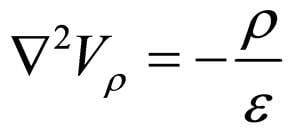
7ebcf984-7712-4702-803b-256b121ea07f.jpg


My dificulty is how to solve it for a line charge (what is the best equation for ρ). I used the Dirac delta, and some aproximations for delta function but my code has wrong results.
 

Attachments

  • 01.png
    01.png
    9.2 KB · Views: 466
  • 7ebcf984-7712-4702-803b-256b121ea07f.jpg
    7ebcf984-7712-4702-803b-256b121ea07f.jpg
    3.3 KB · Views: 716
Engineering news on Phys.org
Anyone can help me?
Please
 
wow
it's been fifty+ years and the term "Dirac delta" is unfamiliar
and in my day we didn't have computers with precoded solutions .

In slide rule days we'd integrate along the line.

sorry i can't be more help.

old jim
 
Alan Lins Alves said:
I tested the code for temperature problems and it works
Hi,

then how did you specify a pointlike heat source ?
 
jim hardy said:
wow
it's been fifty+ years and the term "Dirac delta" is unfamiliar
and in my day we didn't have computers with precoded solutions .

In slide rule days we'd integrate along the line.

sorry i can't be more help.

old jim

Ok,
Thanks old Jim!
 
BvU said:
Hi,

then how did you specify a pointlike heat source ?

3326OS_06_01F.jpg

This is the Poisson equation for temperature problem.
Note that temperature is in left side of equation.
 

Attachments

  • 3326OS_06_01F.jpg
    3326OS_06_01F.jpg
    4.1 KB · Views: 508
Alan,
I've done a lot of electrostatic calculations, analytical, numerical and FEA. However, I don't quite understand your question.
Could you elaborate on it? Draw a picture without a mesh to start with.
Are you trying to calculate the field of a charged wire next to a ground plane?
 

Similar threads

Replies
3
Views
2K
  • · Replies 4 ·
Replies
4
Views
3K
  • · Replies 6 ·
Replies
6
Views
4K
  • · Replies 2 ·
Replies
2
Views
1K
  • · Replies 9 ·
Replies
9
Views
3K
  • · Replies 2 ·
Replies
2
Views
2K
  • · Replies 4 ·
Replies
4
Views
2K
  • · Replies 3 ·
Replies
3
Views
3K
  • · Replies 4 ·
Replies
4
Views
2K
Replies
1
Views
1K