Product of Sums Design Problem: Did I Minimize the Equation Correctly?

  • Context: MHB 
  • Thread starter Thread starter shamieh
  • Start date Start date
  • Tags Tags
    Design Product Sums
Click For Summary
SUMMARY

The forum discussion centers on designing a Product of Sums (POS) circuit for the function f(W,X,Y,Z) = M(0,2,4,9,13) + D(6,14). Participants clarify the correct interpretation of minterms and maxterms, emphasizing that the Karnaugh map must be filled with the opposite values for zeros and ones. The final minimized circuit expressions discussed include (y + z + w)(y + ¬z + ¬w)(z + w + x) and (w + z)(¬w + y + ¬z), with the latter being shorter and equivalent up to a "don't care" condition. The use of tools like Karnaugh Explorer for generating minimal POS expressions is also highlighted.

PREREQUISITES
  • Understanding of digital logic design principles
  • Familiarity with Karnaugh maps for simplification
  • Knowledge of minterms and maxterms notation
  • Experience with NOR gate circuit design
NEXT STEPS
  • Learn how to effectively use Karnaugh maps for digital circuit simplification
  • Study the differences between minterms and maxterms in digital logic
  • Explore the functionality of Karnaugh Explorer for circuit design
  • Research advanced techniques for minimizing Boolean expressions
USEFUL FOR

Digital circuit designers, electrical engineering students, and professionals involved in logic design and optimization will benefit from this discussion.

shamieh
Messages
538
Reaction score
0
Need someone to check my answer please.

Consider a 4 input, 1 output digital system (W,X,Y,Z, and f respectively) . Design a POS circuit with any number of inputs such that f(W,X,Y,Z) = M(0,2,4,9,13) + D(6,14). First fill in the Truth Table, then find the minimum product of sums equation using a karnaugh map, and finally draw a schematic of a minimized circuit implementing the logic using NOR Gates.My Answer: (y + z + $$\bar{w}$$)($$\bar{z}$$ + w)($$\bar{y}$$ + $$\bar{w}$$)
 
Technology news on Phys.org
I got $(w+z)(\bar{w}+y+\bar{z})$.
 
Evgeny.Makarov said:
I got $(w+z)(\bar{w}+y+\bar{z})$.

Um..how?

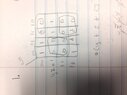
I grouped the four zeros in the row above the last in the bottom left.. I also grouped the four zeros and the d in the bottom right. Finally, I grouped the two zeros in the top right. I don't understand how you got that solution.

See.
View attachment 1447 Apologies in advance for the horizontal placement of my image.(Bandit)
 

Attachments

  • photo.JPG
    photo.JPG
    26 KB · Views: 112
Last edited:
The product-of-maxterms notation like ΠM(0,2,4,9,13) lists rows where the function is 0, not 1 (the opposite of the sum-of-minterms notation). So, in your Karnaugh map you should flip zeros and ones.

Once again, a number, say, 6₁₀ = 110₂ denotes the minterm $xy\bar{z}$, but it denotes the maxterm $\bar{x}+\bar{y}+z$. Also, Σm(1, 2, 3) (lowercase m for "minterm"), by definition, denotes the sum of minterms 1, 2, 3, i.e., $\bar{x}\bar{y}z+\bar{x}y\bar{z}+\bar{x}yz$. This function returns 1 in rows 1, 2 and 3. Similarly, ΠM(1, 2, 3) (uppercase M for "maxterm"), by definition, denotes the product of maxterms 1, 2, 3. However, the expression now is $(x+y+\bar{z})(x+\bar{y}+z)(x+\bar{y}+\bar{z})$. This function returns 0 in rows 1, 2 and 3.

Thus, the only common thing is that both Σm(1, 2, 3) and ΠM(1, 2, 3) refer to min/maxterms 1, 2, 3. Everything else is the opposite: binary 0 in a minterm means the presence of negation, binary 0 in a maxterm means the absence of negation. Minterms are products, maxterms are sums. The function corresponding to Σm(1, 2, 3) has 1 in rows 1, 2, 3; the function corresponding to ΠM(1, 2, 3) has 0 in those rows.

See again the section in Wikipedia about indexing minterms and maxterms, as well as these slides (PDF) (the first result in Google).

I keep forgetting these conventions, so I am going to make a bookmark for this post. I recommend that you also make a note with this information.
 
So my $f$ should consist of these values then correct?

$f$
0
1
0
1
0
1
d
1
1
0
1
1
1
0
d
1
 
I see. But I believe your final answer is still incorrect. I got $$(y + z + w)(y + \bar{z} + \bar{w})(z + w + x)
$$
does that look correct?
 
shamieh said:
So my $f$ should consist of these values then correct?

$f$
0
1
0
1
0
1
d
1
1
0
1
1
1
0
d
1
Yes.

shamieh said:
I got $$(y + z + w)(y + \bar{z} + \bar{w})(z + w + x)$$
My expression $(w+z)(\bar{w}+y+\bar{z})$ and your $$(y + z + w)(y + \bar{z} + \bar{w})(z + w + x)$$ are equivalent up to row 6 (0 1 1 0), where mine equals 0 and yours equals 1. But row 6 is "don't care", and my expression is shorter.

In fact, I got mine from the same http://www.ee.calpoly.edu/media/uploads/resources/KarnaughExplorer_1.html. Here is how to use it to create a minimal POS (rather than SOP) from an expression like ΠM(0, 2, 4, 9, 13) + D(6, 14). Enter it as if it is Σm(0, 2, 4, 9, 13) + D(6, 14), i.e., enter 1 in rows 0, 2, 4, 9, 13 and x in rows 6 and 14. This is the dual function to the one we need (we need 0's in rows 0, 2, etc.), but the program only knows how to group 1's in the Karnaugh map, so we have to adjust. Then take the dual of the minimal SOP it produces, i.e., switch + and * and all negations. This way you get the original function. In this example, the program produces $\bar{A}\bar{D}+A\bar{C}D$. Using $w, x, y, z$ instead of $A, B, C, D$, this is $\bar{w}\bar{z}+w\bar{y}z$. The dual of this is $(w+z)(\bar{w}+y+\bar{z})$. In any case, you can see by hovering the mouse over minterms how the program grouped 1's in the Karnaugh map.

Hint: write variables in min- and maxterms in the alphabetical order. This makes checking your answers easier.
 

Similar threads

  • · Replies 4 ·
Replies
4
Views
2K
  • · Replies 2 ·
Replies
2
Views
3K
  • · Replies 3 ·
Replies
3
Views
3K
  • · Replies 1 ·
Replies
1
Views
2K
  • · Replies 4 ·
Replies
4
Views
2K
  • · Replies 4 ·
Replies
4
Views
3K
  • · Replies 6 ·
Replies
6
Views
4K
  • · Replies 8 ·
Replies
8
Views
3K
  • · Replies 1 ·
Replies
1
Views
4K
  • · Replies 1 ·
Replies
1
Views
3K